
Check Out Our Reviews!

Santa Fe Springs is one of the most truck-dense cities in Los Angeles County. With over 80% of the city zoned industrial or commercial, and 845 carriers actively shipping in and through Santa Fe Springs, the stakes around Clean Truck Check compliance aren’t abstract they’re daily. A DMV registration hold doesn’t just create paperwork. It pulls a truck off the road during a dispatch window that already had a load attached to it.
CARB’s roadside emissions monitoring devices operate on major freight corridors, and the I-5 and I-605 both running directly through Santa Fe Springs are exactly the kind of high-traffic truck routes they screen. If your truck gets flagged, you have 30 days to submit a passing OBD test or face escalating consequences. The operators who get ahead of that window are the ones who keep their trucks moving.
What Clean Truck Check compliance actually gives you is control. You know your trucks are cleared. You know your DMV registration is clean. And when CARB sends that nightly data transmission to the DMV, your VINs are on the right list. For a fleet manager running dispatch out of a warehouse off Slauson Avenue or Freeway Drive in Santa Fe Springs, that certainty is worth more than the cost of the test.
All SMOG Motors is a CARB-credentialed heavy-duty emissions testing company serving Los Angeles County, including Santa Fe Springs and the broader Gateway Cities corridor. The credential isn’t a marketing claim it’s publicly listed on CARB’s official website, and you can verify it before you book.
The focus here is narrow by design. We test model year 2013 and newer diesel and alternative-fuel trucks with a GVWR over 14,000 pounds the exact vehicles subject to California’s Clean Truck Check OBD program. No passenger cars. No opacity tests for older trucks. No generalist smog shop trying to fit heavy-duty compliance into a side service. This is the only thing on our menu, and that specialization matters when compliance has real consequences for Santa Fe Springs operators.
Every test is conducted using only CARB-certified OBD equipment devices that hold CARB Executive Orders and produce results that CTC-VIS will actually accept. And every result is submitted directly and electronically to CARB’s system, so there’s no manual upload step that can fall through the cracks.

The process starts with scheduling. You tell us where your trucks are whether that’s a distribution yard off Freeway Drive, a dock on Slauson Avenue, or a lot near the I-5/I-605 interchange in Santa Fe Springs and we come to you. There’s no repositioning drive to a fixed facility, no fuel burned moving trucks across town, and no dispatch window lost to a smog shop trip.
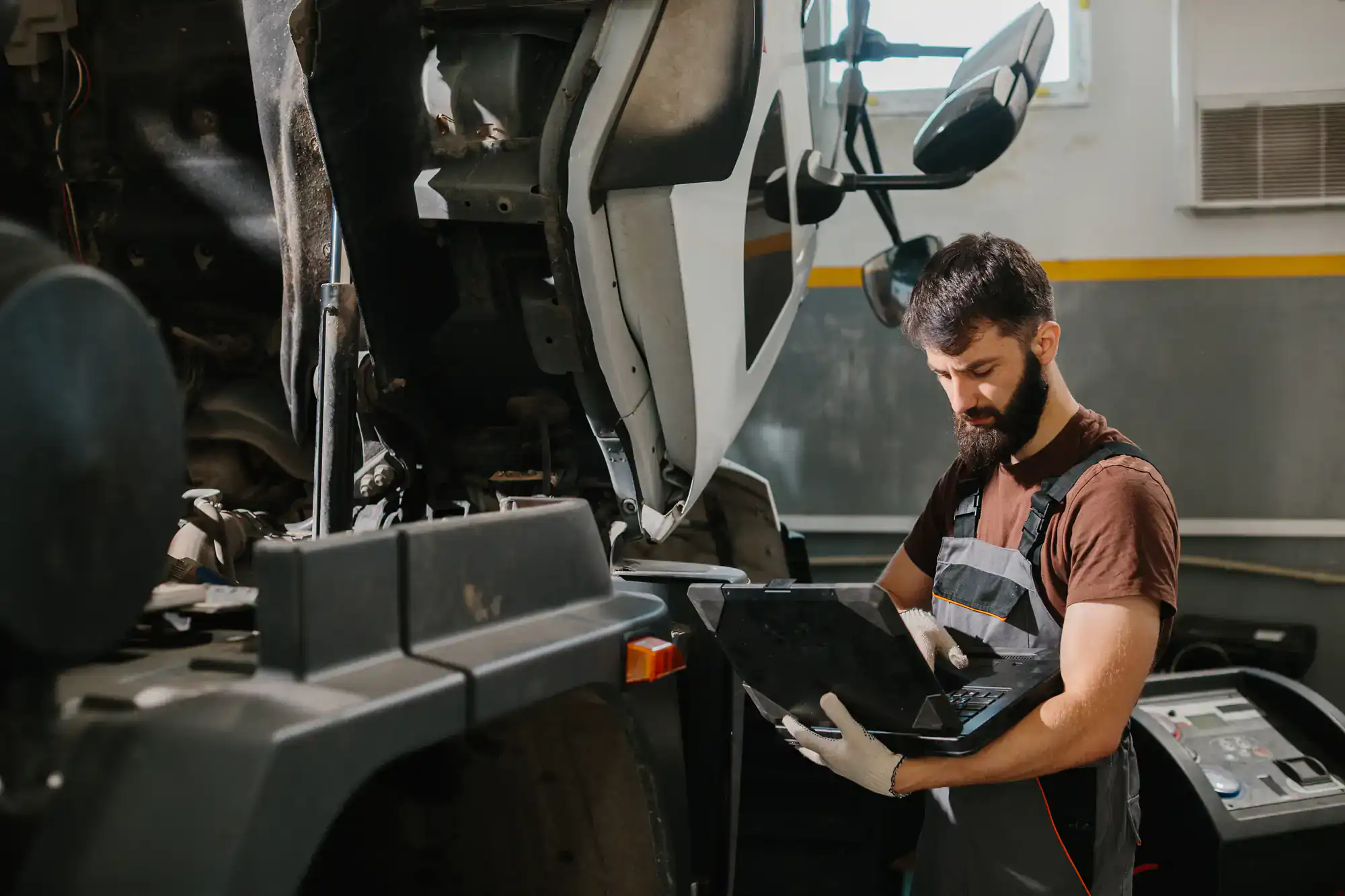
When our technician arrives, we connect a CARB-certified OBD device directly to each truck’s ECU and pull the emissions data. For 2013-and-newer heavy-duty trucks, this is the test a direct data download from the vehicle’s onboard diagnostics system. It’s not a tailpipe sniff test. It’s not a visual inspection. It’s a precise read of what the truck’s own computer has been recording. The test itself typically takes a matter of minutes per vehicle, which makes batching multiple trucks in a single visit practical and efficient.
Once testing is complete, we submit results directly and electronically to CARB’s CTC-VIS database. You don’t touch a portal. You don’t upload anything. The submission happens on our end, and within 3 to 5 business days, your DMV records reflect the passing result. If a truck doesn’t pass, you’ll know immediately and you’ll have time to address the issue before the compliance window closes.

Ready to get started?
Clean Truck Check testing through All SMOG Motors covers model year 2013 and newer diesel and alternative-fuel heavy-duty vehicles with a GVWR over 14,000 pounds. That’s the scope of the program, and it’s the scope of our service. If your truck doesn’t meet both of those criteria model year and weight class it falls outside the Clean Truck Check OBD program entirely, and we’ll tell you that upfront rather than run a test that doesn’t apply.
For Santa Fe Springs fleet operators, the mobile format is the core of what makes this practical. The industrial corridors in this city along the I-5, the I-605, and the surface streets connecting distribution centers to the ports aren’t set up for trucks to break away from a schedule for a smog shop visit. We come to your location, and for fleets with multiple vehicles, all of them can be tested in a single on-site visit. Results for every truck go directly into CTC-VIS under the correct VINs, and the compliance record is updated without any manual steps on your end.
It’s also worth being clear about one thing that trips up a lot of operators in Los Angeles County: paying the annual CARB compliance fee currently $31.18 per vehicle is not the same as passing the OBD test. Both are required. The fee covers registration. The test closes the actual compliance loop. If you’ve paid the fee but haven’t submitted a passing OBD result, your truck is still non-compliant, and the DMV hold risk is still there.
If you’re operating diesel or alternative-fuel trucks that are model year 2013 or newer and have a GVWR over 14,000 pounds in Santa Fe Springs, yes Clean Truck Check testing is a current, active requirement. CARB’s enforcement phase began October 1, 2024, with the first compliance deadline landing January 1, 2025. This isn’t a future program. It’s already in effect, and non-compliant trucks are already receiving DMV registration holds.
For operators in Santa Fe Springs specifically, the risk is compounded by the fact that the I-5 and I-605 both running through the city are active CARB REMD screening corridors. Trucks that get flagged by roadside monitoring receive a Notice to Submit to Testing with a 30-day window to produce a passing result. If you’re running a fleet out of a distribution center or warehouse in Santa Fe Springs, the question isn’t really whether you need to test. It’s whether you want to do it on your schedule or CARB’s.
A failed test doesn’t immediately result in a fine or a registration hold but it does start a clock. The truck will need to be repaired and retested within the compliance window. The specific next steps depend on whether the failure was triggered by a Notice to Submit to Testing or identified during a proactive test. If it was an NST, you’re already inside a 30-day window, so repair and retest need to happen quickly.
The advantage of proactive testing which CARB allows up to 90 days before your compliance deadline is exactly this: if a truck doesn’t pass, you have time to get it into a shop, address the issue, and retest before the deadline creates a crisis. For fleet managers in Santa Fe Springs running trucks on tight dispatch schedules, that buffer is the difference between a manageable maintenance issue and a truck that gets pulled from service at the worst possible time.
Right now, in 2025, OBD-equipped heavy-duty trucks are required to test twice per year semi-annually. That frequency is set to increase starting October 1, 2027, when the requirement shifts to quarterly testing, meaning four tests per year per vehicle.
For a Santa Fe Springs fleet operator running 10 trucks, that’s a jump from 20 tests per year to 40. That’s not a minor scheduling change it’s a significant compliance workload. Establishing a reliable, mobile testing relationship now, before the frequency doubles, is the practical move. Operators who are already working with a credentialed tester and have a process in place will absorb that change without disruption. Those who are still scrambling for a tester every six months will feel the shift.
This is one of the most common and costly misconceptions in the program. The annual CARB compliance fee currently $31.18 per vehicle is a registration requirement, not a substitute for the OBD emissions test. Paying the fee and passing the test are two completely separate obligations. Both are required. The fee covers registration. The test closes the actual compliance loop. If your truck has paid the fee but hasn’t submitted a passing OBD result through CTC-VIS, it won’t appear on that compliant list and a DMV registration hold can follow. For operators in Los Angeles County who assumed the fee was the finish line, this distinction matters. The test is what actually closes the compliance loop.
Yes, and for most fleet operators in Santa Fe Springs, that’s exactly how we work. Our mobile testing model is built around coming to your yard, dock, or lot and testing as many vehicles as you have ready in a single visit. There’s no per-trip limit on vehicles, and batching multiple trucks in one visit is more efficient for both scheduling and cost.
Given the density of fleet operations in Santa Fe Springs distribution centers, logistics companies, and freight carriers concentrated along the I-5 and I-605 corridors single-vehicle testing visits are actually the exception here, not the rule. If you’re managing a fleet of 5, 15, or 30 trucks, the process is the same: we come to your location, test every qualifying vehicle, and submit all results directly to CTC-VIS. Your compliance records are updated without multiple scheduling windows or multiple trips.
It does. Any diesel or alternative-fuel heavy-duty truck model year 2013 or newer, GVWR over 14,000 pounds that operates on California public roads is subject to Clean Truck Check requirements, regardless of where it’s registered. Out-of-state registration doesn’t exempt a vehicle from CARB’s program.
This catches a lot of interstate carriers off guard, particularly those running loads through the I-5 corridor into and out of Santa Fe Springs on a regular basis. If your trucks are based out of state but spend meaningful time operating in California picking up or dropping freight at warehouses in the Gateway Cities, for example they need to be enrolled in the program and tested on the same schedule as California-registered vehicles. CARB’s enforcement doesn’t differentiate by plate. If the truck is on a California road and meets the criteria, the requirement applies.
Useful Links
Other Services we provide in Santa Fe Springs