
Check Out Our Reviews!

When your truck is sitting at a testing facility, it’s not making you money. That’s the part nobody talks about when they tell you to “just get it tested.” In Palm Desert’s construction economy where active job sites are running from north Palm Desert’s new residential developments all the way down to the Desert Willow corridor a truck that’s off the road is a problem, not a minor inconvenience.
Mobile Clean Truck Check testing solves that. We come to wherever your truck is working. The test is fast, the results go straight to CARB’s CTC-VIS database, and your truck never has to leave the site. For fleet operators running multiple vehicles across the Coachella Valley, that means you can test your whole lineup without rearranging your schedule around a shop.
There’s also a desert-specific reality that Palm Desert operators deal with that most California truck owners don’t. Sustained heat above 110°F a routine summer in the Coachella Valley puts real stress on diesel emissions systems. DPF components, EGR sensors, and OBD systems all wear faster under that kind of heat. Testing proactively, before the summer heat peaks, gives you a clean compliance window and time to address any issues before they turn into a failed test and a 30-day NST clock.
We don’t test passenger cars. We don’t handle older diesels or light-duty vehicles. We focus exclusively on model year 2013 and newer heavy-duty trucks with a GVWR over 14,000 pounds the exact vehicles the CARB Clean Truck Check program was built for. That’s it. That narrow focus means every test we run is handled by someone who knows this program inside and out, not a generalist shop fitting HD I/M testing between oil changes.
We’re CARB-credentialed and use only CARB Executive Order-approved OBD equipment you can verify our credentials directly on CARB’s publicly available tester list at arb.ca.gov before you ever call us. We serve Riverside County, which means Palm Desert, Rancho Mirage, Indian Wells, and the surrounding Coachella Valley communities are all in our service area. After every test, we submit your results directly to CTC-VIS. You don’t have to touch a portal or follow up on submission status it’s handled.

The process is straightforward. You contact us, tell us where your truck is located whether that’s a job site in north Palm Desert, a yard near the I-10 corridor, or a resort loading dock off SR-111 and we schedule a time to come to you. There’s no drop-off, no waiting room, and no driving your truck across the valley to a shop.
When we arrive, we connect our CARB-certified OBD diagnostic equipment directly to your truck’s ECU. The system reads the vehicle’s onboard emissions data fault codes, readiness monitors, system status and generates a test result. For most trucks in good working order, this part of the process is fast. If your truck has active fault codes that would result in a failure, we’ll tell you exactly what’s flagged so you know what needs attention before retesting.
Once the test is complete, we submit your results electronically to CARB’s CTC-VIS database. CARB transmits compliant VINs to the DMV nightly, so your compliance status updates quickly typically within three to five business days. If you’re testing proactively, you can do this up to 90 days before your compliance deadline, which is a smart move for any Palm Desert operator running trucks during the busy winter resort season when you can’t afford a registration hold slowing you down.

Ready to get started?
The CARB Clean Truck Check applies specifically to diesel trucks that are model year 2013 or newer with a GVWR over 14,000 pounds, and to alternative fuel trucks model year 2018 or newer in the same weight class. If your truck doesn’t meet both of those thresholds year and weight it’s not subject to this program. We test only vehicles that fall within this category. We won’t take your money for a test your truck doesn’t need.
For trucks that do qualify, the current requirement is semi-annual testing twice per year. That frequency increases to quarterly starting October 1, 2027, meaning four tests per year. Palm Desert contractors, landscaping operators serving the valley’s golf courses and resort properties, agricultural haulers running SR-74 and SR-111, and hospitality supply chain operators serving the city’s 30-plus hotels all have trucks that likely fall under this requirement. If you’re running those routes and your truck is a 2013 or newer heavy-duty diesel, you need to be tested.
One thing worth knowing: paying the annual CARB compliance fee does not satisfy the testing requirement. That’s one of the most common misconceptions we see. The fee and the OBD test are two separate obligations. And if your truck is registered out of state but operating on California roads including I-10 through the Coachella Valley California’s Clean Truck Check requirements apply to you regardless of where your plates are from.
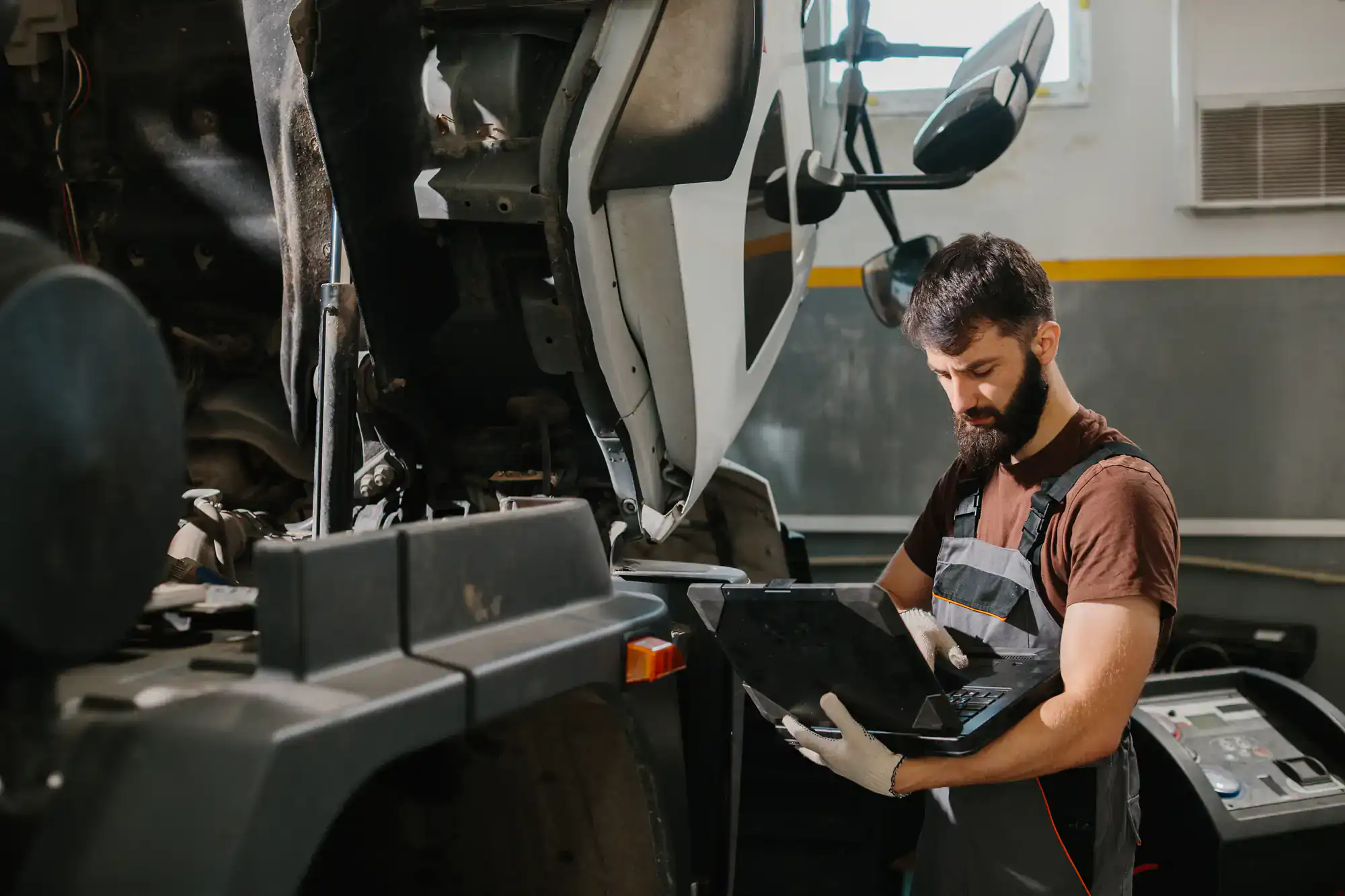
It depends on two things: the model year and the GVWR. If your truck is a 2013 or newer diesel with a Gross Vehicle Weight Rating over 14,000 pounds, then yes the CARB Clean Truck Check applies to it, regardless of what it’s hauling or where it’s working. Concrete mixers, flatbeds, dump trucks, equipment haulers if they meet both thresholds, they’re subject to the program.
Palm Desert is in the middle of a significant construction cycle right now. With active projects like the DSRT Surf resort at Desert Willow, the new fire station on the city’s north side, and over a thousand new residential units in development, there are a lot of heavy-duty construction trucks operating in this city daily. Many of those operators are still catching up on what the Clean Truck Check actually requires. If you’re not sure whether your specific truck qualifies, the safest move is to check the GVWR on your registration or door placard and compare it against the 14,000-pound threshold.
Yes. California’s Clean Truck Check requirement applies to any qualifying truck operating on California public roads, regardless of where it’s registered. The program is based on where the truck operates, not where it’s plated. If your truck is a 2013 or newer diesel over 14,000 pounds GVWR and it’s driving on California roads including I-10 through the Coachella Valley you’re subject to the same compliance requirements as a California-registered truck.
This catches a lot of out-of-state operators off guard, especially in the Coachella Valley where seasonal contractors, agricultural haulers, and resort supply chain operators from Arizona and Nevada work regularly during the winter season. CARB enforces this through roadside emissions monitoring devices on major freight corridors, and I-10 is one of the primary corridors they monitor. Getting flagged triggers a Notice to Submit to Testing with a 30-day deadline. It’s a much easier situation to handle proactively than reactively.
Not automatically, no. The annual compliance fee and the OBD emissions test are two completely separate requirements under the Clean Truck Check program. Paying the fee registers your vehicle in CARB’s CTC-VIS system, but it does not substitute for the actual test. You still need a credentialed tester to connect to your truck’s OBD port, run the diagnostic, and submit the results to CTC-VIS electronically.
This is one of the most common misunderstandings we encounter, and it’s an easy one to make the fee payment process and the testing process both happen through the same CTC-VIS portal, so they can feel like the same step. They’re not. If you’ve paid your fee but haven’t had a credentialed tester submit a passing test result, your truck is not fully compliant, and your DMV registration is at risk of a hold. Check your CTC-VIS account to confirm both the fee payment and a valid test result are on file.
Right now, OBD-equipped trucks meaning 2013 and newer diesel trucks and 2018 and newer alternative fuel trucks over 14,000 pounds GVWR are required to test semi-annually, which means twice per year. The first full periodic testing phase began October 1, 2024, with the first compliance deadline hitting January 1, 2025. If you haven’t tested since then, you’re likely overdue.
Starting October 1, 2027, the frequency increases to quarterly four tests per year. That’s a significant jump, and it’s worth establishing a testing relationship with a credentialed mobile provider now rather than scrambling when the schedule tightens. For Palm Desert fleet operators running multiple trucks through the busy winter resort season, having a reliable testing provider who comes to your location becomes especially important when quarterly testing is in effect and you’re at peak operational capacity.
A failed test means your truck has active OBD fault codes that indicate an emissions system issue something the CARB-certified diagnostic equipment flagged during the data read. A failure doesn’t result in an immediate fine on its own, but it does mean your truck remains non-compliant until a passing test is submitted to CTC-VIS. If your compliance deadline has already passed, the non-compliant status can result in a DMV registration hold that blocks renewal.
When we run a test and your truck comes back with fault codes, we’ll tell you exactly what was flagged. That information goes to you directly so you can take it to a diesel repair shop and address the specific issue. Once the repair is made and the fault codes are cleared, we can return to retest. Given that Palm Desert’s extreme summer heat accelerates wear on DPF and EGR components, it’s worth having emissions-related issues addressed promptly rather than letting them compound between testing cycles.
Yes, and for fleet operators in the Coachella Valley, that’s often the most efficient way to handle compliance. We can coordinate a single visit to your yard, job site, or facility and test multiple qualifying trucks in sequence. You don’t need to schedule separate appointments for each vehicle or pull trucks off different job sites on different days.
For Palm Desert operators running fleets that serve the resort economy, the valley’s agricultural routes, or active construction projects, coordinating a batch testing visit during a planned downtime window early morning before crews head out, or during a scheduled maintenance day keeps compliance from disrupting your operation. If you’re managing a fleet of trucks and want to get ahead of a compliance deadline or the upcoming quarterly testing schedule starting in 2027, reach out and we’ll work out a visit schedule that fits your operation.
Useful Links
Other Services we provide in Palm Desert