
Check Out Our Reviews!

When your truck is sitting because of a registration hold, it’s not just inconvenient it’s a direct hit to your income. Drayage operators and fleet managers running the I-710 between Lynwood and the Ports of Los Angeles and Long Beach don’t have time to reposition a truck to a fixed testing location, sit in a waiting room, and hope the paperwork gets filed correctly.
We come to your location your yard off Alameda Street, your lot near the I-710/I-105 interchange, wherever your truck is staged in Lynwood and we run the OBD data download directly from your truck’s ECU using CARB-certified equipment. Results go straight to CARB’s CTC-VIS database before we leave. You don’t log into a portal. You don’t upload anything. You don’t wonder if it went through. It’s done.
The South Coast Air Quality Management District covers all of Los Angeles County, and the I-710 corridor specifically has been a priority enforcement zone for CARB for years. Trucks operating in and out of Lynwood’s industrial yards are not flying under the radar. Clean Truck Check compliance isn’t a formality here it’s an active, real-time requirement with real consequences if you miss it.
We do one thing: Clean Truck Check OBD testing for heavy-duty trucks that are model year 2013 or newer with a GVWR over 14,000 pounds. That’s our full scope. No passenger cars, no opacity tests on older equipment, no splitting attention across a dozen unrelated services. When you book with us, you’re working with a team that has done this specific test hundreds of times not a general smog shop that added truck testing to a dropdown menu.
Our CARB credentials are publicly listed on CARB’s official “Available for Hire Credentialed Testers” page at arb.ca.gov. You can look us up before you ever call. That kind of transparency matters in a compliance context, especially for fleet operators in Lynwood’s industrial corridor who need to know their test will actually count.
We serve Los Angeles County, and Lynwood sitting at the I-710/I-105 interchange at the center of the South LA freight corridor is exactly the kind of market we built this service for. Our technicians know the yards, the dispatch schedules, and the compliance pressure that comes with operating heavy trucks in one of California’s most monitored freight zones.

It starts with a call or a booking. You tell us where your truck is in Lynwood a yard, a dock, a lot, a staging area and we schedule a time that works around your operation, not the other way around. For fleet managers running multiple trucks out of the Alameda Street industrial corridor or near the I-710/I-105 interchange, we can sequence multiple vehicles in a single visit so your operation doesn’t stop.
When our technician arrives, we connect CARB-certified OBD equipment directly to your truck’s ECU and pull the diagnostic data. This is not a visual inspection. It’s a direct read of your engine’s onboard monitoring system the same data CARB uses to determine whether your truck is operating within emissions standards. The process is fast, and your truck doesn’t go anywhere.
Once the test is complete, we submit the results electronically to CARB’s CTC-VIS portal on the spot. Your truck’s VIN is updated in CARB’s system, and CARB transmits compliant records to DMV nightly. If your truck passes and most well-maintained 2013-and-newer trucks do your compliance status is current before you make your next port run. If something flags during the test, we’ll tell you exactly what it is so you can address it and retest within your compliance window.

Ready to get started?
Clean Truck Check applies to diesel and alternative-fuel heavy-duty vehicles that are model year 2013 or newer with a GVWR over 14,000 pounds operating on California public roads. If your truck doesn’t meet both of those criteria model year and weight this is not the test for you. We only perform this specific test, so if you’re unsure whether your truck qualifies, just call and we’ll tell you straight.
For trucks that do qualify, CARB currently requires testing twice per year on a semi-annual schedule. That frequency increases to quarterly four times per year for OBD-equipped vehicles starting October 1, 2027. For fleet operators in Lynwood managing five, ten, or twenty trucks, that’s a significant compliance calendar. Building a testing relationship now, before the 2027 schedule change, means you’ll have a credentialed mobile specialist already familiar with your fleet and your location when the new requirements kick in.
If CARB has sent you a Notice to Submit to Testing, you have exactly 30 calendar days to submit a passing result. That window moves fast, especially when you’re managing freight schedules on the I-710 corridor. We can reach your Lynwood location quickly no waiting for a shop appointment, no repositioning your truck across town. You can also test proactively up to 90 days before your compliance deadline, which gives you time to handle any repairs if a truck doesn’t pass on the first attempt.
If your truck is model year 2013 or newer and has a GVWR over 14,000 pounds, yes it needs Clean Truck Check testing regardless of where it’s registered or where it’s based. CARB’s HD I/M program applies to any qualifying vehicle operating on California public roads, and the I-710 corridor through Lynwood is one of the most actively monitored freight routes in the state. Approximately 40,000 diesel trucks travel I-710 daily, many of them staging, fueling, or dispatching from yards in and around Lynwood, which puts this corridor squarely in CARB’s enforcement focus.
Registration or domicile doesn’t change your obligation. If your truck is on California roads and meets the model year and weight threshold, you’re in the program. And given that CARB transmits non-compliant VINs to DMV nightly, a missed test can turn into a registration hold faster than most operators expect. The safest move is to confirm your compliance status now rather than find out at a weigh station or a port gate.
A Notice to Submit to Testing means CARB has flagged your truck as a potential high emitter based on data in their system, and you have 30 calendar days from the date on that notice to submit a passing Clean Truck Check OBD test. That’s a hard deadline not a suggestion. Missing it puts you at risk of fines up to $10,000 per vehicle per day and a DMV registration hold that can take your truck off the road entirely.
The good news is that most 2013-and-newer trucks that are properly maintained pass the OBD test without issue. The test reads your engine’s onboard diagnostic system directly it’s not a tailpipe sniff or a visual inspection. If your truck’s systems are running clean and your check engine light isn’t on for an emissions-related fault, you’re likely in good shape. We can come to your Lynwood location quickly, run the test, and submit your results to CTC-VIS the same day. If something does flag, we’ll tell you what it is so you can get it addressed and retest before your 30-day window closes.
Yes, and for fleet operators in Lynwood’s industrial corridor, that’s exactly how most of our visits work. Whether you’re running trucks out of a yard near Alameda Street, a distribution operation off Imperial Highway, or a logistics facility near the I-710/I-105 interchange, we can sequence multiple vehicles in a single visit so your operation doesn’t have to stop. Each truck gets its own OBD data pull, its own CTC-VIS submission, and its own compliance record there’s no batch processing or shortcuts.
For fleet managers responsible for CARB compliance across five, ten, or more vehicles, coordinating individual shop visits for each truck is a logistical nightmare that costs real time and money. Our mobile fleet testing at your location eliminates that entirely. If you’re managing a fleet and approaching the quarterly testing schedule that takes effect in October 2027, now is a good time to establish a testing cadence with a credentialed provider who already knows your yard and your equipment.
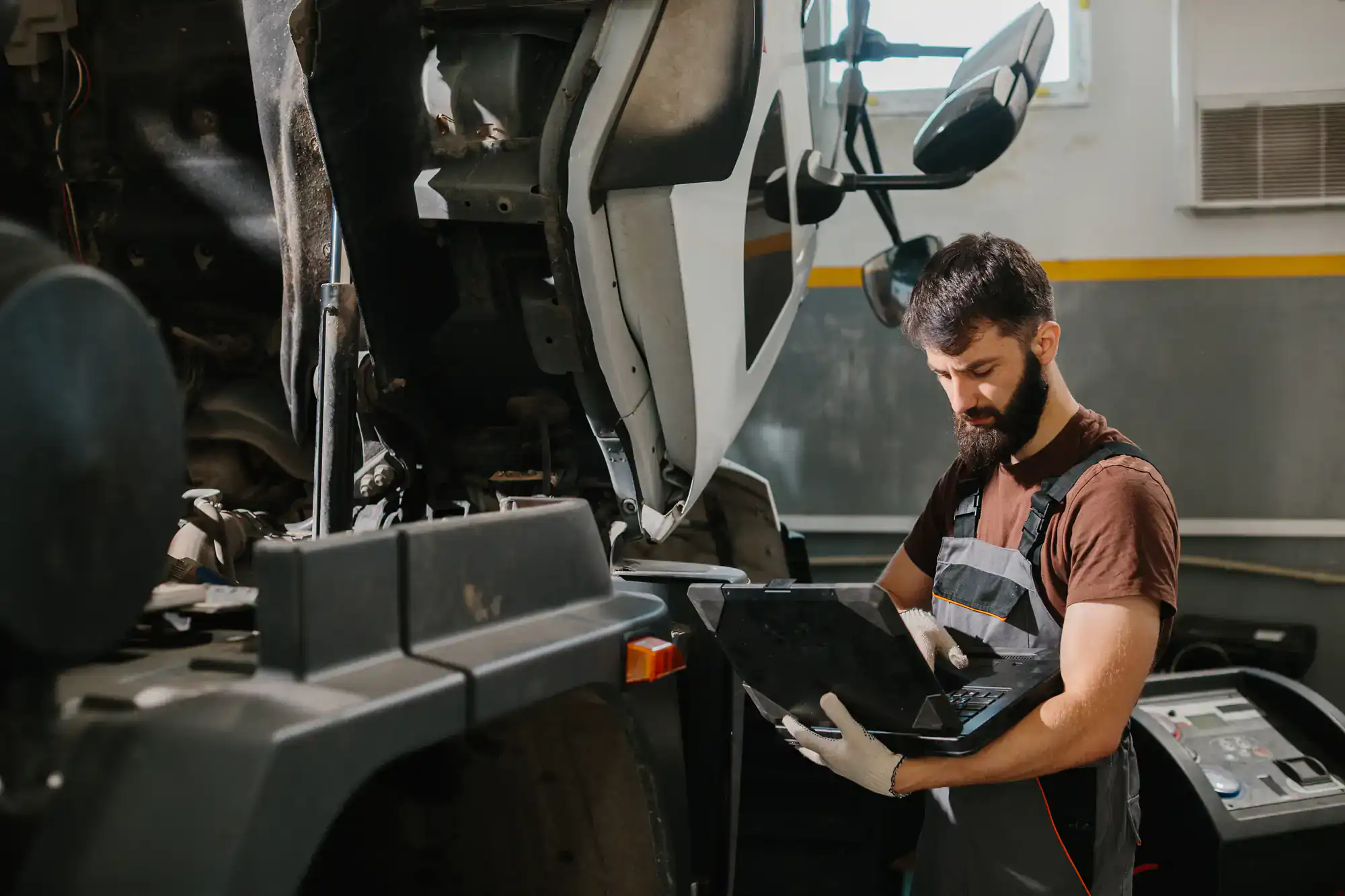
The Clean Truck Check OBD test is a direct electronic read of your truck’s onboard diagnostic system the ECU data your engine generates continuously as it runs. Our technician connects CARB-certified OBD equipment to your truck’s diagnostic port and pulls that data. The system checks whether your engine’s emissions monitors have completed their readiness cycles and whether any active or pending fault codes are present that would indicate an emissions-related problem.
The test itself typically takes 20 to 30 minutes per vehicle, depending on the truck. There’s no driving required, no warm-up procedure, and no tailpipe equipment involved. Your truck stays exactly where it is. Once the data pull is complete, we review the results on-site and submit them electronically to CARB’s CTC-VIS portal before we leave. You get confirmation that the submission went through, and your compliance record updates in CARB’s system the same day. For operators running tight schedules on the I-710 port corridor, that’s the whole process start to finish, at your location, with nothing left for you to file or follow up on.
A failed test doesn’t mean you’re immediately out of compliance it means you have a window to address the issue and retest. If your truck flags during the OBD read, we’ll tell you exactly what the diagnostic data shows so you can take that information to your mechanic or fleet maintenance team. Common reasons a 2013-or-newer truck might not pass include an active emissions-related fault code, incomplete monitor readiness cycles, or a check engine light that’s been ignored longer than it should have been.
The key is timing. If you’re testing proactively up to 90 days before your compliance deadline you have real room to get the repair done and come back for a retest before anything triggers with CARB or DMV. If you’re testing because you’ve already received a Notice to Submit to Testing, your 30-day window is running, so you’ll want to move quickly on the repair. Either way, knowing what the issue is specifically, not vaguely is the first step, and that’s exactly what the OBD test gives you.
Not every technician or company offering Clean Truck Check testing is actually authorized to perform it. CARB requires that testers hold official credentials and that the OBD equipment they use carries CARB Executive Order approval. A test performed with uncertified equipment, or by a tester who isn’t on CARB’s credentialed list, produces a result that CARB will not accept. You’d be just as non-compliant after that test as you were before it, and you’d have paid for nothing.
We’re listed on CARB’s publicly available “Available for Hire Credentialed Testers” page at arb.ca.gov. You can verify that before you book and for fleet managers in Lynwood who are responsible for keeping a full roster of trucks compliant in one of California’s most scrutinized freight corridors, that verification step is worth taking. The I-710 corridor operates under active CARB and South Coast AQMD oversight. This is not the place to cut corners on who’s running your compliance test.
Useful Links
Other Services we provide in Lynwood