
Check Out Our Reviews!

Indian Wells isn’t a city where a sidelined truck is just an inconvenience. When you’re supplying a resort, hauling equipment to the Indian Wells Tennis Garden ahead of the BNP Paribas Open, or running materials to an active job site off Highway 111, a DMV registration hold doesn’t just cost you a day it can cost you a client. The operators serving this valley know that. Clean Truck Check compliance is what keeps your rig on the road and your name off a vendor’s problem list.
There’s also something the Coachella Valley does to diesel equipment that operators coming from the coast don’t always account for. Summer temperatures in Indian Wells regularly push past 110°F, and that kind of sustained heat accelerates wear on diesel particulate filters, SCR systems, and the OBD sensors that the Clean Truck Check test reads directly. A truck that passed six months ago may be showing fault codes today not because anything catastrophic happened, but because the desert is hard on emissions control systems. Testing early gives you time to address that before it becomes a compliance emergency.
For trucks that are model year 2013 or newer with a GVWR over 14,000 pounds, the current requirement is two tests per year. That shifts to four times per year starting October 1, 2027. Getting your compliance process dialed in now with a tester who comes to your truck, submits results directly to CARB’s CTC-VIS database, and holds verifiable credentials means you’re not scrambling when that frequency doubles.
We do one thing: Clean Truck Check OBD testing for heavy-duty trucks that are model year 2013 or newer with a GVWR over 14,000 pounds. That’s it. No passenger cars, no older opacity-test vehicles, no light-duty pickups. Just the trucks that fall under CARB’s HD I/M program tested correctly, every time, by a tester who knows this program inside and out.
Our credentials are real and publicly verifiable. We’re listed on CARB’s official credentialed tester directory at arb.ca.gov. Any fleet manager, resort procurement contact, or compliance officer can look that up before a single test is scheduled. In a market where an invalid test from an uncredentialed tester leaves your truck exactly as non-compliant as before just with less time on the clock that verifiability matters.
We serve Riverside County, which means Indian Wells, the surrounding Coachella Valley cities, and the operators running trucks along the I-10 and SR-111 corridors are all within our service area. Mobile testing means we come to your truck whether it’s staged at a resort loading dock, parked at a construction site near Miles Avenue, or sitting at a yard in nearby Indio or Palm Desert.

It starts with a phone call or a booking. You tell us where your truck is located a resort property off SR-111, a job site near the new Cocun Wellness Resort development at Highway 111 and Miles Avenue, a contractor’s yard in the valley and we schedule a time to come to you. There’s no facility to drive to, no appointment window to sit in, no pulling a working truck off its route.
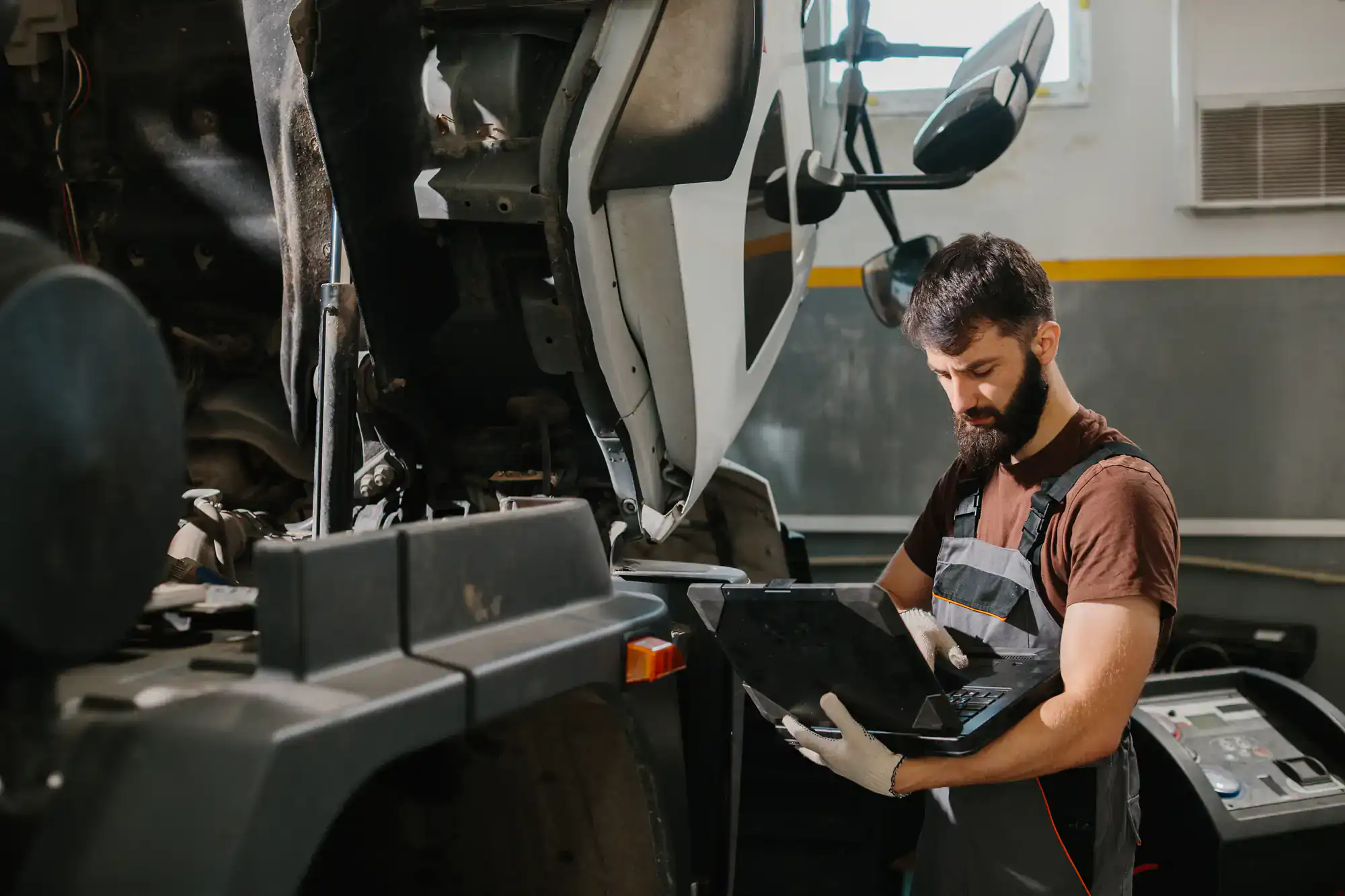
When we arrive, we connect a CARB-certified OBD test device one that holds a CARB Executive Order approval, which is the specific certification that makes the test valid under California law directly to your truck’s diagnostic port. The test reads your vehicle’s onboard emissions data and checks for active fault codes across the systems that matter: the diesel particulate filter, the SCR system, and the broader emissions control architecture. For 2013 and newer trucks, this is the standard Clean Truck Check method. The whole process is typically straightforward and doesn’t require your truck to be out of service for long.
Once the test is complete, results go directly from our equipment into CARB’s CTC-VIS database. You don’t submit anything. You don’t log into a portal. CARB then transmits compliant VIN data to DMV nightly, so a passing test can clear a registration hold within a few business days. If your truck has active fault codes that need attention before it can pass, we’ll tell you exactly what they are so your mechanic knows what to address no vague results, no guesswork on your end.

Ready to get started?
Every Clean Truck Check test we perform covers the full OBD inspection required under CARB’s HD I/M program. That means a complete read of your truck’s onboard diagnostic system using CARB-Executive-Order-approved equipment, direct electronic submission to the CTC-VIS database, and a clear result you can reference if a client, a port, or a compliance auditor ever asks for documentation. There are no manual steps, no paper forms, and no risk of a submission error leaving your VIN in a non-compliant status.
This service applies specifically to diesel and alternative-fuel heavy-duty vehicles that are model year 2013 or newer with a GVWR over 14,000 pounds the trucks that fall under the OBD testing requirement. If your vehicle is older or lighter than those thresholds, it falls under a different inspection pathway and this isn’t the right test for it. We focus exclusively on this category because that specificity is what produces accurate results and valid submissions.
For operators working in and around Indian Wells whether you’re running a refrigerated delivery truck to the Grand Hyatt, hauling event equipment to the Indian Wells Tennis Garden, or managing a small fleet of service vehicles for a resort contractor our mobile testing model means compliance doesn’t interrupt your operation. Trucks that receive a Notice to Submit to Testing from CARB have 30 calendar days to produce a passing result. If that notice has landed in your inbox, the clock is already running and mobile, on-location testing is the fastest way to respond.
Yes if the truck is model year 2013 or newer and has a GVWR over 14,000 pounds, it’s subject to Clean Truck Check requirements regardless of what it’s hauling or where it’s going. That covers a wide range of vehicles in the Indian Wells supply chain: refrigerated food service trucks, linen delivery vehicles, beverage distributors, event equipment haulers, and landscaping or maintenance trucks that regularly service the Grand Hyatt, Renaissance Esmeralda, Miramonte, and the other resort properties along SR-111.
The program applies to any qualifying truck operating on California public roads including vehicles registered out of state. So if a vendor based in Nevada or Arizona is running trucks into the Coachella Valley to service Indian Wells properties, those trucks still need to be compliant. CARB doesn’t carve out exemptions based on where a business is headquartered. The only question that matters is whether the truck meets the model year and GVWR thresholds and if it does, it needs a passing Clean Truck Check test on file.
A failed test means your truck’s OBD system flagged one or more active fault codes that indicate an emissions control issue typically something related to the diesel particulate filter, the SCR system, or a related sensor. The test result itself isn’t a penalty; it’s diagnostic information. What it tells you is that there’s something your mechanic needs to address before the truck can produce a passing result.
Once the repairs are made and the fault codes are cleared, you schedule a retest. There’s no limit on retests you just need a passing result submitted to CTC-VIS before your compliance deadline. For trucks running in the Coachella Valley, the desert heat is worth factoring into this timeline. High temperatures accelerate wear on emissions control components, so if your truck is approaching a deadline during the summer months in Indian Wells, building in extra lead time for potential repairs is a smart call. Waiting until the last week before a deadline especially with a truck that’s been running hard in 110-degree heat leaves no margin if something needs to be fixed.
CARB allows trucks to be tested up to 90 days before their compliance deadline, and that window is genuinely useful especially for fleet operators in Indian Wells managing multiple vehicles across a busy resort-season schedule. Testing early means that if a truck comes back with fault codes, you have time to get repairs done and schedule a retest without blowing past your deadline.
For operators whose trucks are active during the BNP Paribas Open in March or the peak winter resort season running November through April, early scheduling is particularly important. The last thing you want is to discover a compliance issue the week your truck is supposed to be delivering supplies to the Indian Wells Tennis Garden or restocking a resort property at full occupancy. The 90-day window exists precisely so you don’t have to treat compliance as an emergency use it. We can schedule mobile testing at your location in the Indian Wells area well in advance of your deadline, so there’s no reason to cut it close.
Yes as long as the tester holds valid CARB credentials and uses CARB-Executive-Order-approved OBD test equipment, a mobile test carries exactly the same legal weight as any other Clean Truck Check test. The location of the test doesn’t affect its validity. What determines whether a test counts is whether the tester is on CARB’s credentialed list and whether the equipment meets CARB’s certification requirements.
We’re listed on CARB’s publicly available credentialed tester directory at arb.ca.gov you can verify that before scheduling anything. After every test, results are submitted directly and electronically to CARB’s CTC-VIS database. Your truck’s VIN shows as compliant in the system, and CARB transmits that data to DMV nightly. For operators whose trucks are subject to vendor compliance audits which is common in the Indian Wells resort and event market this direct-to-CARB submission creates a clean, verifiable documentation trail that holds up if a client or a port authority ever asks for proof.
Starting October 1, 2027, OBD-equipped heavy-duty trucks that currently test twice per year will be required to test four times per year once per quarter. For a single-truck owner-operator, that’s a manageable shift. For a fleet operator running multiple vehicles in and out of Indian Wells, it means four scheduling cycles per year, per truck, with results that all need to be submitted to CTC-VIS on time.
The practical implication is that your testing process needs to be reliable and repeatable not something you figure out from scratch every six months. Establishing a relationship with a mobile, CARB-credentialed tester now, before 2027, means you’re not scrambling to find a qualified provider when the frequency doubles and demand spikes across the Coachella Valley. It also gives you time to identify any trucks in your fleet that have recurring emissions issues the kind that show up as fault codes under desert operating conditions and address them proactively rather than reactively. The 2027 shift isn’t far off. Building your compliance process around it now is the low-stress version of this problem.
Yes. CARB’s Clean Truck Check requirement applies to any qualifying heavy-duty vehicle operating on California public roads the truck’s state of registration doesn’t change that. If the vehicle is model year 2013 or newer, has a GVWR over 14,000 pounds, and it’s running on California highways, it needs to be compliant with the HD I/M program. That includes trucks registered in Nevada, Arizona, Utah, or anywhere else.
This comes up regularly in the Indian Wells area because a number of the vendors, contractors, and logistics operators serving the valley’s resort properties are based outside California. A food distributor running out of Nevada, a construction subcontractor headquartered in Arizona, an event production company operating across state lines if their trucks are on SR-111 or pulling into a resort property in Indian Wells, CARB’s rules apply. We handle testing for out-of-state operators working in Riverside County. The process is the same: mobile testing at your truck’s location, CARB-certified OBD equipment, and direct electronic submission to CTC-VIS. Where the truck is registered doesn’t change how the test works or what a passing result means.
Useful Links
Other Services we provide in Indian Wells