
Hear from Our Customers

If you’re operating a semi truck or heavy-duty vehicle over 14,000 pounds in California—and it’s a 2013 or newer model—you already know CARB isn’t asking nicely anymore. They’re requiring Clean Truck Check testing, and the penalties for skipping it aren’t small. We’re talking up to $10,000 per vehicle per day, plus registration holds that can shut down your operation.
You don’t have time to figure out the difference between OBD testing and opacity testing, or whether your truck falls under semi-annual or quarterly requirements. You need someone who knows the regulations, has the credentials, and can get your trucks tested without eating up half your day.
That’s what we do. You bring your truck to our Hacienda Heights, CA location, we run the test, submit the results directly to CARB’s database, and you’re back on the road. No drama, no delays, no wondering if it was done right.
All SMOG Motors has been serving Hacienda Heights, CA and the San Gabriel Valley for years, handling California’s emissions requirements for all kinds of vehicles. When CARB rolled out the Clean Truck Check program for heavy-duty vehicles, we didn’t scramble to catch up—we got credentialed, trained our testers, and integrated directly with the state’s compliance systems.
Hacienda Heights, CA sits right in the middle of one of California’s busiest freight corridors. You’ve got the 60, the 605, and proximity to the ports and distribution centers that keep goods moving. That means a lot of trucks, a lot of owner-operators, and a lot of fleets that need reliable access to CARB diesel compliance testing without driving an hour out of their way.
We’re here because this community needs a local option that understands the pressure you’re under. You’re not looking for the cheapest test—you’re looking for one that’s done right, submitted correctly, and doesn’t waste your time.

First, we verify your truck qualifies—model year 2013 or newer, gross vehicle weight rating over 14,000 pounds. If you’re not sure, bring your registration and we’ll confirm it. This matters because older trucks and lighter vehicles aren’t part of the Clean Truck Check program, and we’re not going to waste your time testing something that doesn’t need it.
Once we confirm eligibility, we run the appropriate test. Most 2013+ trucks use OBD testing, which connects to your vehicle’s onboard diagnostics system and takes about 15 to 20 minutes. If your truck requires opacity testing instead, that measures visible smoke from the exhaust. Either way, we’re checking what CARB requires—not more, not less.
If your truck passes, we submit the results directly to CARB’s database that same day. You’ll get documentation for your records, and the state updates your compliance status. If something comes back flagged, we’ll tell you exactly what the issue is and what your options are. No guessing, no vague explanations.
You’re required to test within a 90-day window before your compliance deadline. Most operators are on a semi-annual schedule, but starting in 2027, some OBD-equipped vehicles will move to quarterly testing. If you’re not sure where you stand, we can walk you through it.
Ready to get started?
When you come in for CARB emissions testing, you’re getting a state-mandated inspection performed by a CARB-credentialed tester who’s been trained and licensed specifically for heavy-duty vehicle compliance. That credential isn’t optional—it’s required, and not every shop has it.
You’re also getting direct submission to CARB’s CTC-VIS database, which means your passing test shows up in the state’s system immediately. No waiting, no manual uploads, no wondering if it went through. If you’re an out-of-state carrier operating in California, this is especially important—your compliance status needs to be current, and it needs to be verifiable.
Hacienda Heights, CA is a smart location for this. If you’re running routes through the San Gabriel Valley, the Inland Empire, or down to the ports, you’re already passing through this area. We’re not asking you to drive to the middle of nowhere or sit in traffic for an hour just to get a 20-minute test done.
And if you’re running a fleet, we can handle multiple vehicles without turning it into an all-day event. Bring your trucks in, we’ll move through them efficiently, and you’ll have your compliance documentation by the time you leave. We’ve worked with independent owner-operators and multi-truck operations—we know the difference, and we adjust accordingly.
If your truck is model year 2013 or newer and has a gross vehicle weight rating over 14,000 pounds, yes—you need it. This applies to diesel trucks, alternative fuel trucks, hybrids, commercial vehicles, privately-owned trucks, government vehicles, and out-of-state trucks operating in California.
It doesn’t matter if you’re an independent owner-operator with one truck or a fleet with fifty. CARB’s Heavy-Duty Inspection and Maintenance program applies to all heavy-duty vehicles meeting those criteria. The only exceptions are very specific vehicle types that CARB has explicitly exempted, and those are rare.
If your truck is older than 2013 or weighs less than 14,000 pounds GVWR, this program doesn’t apply to you. Don’t let anyone tell you otherwise or try to sell you a test you don’t need.
Most heavy-duty vehicles are on a semi-annual testing schedule, which means you need a passing Clean Truck Check test every six months. Your specific compliance deadline is tied to your vehicle’s registration and CARB’s system, so it’s not the same for everyone.
You’re allowed to test within a 90-day window before your deadline. If you wait until the last minute and something comes back flagged, you’re going to have a problem. Testing early gives you time to address any issues without facing penalties or registration holds.
Starting in October 2027, OBD-equipped vehicles will move to quarterly testing—four times per year. That’s a significant increase, and it’s going to require better planning and more frequent visits. If you’re not already tracking your compliance deadlines, now’s the time to start.
If your truck doesn’t pass, you’ll get a detailed report showing what triggered the failure. For OBD testing, that usually means a diagnostic trouble code related to emissions systems. For opacity testing, it means visible smoke exceeded CARB’s limits.
You’ll need to get the issue repaired and then come back for a retest. CARB doesn’t give you unlimited time—you still have a compliance deadline, and if you miss it, you’re looking at penalties and potential registration holds. The faster you address the problem, the better.
We can’t do the repairs ourselves, but we can tell you exactly what the test flagged so you’re not guessing. Take that information to a qualified mechanic who works on heavy-duty trucks, get it fixed, and come back. If the repair was done correctly, the retest should come back clean.
Pricing varies depending on the type of test your truck requires and whether you’re bringing in a single vehicle or multiple trucks. OBD testing is typically faster and less involved than opacity testing, which can affect the cost.
What you’re paying for is a state-mandated inspection by a CARB-credentialed tester, direct submission to the state database, and compliance documentation. If you’re comparing prices, make sure you’re comparing the same thing—some mobile services charge premium rates, and not every shop is actually credentialed to perform these tests.
For fleets, we offer pricing that makes sense when you’re testing multiple vehicles. If you’ve got more than one truck that needs testing, call ahead and we’ll work out the details. It’s faster for you, and it’s more efficient for us.
Yes. If your truck operates in California and meets the criteria—2013 or newer, over 14,000 pounds GVWR—you’re required to comply with CARB’s Clean Truck Check program, even if your truck is registered in another state.
Out-of-state carriers sometimes assume California’s rules don’t apply to them, but that’s not how it works. If you’re operating here, you’re subject to the same testing and compliance requirements as California-registered vehicles. CARB enforces this, and the penalties for non-compliance are the same regardless of where your truck is registered.
We can test out-of-state trucks and submit the results to CARB’s system just like we do for California vehicles. Bring your registration and any compliance documentation you already have, and we’ll make sure everything gets filed correctly.
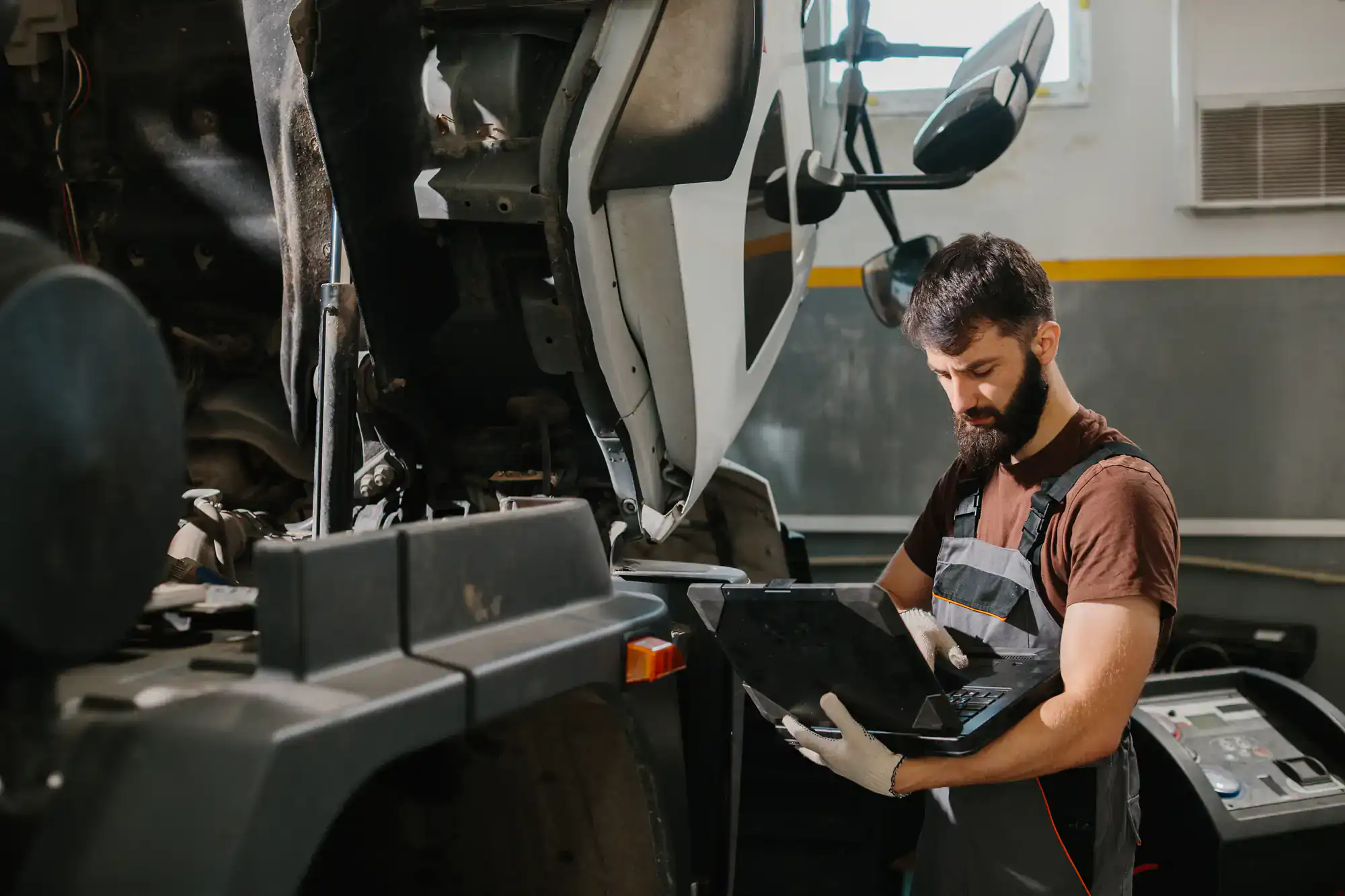
OBD testing connects to your truck’s onboard diagnostics system and checks for trouble codes related to emissions controls. Most 2013 and newer trucks use OBD testing because they’re equipped with the necessary systems. It’s faster—usually 15 to 20 minutes—and it’s what the majority of heavy-duty vehicles will need.
Opacity testing measures visible smoke coming from your exhaust. It’s typically used for older trucks or vehicles that don’t have OBD systems, but some newer trucks may still require it depending on their configuration. The test involves running the engine under load and measuring smoke density.
Which test your truck needs isn’t up to you or us—it’s determined by CARB based on your vehicle’s year, weight, and equipment. When you come in, we’ll confirm which test applies to your truck and run the correct one. You don’t need to figure that out ahead of time.
Useful Links
Other Services we provide in Hacienda Heights