
Check Out Our Reviews!

If your truck is model year 2013 or newer and has a GVWR over 14,000 pounds, it falls under California’s Clean Truck Check program and if it’s operating on California public roads, compliance isn’t optional. For French Valley operators running freight on the I-15 corridor, that means CARB’s roadside emissions monitoring devices are already screening your truck every time it passes through. A Notice to Submit to Testing can show up with a 30-day deadline attached. That’s not a lot of runway.
What most operators don’t realize is that paying the annual CARB compliance fee doesn’t mean you’re done. The fee registers your vehicle in the system. The OBD emissions test is a separate requirement and it needs to happen twice a year under current rules. Starting October 1, 2027, that shifts to four times a year. French Valley’s commercial vehicle footprint is growing alongside the community itself, and the operators building compliance into their calendar now are the ones who won’t be scrambling when that change hits.
Getting tested also means knowing what happens after. Once your results are submitted to CARB’s CTC-VIS database, it takes 3 to 5 business days for your DMV records to fully update. That window catches a lot of truck owners off guard especially at registration renewal time. When you work with a tester who explains that timeline upfront, you’re not left wondering whether the test actually counted.
We don’t test passenger cars, older opacity trucks, or anything outside the Clean Truck Check category. Our entire operation is built around one thing: OBD emissions testing for heavy-duty trucks that are model year 2013 or newer with a GVWR over 14,000 pounds. That’s it. When that’s all we do, we get very good at it.
Riverside County is part of our established service area which means French Valley, the Winchester Road corridor, and the broader Southwest Riverside County commercial zone aren’t unfamiliar territory. The operators near the French Valley Airport, the ones running routes off the French Valley Parkway interchange, the small fleets based in the I-15/215 corridor these are the customers we’re already serving.
Our CARB credentials are publicly listed on CARB’s official website. You can verify them before you book. Our OBD testing equipment carries CARB Executive Order certification meaning the results are valid, submittable, and accepted by the state. That’s not something every tester in the market can say.

It starts with a booking. You tell us where your truck is located your yard off Winchester Road, a job site near the French Valley Parkway, a lot near the I-15 and one of our credentialed testers comes to you. The truck doesn’t move. Your schedule doesn’t blow up.
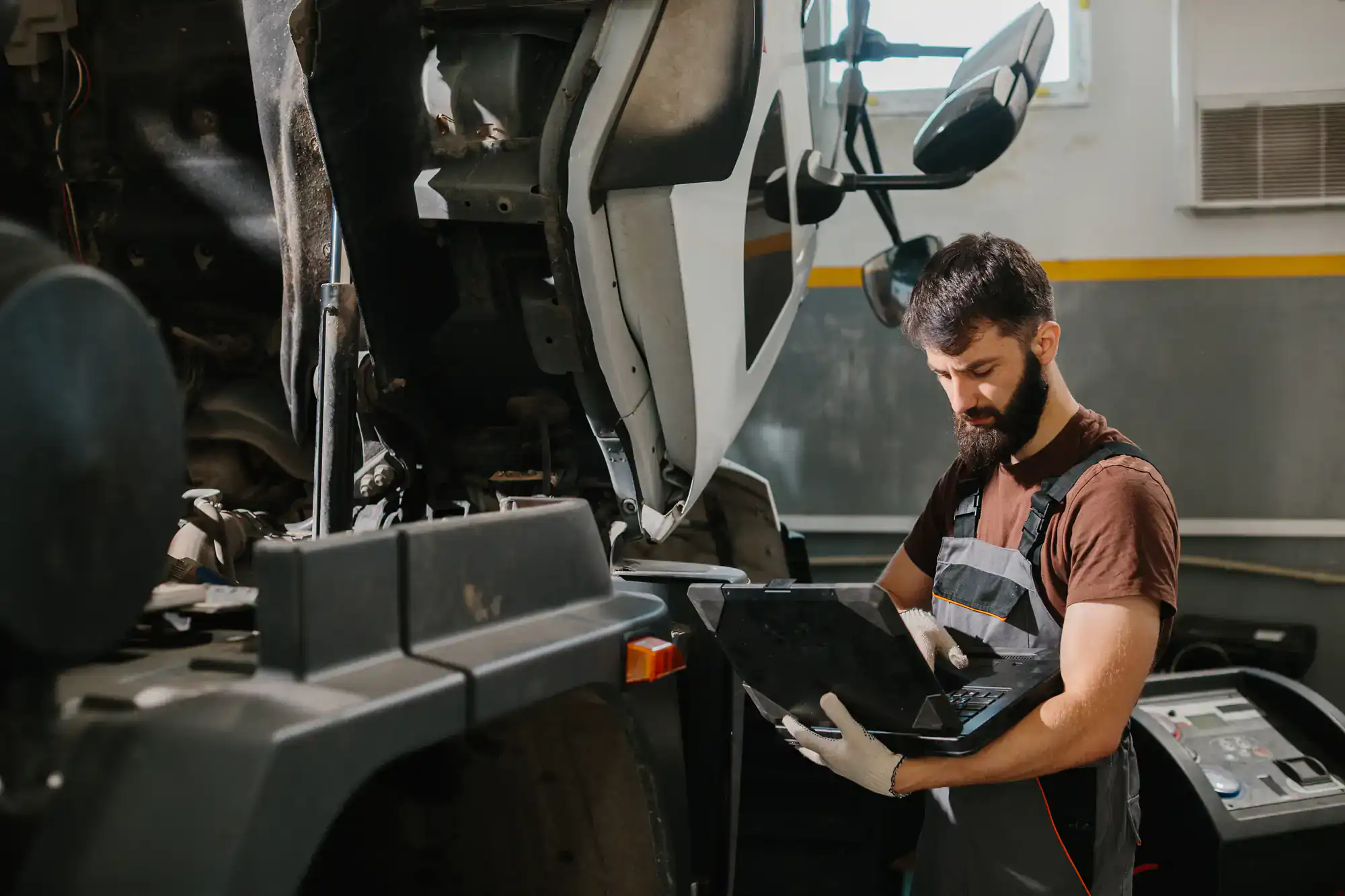
On-site, our tester connects CARB-certified OBD equipment directly to your truck’s diagnostic port. The system reads emissions data from the engine control module this is the same data CARB uses to evaluate compliance. The test itself typically takes under an hour for a single vehicle. If you’re running a small fleet, multiple trucks can be tested in the same visit, which saves time across the board.
Once the test is complete and your truck passes, we submit results electronically and directly to CARB’s CTC-VIS database not handed to you to upload yourself. You’ll receive confirmation, and your VIN will show as compliant in the system. From there, CARB transmits compliant vehicle data to DMV nightly, but allow 3 to 5 business days for your DMV record to fully reflect the update. If you have a registration renewal coming up, that’s the timeline to plan around. Because French Valley is unincorporated Riverside County, there’s no city-level permit layer to deal with the compliance picture here is entirely state-driven, which keeps the process straightforward.

Ready to get started?
Clean Truck Check applies specifically to diesel and alternative-fuel heavy-duty vehicles that are model year 2013 or newer and carry a GVWR over 14,000 pounds. If your truck doesn’t meet both of those criteria, this program doesn’t apply to you. If it does, it applies regardless of where your truck is registered out-of-state operators hauling through the I-15 corridor in Southwest Riverside County are subject to the same requirements as any California-based fleet.
The test itself is an OBD-based emissions evaluation. It’s not a visual inspection, not an opacity test, and not a general mechanical check. Our tester connects certified diagnostic equipment to your truck’s OBD port, pulls the emissions data from the engine control module, and submits the results to CARB’s CTC-VIS system. We handle the submission directly you don’t need a CTC-VIS account, and you don’t need to navigate the portal.
Current compliance requires semi-annual testing two tests per calendar year. That frequency increases to quarterly testing beginning October 1, 2027. The annual compliance fee is $31.18 per vehicle, indexed to CPI. That fee is separate from the cost of the test itself. Non-compliance carries penalties up to $10,000 per vehicle per day, and CARB has the authority to place holds on DMV registration for non-compliant vehicles. For French Valley operators running active loads on the I-15 and SR-79 corridor, a registration hold isn’t an inconvenience it’s a work stoppage.
If your truck is model year 2013 or newer and has a GVWR over 14,000 pounds, yes it’s subject to California’s Clean Truck Check program. This applies whether your business is based in French Valley, you’re operating out of the Winchester Road corridor, or you’re an out-of-state carrier running freight through the I-15 corridor in Southwest Riverside County. The requirement follows the truck and where it operates, not where it’s registered.
French Valley is unincorporated Riverside County, so there’s no city-level layer of trucking regulation to navigate here. The compliance obligation is entirely state-driven through CARB. That actually simplifies things you’re dealing with one regulatory authority, one testing requirement, and one submission system. If your truck fits the model year and weight threshold, the Clean Truck Check requirement applies, and the testing schedule is currently twice per year, moving to four times per year starting October 2027.
A failed test means the OBD data pulled from your truck’s engine control module showed emissions readings outside of CARB’s acceptable range. The result gets submitted to CTC-VIS just like a passing test would CARB receives the data either way. What it means for you is that your truck is flagged as non-compliant, and you’ll need to address the underlying issue and retest before your compliance window closes.
The most important thing to understand is that a failed test is not the same as no test. CARB can see that a test occurred. What triggers the most serious consequences registration holds, escalating penalties up to $10,000 per vehicle per day is failing to test at all or missing a deadline entirely. If your truck fails, get the mechanical issue diagnosed and addressed, then schedule a retest. We can return for the follow-up test once the repair is complete. Don’t let a failed result sit the clock doesn’t stop.
A Notice to Submit to Testing means CARB’s roadside monitoring equipment the emissions monitoring devices and automated license plate readers deployed on major California corridors, including the I-15 flagged your truck as a potential high emitter. From the date on the notice, you have 30 calendar days to submit a passing Clean Truck Check test to CARB’s CTC-VIS system. That window goes fast, especially if you’re in the middle of an active hauling schedule.
The first step is to book a test immediately not at the end of the 30 days. If there’s an underlying emissions issue with your truck, you’ll want time to get it diagnosed and repaired before a retest. Our mobile model means you don’t have to take the truck out of rotation to get tested we come to your location in French Valley or wherever the truck is staged. Once you pass, results are submitted directly to CTC-VIS. Allow 3 to 5 business days for your DMV record to update after submission.
This is one of the most common points of confusion for truck owners, and it’s worth understanding clearly. After a passing test is submitted to CARB’s CTC-VIS database, CARB transmits compliant VIN data to the DMV nightly. However, it takes 3 to 5 business days for your DMV record to fully reflect the update. During that window, your truck is compliant in CARB’s system but your DMV record may not show it yet.
If you have a CTC-VIS account, you can log in and check your vehicle’s compliance status directly. That’s the most reliable way to confirm your test was received and processed. If you don’t have an account, we can confirm that results were submitted at the time of testing. For French Valley operators with registration renewals coming up, the practical advice is simple: don’t schedule your test the day before your renewal deadline. Build in that 3-to-5-day buffer so your DMV record is current before you need it to be.
Under current CARB rules, most OBD-equipped heavy-duty vehicles subject to Clean Truck Check must be tested twice per year semi-annually. That schedule is set to change on October 1, 2027, when the requirement increases to quarterly testing, meaning four tests per calendar year. That’s a significant increase in frequency, and it’s worth planning for now rather than reacting to it in 2027.
For French Valley fleet operators managing multiple trucks, that shift means your annual compliance calendar doubles in testing appointments. Building a relationship with a credentialed mobile tester now before demand spikes across Riverside County when the quarterly requirement kicks in puts you in a better position operationally. The annual CARB compliance fee of $31.18 per vehicle is separate from the cost of each individual test and is required regardless of how many tests you complete in a year. Both obligations run concurrently, and both need to be met to maintain full compliance.
Yes and for most operators in French Valley, mobile testing is the only practical option. There’s no brick-and-mortar Clean Truck Check facility located within the community, and driving a loaded semi truck to a testing station in another city means lost time, wasted fuel, and a disrupted schedule. We operate on a fully mobile model, which means our tester comes to wherever your truck is your yard, your staging area near the French Valley Parkway interchange, a lot off Winchester Road, or any other location in the area.
The test is self-contained. Our tester brings all required CARB-certified OBD equipment, connects to your truck on-site, completes the emissions evaluation, and submits results directly to CTC-VIS before leaving. You don’t need a shop, a lift, or any special facility setup. For owner-operators and small fleets running active loads on the I-15 and SR-79 corridor through Southwest Riverside County, this means compliance gets handled without pulling your truck out of rotation. Book a time that works for your schedule, and the rest gets taken care of at your location.
Useful Links
Other Services we provide in French Valley