
Check Out Our Reviews!

A lot of operators running trucks out of Azusa first find out they’re non-compliant at the DMV counter when the hold is already on the vehicle and the registration won’t go through. By that point, you’re not just dealing with paperwork. You’re dealing with a truck that can’t legally operate, a deadline you didn’t know was coming, and a 30-day window to fix it. That’s not a position you want to be in when you’ve got loads to move on Arrow Highway or runs scheduled up SR-39 into the canyon.
The Clean Truck Check program requires an actual OBD emissions test not just the $31.18 annual compliance fee. Plenty of Azusa truck owners have paid that fee and assumed they were done. They weren’t. The test is a separate step, and until that OBD data gets submitted to CARB’s CTC-VIS portal, your truck isn’t compliant no matter what you’ve paid. Getting that test done before your deadline means your VIN shows clean in CARB’s system, DMV gets the update, and you’re back to running without the threat of a fine or a registration block hanging over you.
Trucks operating on the I-210 Foothill Freeway corridor, hauling aggregate out of the San Gabriel Canyon, or staging at yards near the Azusa Industrial park are exactly the vehicles this program targets. The good news is the test itself is fast, the process is straightforward, and you don’t have to take the truck anywhere to get it done.
We’re a CARB-credentialed emissions testing company that works exclusively with heavy-duty trucks model year 2013 or newer, GVWR over 14,000 pounds. That’s the only vehicle class subject to Clean Truck Check OBD testing, and it’s the only class we test. No passenger cars, no light trucks, no general smog checks. Just the specific program, the specific equipment, and the specific submission process that CARB requires.
That focus matters when you’re an owner-operator running a dump truck on Azusa Avenue or a fleet manager keeping tabs on vehicles spread across the San Gabriel Valley. The local smog shops along Foothill Boulevard the ones handling passenger cars and light-duty vehicles aren’t credentialed for this. We are. You can verify our credentials directly on CARB’s website before you ever pick up the phone.
We use only CARB Executive Order-approved OBD test devices, and we submit your results directly to CTC-VIS after every test. You don’t touch a portal, you don’t follow up, and you don’t wonder if it went through. When we leave your location in Azusa, your truck is in the system.

The process starts when you reach out to us. We confirm your truck qualifies 2013 or newer, GVWR over 14,000 lbs and schedule a time that works around your operation, not around a shop’s calendar. Whether your truck is parked at a yard near the Irwindale border, staged at a job site off Arrow Highway, or sitting at a facility near the I-210 Azusa Avenue interchange, we come to you.
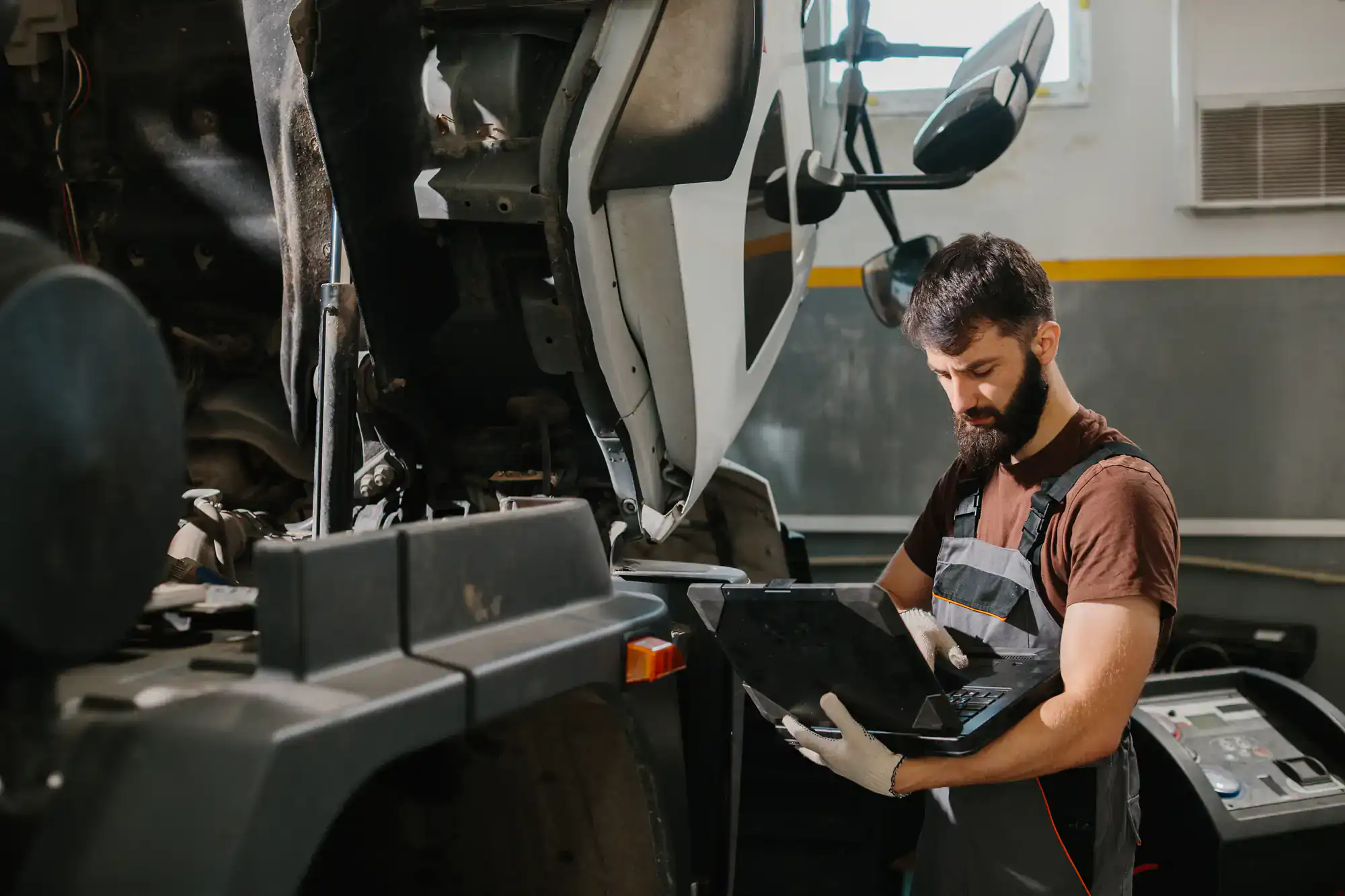
On the day of the test, we connect CARB-certified OBD diagnostic equipment to your truck’s onboard system. The device reads the emissions data directly from the vehicle’s ECM no opacity test, no tailpipe probe, no lengthy inspection process. The test itself typically takes under an hour for a single vehicle. For a fleet, we work through vehicles on-site so nothing has to be repositioned or taken out of service longer than necessary.
Once the test is complete, we submit your results directly to CARB’s CTC-VIS portal from the field. That submission triggers the compliance update in CARB’s database, and CARB transmits compliant VIN data to DMV on a nightly basis. You’ll typically see the DMV record update within 3 to 5 business days. If you want to confirm before calling DMV, you can check your own CTC-VIS account the status will be there. The test can also be submitted up to 90 days before your compliance deadline, which means you don’t have to wait for an NST notice or a registration crunch to get this handled.

Ready to get started?
The Clean Truck Check program applies to OBD-equipped heavy-duty vehicles that are model year 2013 or newer with a GVWR over 14,000 pounds. If your truck falls into that category and operates on California public roads including the I-210 Foothill Freeway, SR-39 through Azusa, or any surface route in Los Angeles County CARB compliance testing is required. This includes dump trucks, semi-trucks, flatbeds, concrete mixers, box trucks, and heavy haul equipment. It also applies to out-of-state trucks that regularly operate in California, which is worth knowing if you’re running vehicles registered in Nevada or Arizona but moving freight through the San Gabriel Valley.
When you book with us, here’s what’s included: a CARB-credentialed tester comes to your location in or around Azusa with Executive Order-approved OBD diagnostic equipment, performs the required data download from your truck’s onboard system, and submits the results directly to CARB’s CTC-VIS portal. You get confirmation that your submission went through, and your truck’s VIN is updated in CARB’s compliance database. There’s no paperwork you have to manage, no portal login you have to figure out, and no follow-up required on your end.
Currently, most OBD trucks in Azusa require testing twice per year. Starting October 1, 2027, that frequency increases to quarterly four tests per year, per vehicle. If you’re managing a fleet of trucks operating out of the Azusa or Irwindale corridor, that’s a significant compliance calendar to stay ahead of. Getting a testing relationship in place now means that shift doesn’t catch you off guard.
If your truck is model year 2013 or newer and has a GVWR over 14,000 pounds, yes CARB’s Clean Truck Check requirement applies to you regardless of where in California you’re based. Azusa falls within Los Angeles County, which is fully covered under CARB’s HD I/M regulation. That includes trucks operating on the I-210 Foothill Freeway, SR-39 through the San Gabriel Canyon, Arrow Highway, and any other public road in the state.
The requirement isn’t based on your mileage, your route, or how often you cross county lines. It’s based on your vehicle’s model year and weight class. If your truck meets both thresholds 2013 or newer and over 14,000 lbs GVWR you’re in the program. The only way to satisfy the requirement is through an OBD emissions test submitted to CARB’s CTC-VIS portal by a credentialed tester. Paying the annual $31.18 compliance fee registers you in the system, but it does not fulfill the testing requirement. Those are two separate steps, and missing the test step is the most common reason Azusa truck owners end up with DMV registration holds.
Yes, and the numbers are serious. CARB’s enforcement authority under the HD I/M regulation allows for fines of up to $10,000 per vehicle per day for non-compliance. That’s not a typo, and it’s not a worst-case scenario reserved for large fleets. Individual owner-operators are subject to the same penalties. Beyond fines, CARB transmits non-compliant VIN data to the DMV, which can result in a registration hold that blocks your renewal until a passing test is on file.
For an owner-operator running a single truck out of Azusa whether that’s a haul truck serving the San Gabriel Canyon aggregate operations or a flatbed working the Arrow Highway industrial corridor a registration hold means the truck can’t legally operate. That’s lost revenue, not just a paperwork problem. The cost of getting tested is a fraction of what a single enforcement action could run you. If you’ve received a Notice to Submit to Testing from CARB, you have 30 calendar days to submit a passing test. We can typically schedule and complete testing well within that window.
For a single truck, the on-site test typically takes under an hour from the time we arrive. The OBD data download itself is fast we connect CARB-certified diagnostic equipment to your truck’s OBD port, the system reads the emissions data from the vehicle’s ECM, and we submit the results to CTC-VIS directly from the field. There’s no warm-up period, no tailpipe probe, and no waiting for a shop bay to open up.
For fleet operators in Azusa managing multiple vehicles say, a small fleet staged at a yard near the Azusa Industrial park or a distribution operation off the I-210 corridor we work through vehicles sequentially on-site. You don’t need to reposition trucks between a yard and a shop, which is where most of the real time loss happens in a traditional testing setup. The goal is to get in, test, submit, and get out of your way. Your trucks stay where they are, and your operation keeps moving.
Yes. CARB’s Clean Truck Check requirement applies to any heavy-duty OBD-equipped vehicle that operates on California public roads regardless of where the truck is registered. If you’re running a 2013 or newer truck with a GVWR over 14,000 lbs that regularly travels through Los Angeles County, including the I-210 corridor through Azusa or SR-39 into the San Gabriel Canyon, you’re subject to the same testing requirements as a California-registered vehicle.
This catches a lot of operators off guard. Trucks registered in Nevada, Arizona, or other western states that regularly haul freight into California including through the San Gabriel Valley are not exempt. CARB enforcement doesn’t stop at the state line when the truck is already operating in California. If you’re in this situation and haven’t completed a Clean Truck Check, the process is the same: a credentialed tester connects to your OBD system, submits results to CTC-VIS, and your truck’s compliance is recorded. We can handle this for out-of-state vehicles operating in the Azusa area the same way we handle California-registered fleets.
This is one of the most common misunderstandings in the program, and it’s the reason a lot of Azusa truck owners end up blindsided at DMV renewal. The $31.18 annual compliance fee registers your vehicle in CARB’s Clean Truck Check system it does not satisfy the OBD emissions testing requirement. Those are two completely separate obligations, and CARB treats them that way.
Think of it this way: the fee gets you into the program. The OBD test is what actually proves your truck’s emissions systems are functioning within CARB’s standards. Until a credentialed tester submits a passing test result to CTC-VIS with your truck’s VIN, CARB’s database shows your vehicle as registered but not tested which means non-compliant for the testing requirement. DMV sees that status and applies a hold at renewal. If you’ve paid the fee but haven’t completed a test, your truck is not fully compliant. The fix is straightforward schedule an OBD test with a CARB-credentialed provider but it needs to happen before your compliance deadline, not after the hold appears.
Right now, most OBD-equipped heavy-duty trucks subject to Clean Truck Check are required to test twice per year semi-annually. That’s the current schedule for the majority of vehicles in the program, including trucks operating out of Azusa and the broader San Gabriel Valley. Your specific compliance deadline is tied to your DMV registration date, so the timing varies by vehicle.
Starting October 1, 2027, the testing frequency for OBD trucks increases to quarterly four times per year, per vehicle. For a single owner-operator, that’s a manageable calendar shift. For a fleet of 10 or 15 trucks working the I-210 corridor or servicing industrial accounts in the Azusa and Irwindale area, that’s 40 to 60 tests per year. Getting a consistent testing relationship in place now before that frequency change takes effect means you’re not scrambling to find a credentialed provider when the schedule doubles. The annual CARB compliance fee is also subject to CPI indexing, so costs will adjust over time, but the testing requirement itself is the more significant operational factor to plan around.
Useful Links
Other Services we provide in Azusa