
Check Out Our Reviews!

A DMV registration hold doesn’t just mean paperwork it means your truck sits while your schedule falls apart. For owner-operators running loads along the I-210 between Monrovia and the Inland Empire, that’s not a minor inconvenience. That’s lost revenue, missed pickups, and a problem that compounds fast if you don’t move on it quickly.
The Clean Truck Check program requires OBD emissions testing for model year 2013 and newer heavy-duty trucks with a GVWR over 14,000 pounds twice a year right now, and four times a year starting October 2027. Paying the annual $31.18 CARB compliance fee does not satisfy the testing requirement. A lot of Monrovia operators find that out the hard way when the DMV hold shows up anyway.
What changes when you get this handled correctly is straightforward: your VIN shows compliant in CARB’s database, DMV updates within 3 to 5 business days, and your truck goes back to work. For fleet managers overseeing vehicles that serve corporate operations along Shamrock Avenue or contractor fleets tied to the Station Square development, that kind of clean, documented compliance isn’t optional it’s how you keep operations running without interruption.
We are a CARB-credentialed emissions testing company serving Los Angeles and Riverside Counties. Our entire operation is built around one thing: Clean Truck Check OBD testing for 2013 and newer heavy-duty trucks with a GVWR over 14,000 pounds. That’s it. No passenger cars, no general smog checks, no side services that dilute the focus.
That specialization matters when you’re dealing with a program as specific as CARB’s HD I/M requirements. Monrovia sits in the San Gabriel Valley, governed by the South Coast Air Quality Management District one of the most stringent air quality regulatory environments in the country. The trucks operating along the I-210 corridor face real compliance pressure from multiple directions, and the tester you choose needs to actually know the program, not just claim to.
We are listed on CARB’s public credentialed tester registry at arb.ca.gov. You can verify that before you book. Every test we perform uses CARB Executive Order-approved OBD equipment, and results are submitted directly to the CTC-VIS database no manual steps, no portal confusion, no risk of a missed submission leaving your truck technically non-compliant.

The process starts when you reach out to schedule. You tell us where your truck is a yard off Huntington Drive, a corporate facility near Shamrock Avenue, a staging area along the I-210 corridor and we come to you. You don’t reposition the truck, you don’t burn fuel driving to a shop, and you don’t lose half a workday waiting in line somewhere.
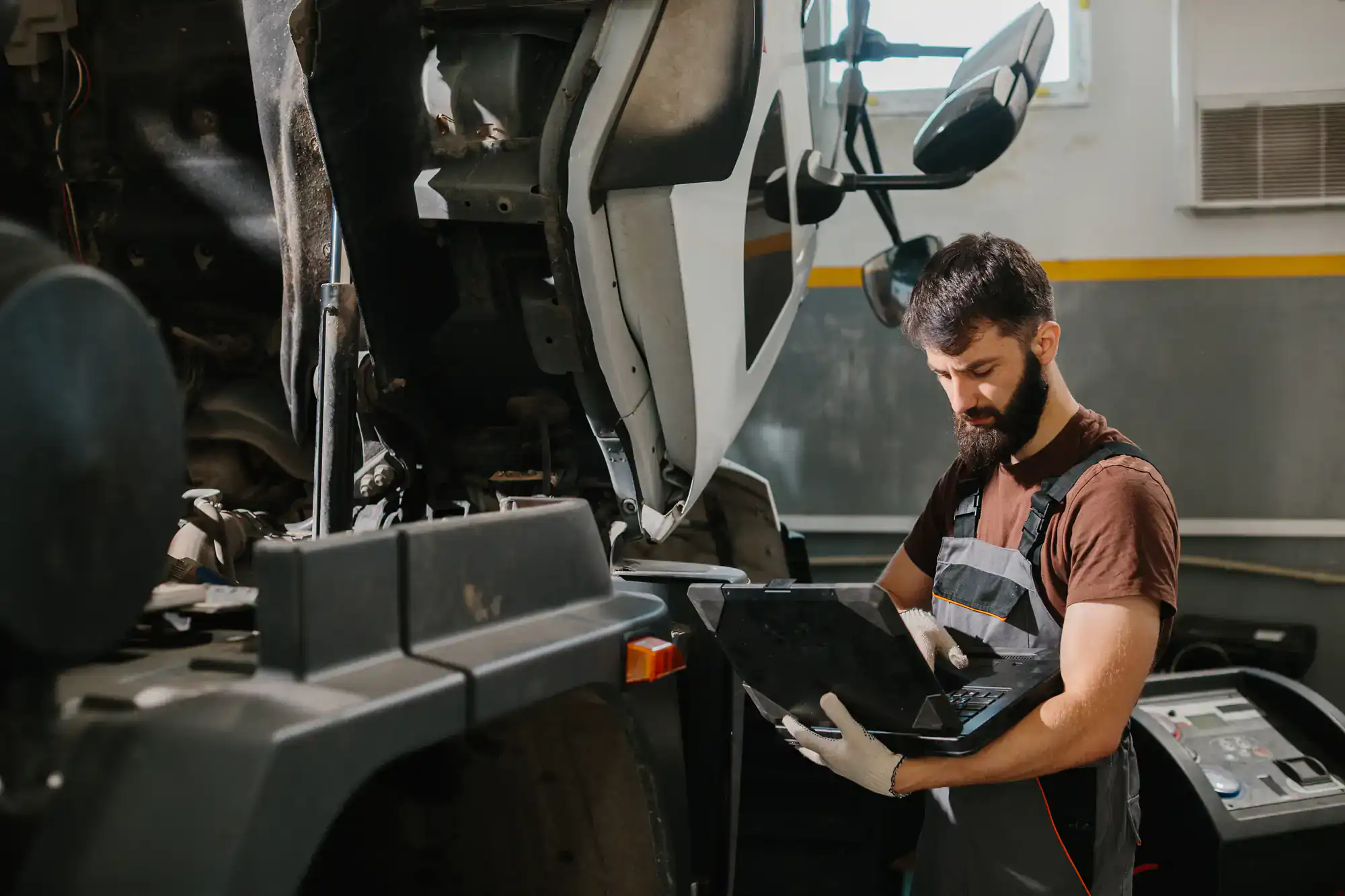
When we arrive, we connect CARB-certified OBD equipment directly to your truck’s diagnostic port and pull the emissions data. This is not a visual inspection or a smoke opacity test it’s a full electronic data download from the vehicle’s onboard system. The test applies specifically to model year 2013 and newer trucks with a GVWR over 14,000 pounds. If your truck doesn’t meet both of those criteria, this program doesn’t apply to you, and we’ll tell you that upfront.
Once the test is complete and your truck passes, we submit the results directly to CARB’s CTC-VIS database before we leave. You don’t touch the portal. CARB transmits compliant VIN data to DMV nightly, and your registration record typically updates within 3 to 5 business days. If you received a Notice to Submit to Testing, you have 30 days from that notice to submit a passing result we understand that timeline and we move accordingly.

Ready to get started?
Every Clean Truck Check we perform includes the full OBD data download using CARB Executive Order-approved equipment, direct electronic submission to the CTC-VIS database, and a compliance record tied to your VIN. There’s no paperwork you have to file separately, no portal you have to navigate, and no follow-up step that falls on you.
This service applies exclusively to model year 2013 and newer commercial trucks with a GVWR over 14,000 pounds the vehicles subject to CARB’s HD I/M program under SB 210. If you’re running a fleet in Monrovia with mixed model years, we’ll tell you exactly which vehicles qualify for OBD testing and which don’t. Older trucks and lighter vehicles fall outside this program entirely, and we won’t test something that doesn’t apply just to bill you for it.
For fleet operators managing multiple vehicles whether you’re overseeing logistics contractors connected to a Monrovia corporate campus or running a service fleet across the San Gabriel Valley we can test on-site at your location and handle multiple vehicles in a single visit. The 2027 shift to quarterly testing is coming, and operators who build a reliable compliance routine now will be in a significantly better position when testing frequency doubles. That’s not a sales pitch it’s just how the calendar works.
Yes, it does. If your truck operates in California even if it’s registered in another state it’s subject to CARB’s Clean Truck Check requirements. This catches a lot of out-of-state operators off guard, especially those running loads through Monrovia and the San Gabriel Valley on the I-210 corridor who assume California rules only apply to California-registered vehicles. CARB’s program is based on where the truck operates, not where it’s registered.
If you’ve been flagged or received a Notice to Submit to Testing as an out-of-state operator, the 30-day deadline applies to you the same as anyone else. The good news is the process is the same regardless of registration state we come to your location, perform the OBD test, and submit directly to CTC-VIS. Your compliance record updates in CARB’s system, and you’re cleared to continue operating in California without the risk of fines or enforcement action.
This is one of the most common points of confusion in the Clean Truck Check program. The annual compliance fee $31.18 per vehicle in 2025 is a separate requirement from the OBD emissions test. Paying the fee registers your vehicle in the program, but it does not satisfy the testing requirement. You still need to submit a passing OBD test result through a CARB-credentialed tester to become fully compliant.
If your DMV registration is on hold, it’s almost certainly because the passing test result hasn’t been submitted to CTC-VIS not because the fee is missing. CARB transmits compliant VIN data to DMV nightly, so once a passing test is submitted, your DMV record typically updates within 3 to 5 business days. The fastest way to clear a hold is to get the OBD test done and submitted correctly, which is exactly what we handle for Monrovia operators from start to finish.
Right now, OBD-equipped commercial trucks subject to the Clean Truck Check program are required to test twice per year semi-annually. That’s the current schedule as of 2025. However, starting October 1, 2027, CARB is increasing the testing requirement to quarterly four times per year, per vehicle. That’s a significant jump in compliance frequency, and it affects every qualifying truck operating in California, including those running the I-210 corridor through Monrovia and the broader San Gabriel Valley.
For fleet operators managing multiple vehicles, that shift from semi-annual to quarterly testing means your compliance calendar gets considerably more demanding in 2027. Building a reliable testing relationship with a credentialed provider before that change takes effect is worth doing now, while the schedule is still manageable. You can also submit a passing test up to 90 days before your compliance deadline, which gives proactive operators real flexibility to test on their own schedule rather than scrambling when renewal notices arrive.
A failed OBD test means the vehicle’s onboard diagnostic system has flagged an active fault code that indicates an emissions-related issue. The truck hasn’t passed compliance, and that result is recorded in CTC-VIS. You’ll need to have the underlying issue diagnosed and repaired before the truck can be retested and submitted as compliant. The test itself doesn’t cause the failure it surfaces a problem that was already there.
What matters after a failure is moving quickly, especially if you’re working against a Notice to Submit to Testing deadline. You have 30 calendar days from the NST to submit a passing result, so time spent waiting on a repair can eat into that window fast. Once the repair is complete, you schedule a retest, and if the truck passes, we submit the result to CTC-VIS the same day. For Monrovia operators running trucks on tight schedules along the I-210, getting back into compliance as quickly as possible after a repair is the priority and we can turn around the retest as soon as your truck is ready.
Yes on-site testing at your location is exactly how we operate. There’s no shop to drive to and no drop-off required. Whether your trucks are parked at a corporate facility, a service yard, a loading area, or anywhere else in Monrovia, we come to you with CARB-certified OBD equipment and handle the test where the truck sits.
This is especially useful for fleet operators managing multiple vehicles at a single location. Instead of pulling trucks off-site one at a time, we can work through several vehicles in a single visit, which keeps your operation running and minimizes the time your trucks are out of rotation. For businesses in Monrovia’s commercial corridors whether you’re near the Huntington Drive area, off Shamrock Avenue, or anywhere along the I-210 on-site testing means the compliance work fits around your schedule, not the other way around.
CARB maintains a public list of credentialed testers on its official website at arb.ca.gov and you can check it right now, before you book anything. We are on that list. This matters because the Clean Truck Check program only accepts test results submitted by credentialed testers using CARB Executive Order-approved OBD equipment. A test performed by an uncredentialed provider, or with non-approved equipment, does not count your truck remains non-compliant regardless of what the tester tells you.
In the San Gabriel Valley, where multiple providers are competing for the same compliance customers, verifying credentials before you commit is the single most important step you can take. The Monrovia market has templated service pages from providers who list dozens of cities without demonstrating any real program knowledge. Checking CARB’s credentialed tester registry takes about two minutes and tells you everything you need to know about whether a provider’s test will actually hold up in CTC-VIS.
Useful Links
Other Services we provide in Monrovia