

Hear from Our Customers

You’re running a business, not studying CARB regulations all day. But here’s what matters: if your diesel truck is model year 2013 or newer and weighs over 14,000 pounds, you need a passing clean truck check before your next DMV registration renewal. Miss it, and the state blocks your registration.
That’s not a warning. That’s how it works now.
The testing requirement went into effect October 1, 2024. Any compliance deadline on or after January 1, 2025 requires proof of a passing test. No test, no registration. No registration, no legal operation in California. You’re not just risking a fine—you’re risking your ability to work.
We handle CARB certified smog checks for heavy-duty vehicles in Wildomar, CA. You bring the truck, we run the OBD test, and you get documentation you can submit to CARB. The whole process is designed to keep you compliant without eating up your day. You can submit a passing test up to 90 days before your deadline, which means you control the timing instead of scrambling last minute.
All SMOG Motors is a CARB credentialed testing facility in Wildomar, CA. We’re set up specifically to handle clean truck check requirements for 2013 and newer diesel trucks with a gross vehicle weight rating over 14,000 pounds. That’s not every truck—just the ones CARB is targeting with the new Heavy-Duty Inspection and Maintenance program.
Wildomar sits right between Los Angeles and San Diego along the I-15 corridor. You’re moving freight through one of the busiest transportation zones in the country. That means CARB enforcement isn’t theoretical here—it’s active, and it’s coming from both the state and CHP during roadside inspections.
We’ve been doing emissions testing long enough to know what truck owners are up against. The regulations are confusing, the deadlines are tied to your individual registration dates, and the consequences for non-compliance are expensive. Our job is to make the testing part straightforward so you can focus on the road.

First, confirm your truck qualifies. This service applies only to diesel trucks that are model year 2013 or newer with a GVWR over 14,000 pounds. If your truck is older or lighter, this isn’t the test you need. CARB’s HD I/M program specifically targets OBD-equipped diesel engines, which started appearing in 2013 models.
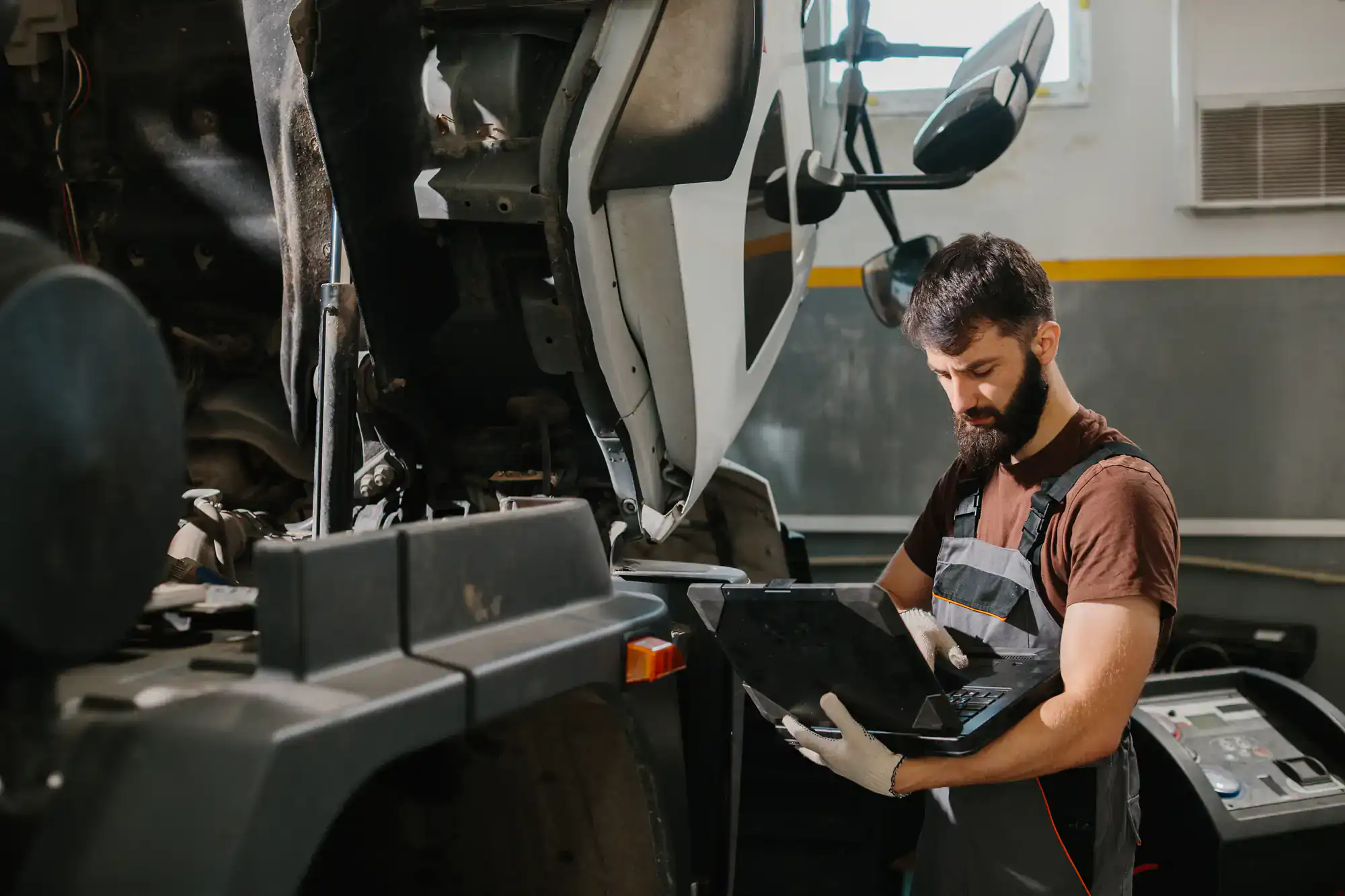
When you come in, we connect to your truck’s onboard diagnostics system using CARB certified testing equipment. The test checks for emission control system malfunctions and ensures your truck meets California CARB compliant standards. It’s not a visual inspection or a tailpipe test—it’s a data pull from your truck’s computer.
If your truck passes, you get documentation immediately. You’ll submit that to CARB through their system, and it satisfies your compliance requirement for the next six months. Yes, this is a recurring test—every six months, tied to your registration cycle.
If your truck doesn’t pass, you’ll need to get the issue repaired and come back for a retest. The test flags specific fault codes, so you’re not guessing what’s wrong. Most failures relate to emission system malfunctions like DPF issues, EGR problems, or sensor faults. Get it fixed, get retested, then submit your passing result before your deadline.
Ready to get started?
You’re getting a full OBD emissions compliance test using state-approved equipment. We check your truck’s emission control systems, pull diagnostic trouble codes, and verify readiness monitors. The test takes about 30 minutes if everything’s working correctly.
You’ll receive official documentation showing your test results. If you pass, that paperwork is what you submit to CARB’s online system to clear your compliance requirement. We can walk you through the submission process if you need help—it’s not complicated, but it’s new for most truck owners.
Here’s what matters for Wildomar operators: you’re in Riverside County, which means you’re likely running routes that cross through CARB’s priority enforcement zones. The I-15 and I-215 corridors see heavy CHP presence, and they’re checking for clean truck check compliance during inspections. If you can’t show proof of a passing test when your deadline has passed, you’re looking at violations that can hit $10,000 per year per non-compliant vehicle.
This isn’t just about registration anymore. It’s about staying operational. Fleet operators and owner-operators both need to track these deadlines carefully because CARB’s enforcement database is tied directly to DMV records. Miss your test, and the state knows. You don’t get a grace period.
Only diesel trucks that are model year 2013 or newer with a gross vehicle weight rating over 14,000 pounds. If your truck doesn’t meet both of those criteria, you’re not subject to this requirement yet.
CARB designed the Heavy-Duty Inspection and Maintenance program specifically for OBD-equipped diesel engines. Those started showing up in 2013 models, which is why that’s the cutoff year. Older trucks and lighter vehicles aren’t part of this testing program.
If you’re running a gas-powered truck, a truck under 14,000 pounds GVWR, or a diesel truck older than 2013, you don’t need a clean truck check. But if you’re driving a 2013 or newer diesel semi truck, box truck, or other heavy-duty vehicle over that weight threshold in California, this applies to you every six months.
Your compliance deadline is tied to your DMV registration renewal date. CARB requires a passing test every six months, and the specific due date depends on when your truck’s registration expires.
Here’s the critical part: any compliance deadline that falls on January 1, 2025 or later requires a passing clean truck check. If you don’t have one on file, DMV can place a registration hold on your vehicle. That means you can’t renew your registration until you complete the test and submit proof of compliance.
You can submit a passing test up to 90 days before your deadline, which gives you a window to plan around your schedule. Don’t wait until the last week. If your truck fails and needs repairs, you’ll need time to fix it and retest before your deadline hits. Missing the deadline doesn’t just delay your registration—it can trigger enforcement action from CARB or CHP if you’re caught operating without compliance.
The test connects to your truck’s onboard diagnostics system and reads data from the emission control monitors. We’re checking for malfunction indicator lights, diagnostic trouble codes, and readiness status on emission-related systems like your diesel particulate filter, exhaust gas recirculation, and NOx sensors.
It’s not a visual inspection of your truck. We’re not looking at your exhaust pipe or checking fluid levels. The test is entirely electronic—pulling data that your truck’s computer already tracks about emission system performance.
If everything’s functioning correctly and there are no active fault codes related to emissions equipment, your truck passes. If there’s a malfunction or a system isn’t ready for testing, it fails. The test results will show exactly which codes or monitors caused the failure, so you know what needs repair before you come back for a retest.
Testing costs vary depending on the facility, but you’re typically looking at a fee comparable to standard smog testing. The bigger cost concern isn’t the test itself—it’s what happens if you fail and need repairs.
Emission system repairs on heavy-duty diesel trucks aren’t cheap. DPF replacements, EGR repairs, and sensor issues can run thousands of dollars depending on what’s wrong. That’s why it makes sense to stay on top of maintenance and get tested early in your 90-day window. If something fails, you have time to shop for repairs and get retested without missing your deadline.
The real expense is non-compliance. Registration holds mean your truck sits instead of earning. CARB violations can cost up to $10,000 per vehicle per year. CHP citations during roadside inspections add up fast. Spending a little on testing and maintenance now is a lot cheaper than dealing with enforcement later.
You can get tested at any CARB credentialed facility in California. It doesn’t have to be in Wildomar specifically, but going local saves you time and keeps things simple.
We’re right here in Wildomar, which matters if you’re running routes through Riverside County or operating between LA and San Diego. You’re not adding extra miles or downtime to get tested. You can schedule around your loads instead of driving out of your way to find a testing station.
Make sure wherever you go is actually credentialed for CARB HD I/M testing. Not every smog shop is set up for heavy-duty diesel trucks. The equipment and certification requirements are different from standard passenger vehicle testing. If you show up somewhere that can’t handle trucks over 14,000 pounds, you’re wasting a trip.
You’ll receive documentation showing your test results and vehicle information. You need to submit that to CARB through their online compliance system. The submission links your passing test to your truck’s VIN and clears your compliance requirement for the next six months.
CARB’s system communicates with DMV, so once your passing test is on file, the registration hold threat goes away. You’ll be able to renew your registration normally when the time comes. Your compliance status also shows up in enforcement databases, which means if CHP pulls you over for an inspection, they can verify you’re current.
Don’t skip the submission step. Passing the test isn’t enough—you have to get it into CARB’s system. We can help you with that process if you need it, or you can do it yourself online. Just make sure it’s done before your deadline. After that, mark your calendar for six months out, because you’ll need to do this again when your next compliance period rolls around.
Useful Links
Other Services we provide in Wildomar