
Check Out Our Reviews!

If your truck runs the I-10 or SR-60 corridor out of West Covina, you already know how much a single day off the road costs. A registration hold or a Notice to Submit to Testing doesn’t just create paperwork it pulls a revenue-generating vehicle out of rotation, often at the worst possible time. The Clean Truck Check program is fully enforced now, and CARB’s compliance checks are active along the exact freight corridors your truck travels every day.
The San Gabriel Valley sits in a natural air basin the San Gabriel Mountains to the north trap particulate matter and diesel exhaust, which is exactly why CARB’s enforcement is particularly focused in this region. West Covina’s location in the heart of this basin means that staying ahead of your testing schedule isn’t just about avoiding fines it’s about keeping your rig moving through one of the most compliance-active freight corridors in California. Anyone running a heavy-duty truck through West Covina, Baldwin Park, or the City of Industry faces the same environmental reality and the same enforcement intensity.
When your test is done and submitted, your truck’s VIN updates in CARB’s CTC-VIS database, and DMV records reflect compliance within 3 to 5 business days. No gray area, no follow-up calls, no wondering if it went through. That’s the outcome your truck is compliant, documented, and back to work.
We do one thing: Clean Truck Check OBD testing for model year 2013 and newer heavy-duty vehicles with a GVWR over 14,000 pounds. That’s the entire scope of what we do. There are plenty of smog check stations along Garvey Avenue and Azusa Avenue in West Covina that handle passenger cars we’re not competing with them, and they can’t do what we do. CARB’s HD I/M program requires specific credentials, specific equipment, and direct CTC-VIS submission capability. We have all three.
Our CARB credentials are publicly listed on arb.ca.gov you can verify them yourself before you book, in under a minute. We serve Los Angeles County, which means West Covina operators in the 91790, 91791, 91792, and 91793 ZIP codes are squarely within our service area. No ambiguity, no “we’ll try to get someone out there.” You’re in our area, and we know the routes your trucks run.

You call or book online, give us your truck’s VIN and location, and we schedule a time to come to you whether that’s a yard off Valley Boulevard, a warehouse near the City of Industry border, or a commercial lot anywhere in West Covina. Your truck doesn’t move. We do.
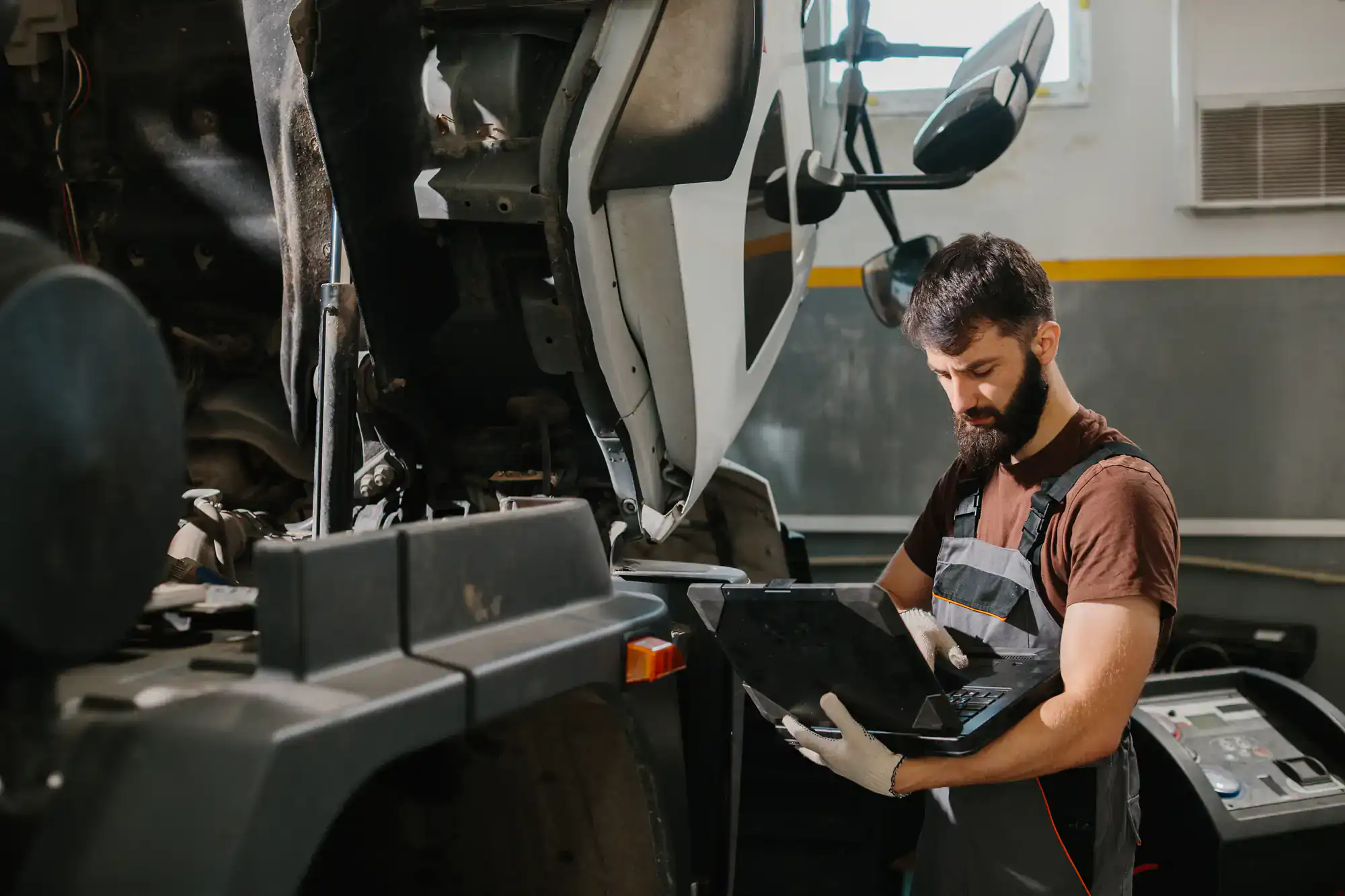
When we arrive, we connect our CARB-certified OBD test device directly to your truck’s ECU. This is not a generic scanner it’s equipment that holds CARB Executive Order approval, which is the only kind of device that produces a test result CARB will actually accept. We read the OBD data, assess your truck’s emissions system status, and generate the test result on-site. The whole process typically takes less than an hour per vehicle.
Once the test is complete, we submit your results electronically to CARB’s CTC-VIS database before we leave your property. You can log into your own CTC-VIS account immediately after to confirm your truck shows as compliant. If your truck is due for its semi-annual test and you’re also approaching a DMV renewal, testing early CARB allows testing up to 90 days before your deadline gives you a buffer in case anything needs attention before the deadline hits. For West Covina fleet operators managing multiple trucks with staggered registration dates, that window matters.

Ready to get started?
The Clean Truck Check program formally called CARB’s Heavy-Duty Inspection and Maintenance program applies specifically to diesel trucks that are model year 2013 or newer with a GVWR over 14,000 pounds. If your truck doesn’t meet both of those criteria, this program doesn’t apply to you. If it does, you’re required to test twice per year right now, and that increases to four times per year starting October 1, 2027. That quarterly requirement is coming faster than most West Covina fleet operators realize, and building a reliable testing relationship before that change takes effect is the smart move.
There’s a misconception worth clearing up: paying the annual CARB compliance fee of $31.18 per vehicle does not satisfy your testing requirement. Many truck owners in the San Gabriel Valley have paid the fee and assumed they were covered then discovered a registration hold at DMV that caught them completely off guard. The fee and the test are two separate obligations. Both are required.
For West Covina operators who receive a Notice to Submit to Testing from CARB, the window is exactly 30 calendar days to submit a passing test result. That’s not a lot of runway when you’re running loads on the I-10 every day. Our mobile model means we can move quickly no facility appointment, no repositioning your truck across the county. Out-of-state trucks operating on California roads, including those coming through West Covina on the I-10 from the Inland Empire, are subject to the same requirements regardless of where they’re registered.
If your truck is model year 2013 or newer and has a GVWR over 14,000 pounds, yes CARB’s Clean Truck Check program applies to you regardless of which California city you’re based in. West Covina is in Los Angeles County, which falls under South Coast Air Quality Management District jurisdiction one of the most actively enforced air quality regulatory districts in the country. The San Gabriel Valley’s geography, with the San Gabriel Mountains trapping diesel exhaust and particulate matter in the air basin, is part of why CARB enforcement is particularly active along the I-10 and SR-60 corridors that run through and alongside West Covina.
The program requires semi-annual testing right now two tests per calendar year. Starting October 1, 2027, that increases to quarterly testing, meaning four tests per year. If you’re operating a qualifying truck on California roads and haven’t submitted a passing test through CARB’s CTC-VIS system, you’re non-compliant regardless of whether you’ve paid the annual fee. The fee and the test are separate requirements.
A failed test means your truck’s OBD system flagged one or more emissions-related fault codes during the test. The result gets submitted to CARB’s CTC-VIS database, and your truck will show as non-compliant until a passing test is submitted. You’ll need to address the underlying issue whatever triggered the fault codes and then retest. CARB does not issue an automatic grace period for a failed test, so the sooner you can get the repair done and retest, the better.
If you’re already within a compliance window or working against an NST deadline, a failed test makes the timeline tighter. The best approach is to test proactively CARB allows testing up to 90 days before your deadline so that if your truck does fail, you have time to repair and retest without hitting a registration hold or fine exposure. For West Covina operators running daily loads on the I-10 corridor, that buffer can be the difference between a manageable repair window and a truck that’s legally restricted from operating.
They’re completely different tests for completely different vehicles. A standard smog check the kind offered at stations like Vista Smog on Garvey Avenue tests passenger cars and light-duty vehicles using a tailpipe emissions measurement. The Clean Truck Check is an OBD-based test specifically for heavy-duty diesel trucks model year 2013 or newer with a GVWR over 14,000 pounds. It reads data directly from the truck’s onboard diagnostic system, not the tailpipe.
General smog check stations in West Covina are not equipped or credentialed to perform a Clean Truck Check. If you’ve ever pulled into a local smog shop with a heavy-duty diesel truck and been turned away, that’s why. The equipment is different, our CARB credentials are different, and the submission process is different. We handle only this type of testing no passenger cars, no older opacity-test trucks which means every piece of equipment and every credential we hold is specific to your truck’s actual compliance requirement.
A Notice to Submit to Testing means CARB has identified your truck as overdue for a Clean Truck Check submission, and you have 30 calendar days from the date of that notice to submit a passing test result. That clock doesn’t pause for weekends, route schedules, or anything else. If you miss the 30-day window without submitting, you’re exposed to fines that can reach up to $10,000 per vehicle per day, and CARB can restrict your truck from operating on California public roads.
The fastest path forward is to book a mobile test as soon as possible. We can come to your location in West Covina your yard, your lot, wherever your truck is parked without requiring you to reposition the vehicle or take it off its route. We run the OBD test on-site and submit the results directly to CTC-VIS before we leave. If your truck passes, your compliance record updates the same day. If there’s a repair needed, testing quickly gives you the maximum remaining time in your 30-day window to address it and retest.
Right now, OBD-equipped heavy-duty trucks model year 2013 or newer with a GVWR over 14,000 pounds are required to test twice per year semi-annually. That’s the current requirement under CARB’s Clean Truck Check program, which went into full enforcement in October 2024 with the first compliance deadline on January 1, 2025.
Starting October 1, 2027, the testing frequency increases to four times per year quarterly. For West Covina fleet operators managing multiple trucks, that’s a significant jump in compliance workload. If you’re running three trucks today, you’re going from six tests per year to twelve. Building a reliable testing relationship with a credentialed mobile provider before that change takes effect is the practical move not scrambling to find someone when quarterly deadlines start stacking up. The 2027 date feels far away until it doesn’t, and the I-10 corridor doesn’t slow down while you’re catching up on compliance.
We are fully mobile we come to wherever your truck is in West Covina, whether that’s a commercial yard off Valley Boulevard, a warehouse near the City of Industry border, a loading dock in the 91792 ZIP code, or anywhere else in Los Angeles County. Your truck doesn’t move. We bring the CARB-certified OBD equipment to you, run the test on-site, and submit the results directly to CARB’s CTC-VIS database before we leave.
For owner-operators and small fleet managers running daily routes on the I-10 and SR-60 corridors, this matters in a practical way. Repositioning a heavy-duty truck to a fixed testing facility takes time, fuel, and often a half-day out of your schedule. Mobile testing eliminates all of that. You stay on your schedule, your truck stays at your location, and compliance gets handled without pulling a revenue-generating vehicle off its route. We serve all West Covina ZIP codes 91790, 91791, 91792, and 91793 and the surrounding San Gabriel Valley area.
Useful Links
Other Services we provide in West Covina