
Check Out Our Reviews!

A DMV registration hold doesn’t just ground your truck in a market like Rancho Mirage, it can cost you a vendor relationship with a resort property that took years to build. The Ritz-Carlton, Westin Mission Hills, Agua Caliente Casino, and Eisenhower Health don’t have tolerance for vendors whose trucks get pulled off the road over a compliance issue that was entirely preventable. That’s the real cost of skipping a Clean Truck Check test.
Rancho Mirage’s desert climate adds another layer to this. Summer highs routinely exceed 108°F, and that kind of sustained heat accelerates wear on diesel emissions systems EGR valves, DPF filters, SCR components. Trucks that run through a Coachella Valley summer can accumulate OBD fault codes that would cause a failure at the next compliance deadline. Testing before that deadline gives you time to fix the problem, not scramble after it.
The high season runs October through April, when the snowbird population floods Rancho Mirage and resort operations run at full capacity. That’s exactly when your trucks need to be moving, not sitting in a yard waiting on a compliance fix. Getting tested before the season starts CARB allows submissions up to 90 days early means you’re protected when it counts most.
We do one thing: Clean Truck Check OBD testing for model year 2013 and newer heavy-duty trucks with a GVWR over 14,000 pounds. That’s the full scope of what we do. No passenger cars, no RVs, no opacity tests for older vehicles just the specific program that applies to your truck.
We’re CARB-credentialed, which means you can verify us before you ever pick up the phone. CARB maintains a public directory of available-for-hire credentialed testers at arb.ca.gov our credentials are listed there. We use only OBD scanning devices with valid CARB Executive Order approval, and every test result is submitted electronically to CARB’s CTC-VIS database directly by us. You don’t touch the portal.
We serve Riverside County, which means the full Coachella Valley corridor Rancho Mirage, Palm Springs, Palm Desert, Cathedral City, and the surrounding area along the I-10 and SR-111. We know the routes, we know the properties, and we show up where your trucks actually are.

You schedule the test, and we come to your location your construction staging area off Frank Sinatra Drive, your delivery yard, your resort loading dock, wherever your truck is parked in Rancho Mirage. Your driver doesn’t need to go anywhere. Your truck doesn’t leave the property. That matters when you’re running tight delivery windows or managing a job site with active permits and lane closure requirements on Rancho Mirage city roads.
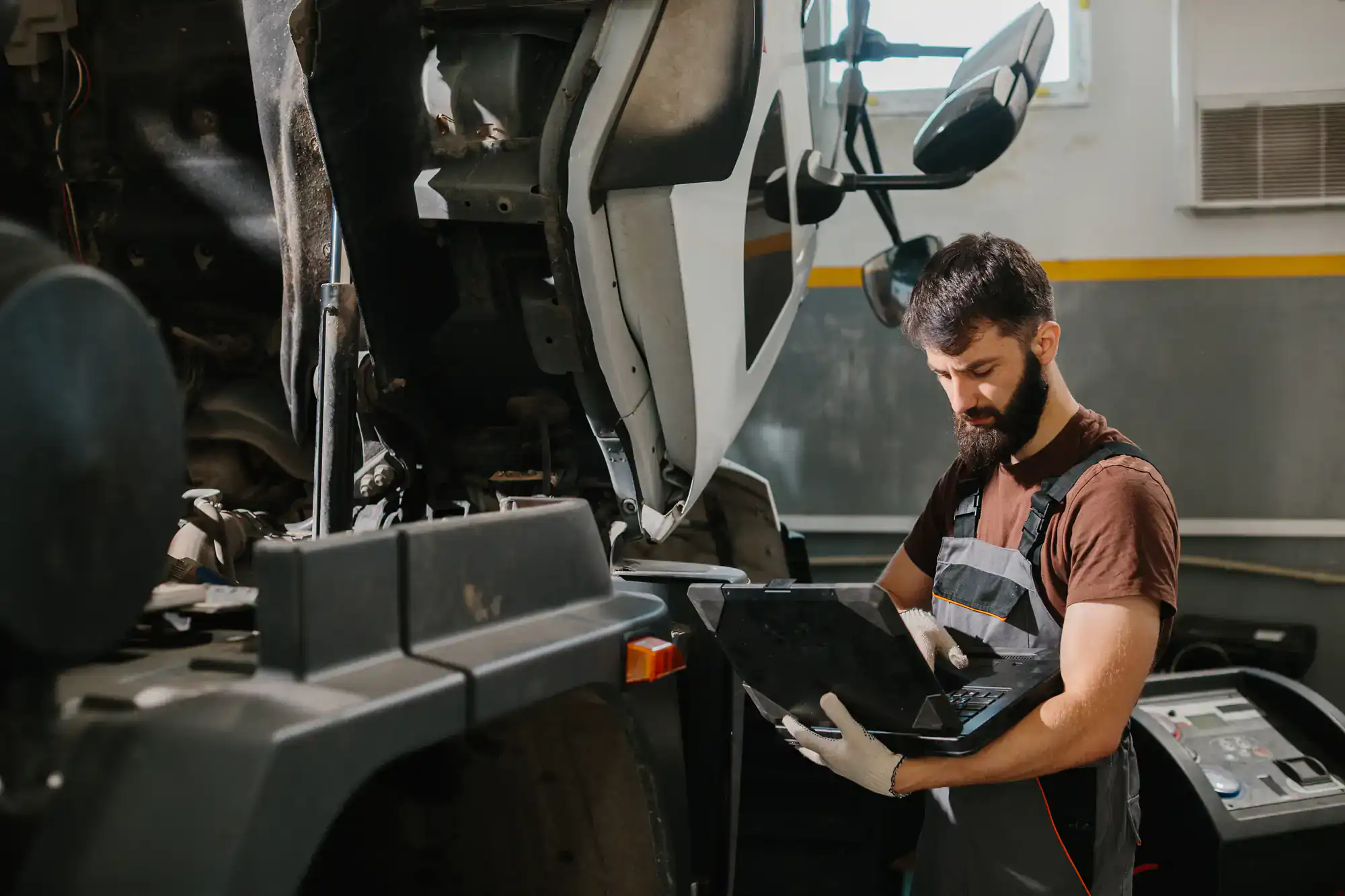
When we arrive, we connect CARB-certified OBD equipment directly to your truck’s ECU and download the required diagnostic data. The process is fast. We’re reading the data the vehicle’s onboard system has already recorded fault codes, emissions readiness monitors, system status. If everything checks out, you have a passing test. If something flags, you know about it immediately, with enough detail to take it to a mechanic before the compliance deadline hits.
After the test, we submit the results electronically to CARB’s CTC-VIS system. That submission happens before we leave your location. CARB transmits compliant VINs to the DMV nightly, so your registration record typically reflects compliance within three to five business days. No paperwork on your end, no portal login, no follow-up calls to confirm it went through. The process is designed to be completely handled on our side so you can stay focused on running your operation.

Ready to get started?
Every Clean Truck Check we perform covers the full OBD diagnostic download, direct CTC-VIS submission to CARB, and confirmation of your compliance status all in one visit. There’s no separate administrative step, no portal you need to manage, and no follow-up required from you after we leave.
This service applies to trucks that are model year 2013 or newer with a GVWR over 14,000 pounds. If your truck falls outside those parameters older model year, lighter vehicle class it isn’t subject to Clean Truck Check requirements, and we’ll tell you that upfront rather than book a test you don’t need. For operators running mixed fleets in and around Rancho Mirage, we can assess each vehicle individually and test only the ones that qualify under CARB’s program.
For fleet operators managing multiple trucks construction companies on active Rancho Mirage job sites, resort supply vendors running regular routes along Highway 111, medical supply distributors serving Eisenhower Health on Bob Hope Drive fleet pricing is available. The semi-annual testing requirement is already in place, and CARB is scheduled to increase that to quarterly testing beginning October 1, 2027. If you’re managing more than a couple of trucks, getting a consistent testing relationship established now makes that transition significantly easier when it arrives.
It depends on two things: the model year and the weight class. Clean Truck Check applies to trucks that are model year 2013 or newer and have a Gross Vehicle Weight Rating over 14,000 pounds. If your truck meets both of those criteria and operates on California roads including delivery routes along Highway 111 or Bob Hope Drive in Rancho Mirage it falls under CARB’s program regardless of where your company is based. Out-of-state operators running trucks into the Coachella Valley are subject to the same requirements as California-registered fleets.
If your truck is older than 2013 or under the 14,000-pound GVWR threshold, Clean Truck Check does not apply to it. We won’t book a test for a vehicle that doesn’t qualify that’s not useful to you. If you’re unsure whether a specific truck in your fleet meets the criteria, call us and we’ll walk through it with you before scheduling anything.
This is one of the most common compliance gaps we see. The annual compliance fee currently $31.18 per vehicle and the OBD emissions test are two completely separate requirements. Paying the fee does not satisfy the testing requirement, and CARB tracks both independently. A lot of operators find this out the hard way when a DMV registration hold appears at renewal, even though they paid the fee on time.
If you’re in that situation right now, the fix is straightforward: get a passing OBD test submitted to CARB’s CTC-VIS system by a credentialed tester. Once we submit your results, CARB transmits your VIN as compliant to the DMV nightly, and your registration record typically updates within three to five business days. The sooner you get the test done, the sooner the hold clears. If you’ve already received a Notice to Submit to Testing from CARB, you have 30 calendar days from that notice don’t let that window run out.
Right now, OBD-equipped heavy-duty trucks that qualify under the program model year 2013 or newer, GVWR over 14,000 pounds are required to be tested twice per year, on a semi-annual schedule. That’s the current requirement as of 2025, following the full enforcement phase launch in October 2024.
That frequency is scheduled to increase. Starting October 1, 2027, CARB’s program moves to quarterly testing four times per year for qualifying vehicles. For fleet operators running trucks on Rancho Mirage resort routes, construction sites, or Coachella Valley delivery circuits, that’s a meaningful increase in testing volume. Building a consistent relationship with a credentialed tester before that shift happens makes the transition much smoother than scrambling to find someone reliable when the new schedule kicks in. It’s worth thinking about now, not in 2027.
Yes, and for active construction sites in Rancho Mirage, on-site testing is usually the most practical option. The city’s Public Works Department requires advance notice and traffic control plans for lane closures, and active job sites like the Ritz-Carlton expansion along Frank Sinatra Drive or other permitted commercial projects are often running tight schedules that make repositioning vehicles off-site difficult and disruptive.
We come to the truck. Whether it’s staged at a construction yard, parked at a materials storage area, or sitting between hauls at an active site, we connect the OBD equipment on location and complete the test without pulling the vehicle out of rotation. The only requirement on your end is that the truck be accessible and the engine be available for the test. We handle everything else, including the CTC-VIS submission to CARB before we leave the site.
The test itself is an OBD onboard diagnostics data download from your truck’s ECU. We connect CARB-certified scanning equipment to the vehicle’s diagnostic port and pull the data the truck’s onboard system has already been recording: emissions readiness monitors, fault codes, and system status across the components we track under the Clean Truck Check program. There’s no emissions probe inserted into the exhaust, no road test, and no extended mechanical inspection it’s a data read.
The actual connection and download is fast, typically completed in a short visit. What takes slightly longer is confirming the data, preparing the submission, and uploading the results to CARB’s CTC-VIS system but we handle all of that on-site before we leave. For fleet operators running multiple trucks at one location, we can test several vehicles in sequence during a single visit, which is usually the most efficient approach for Rancho Mirage vendors managing more than one qualifying truck.
A failed test means the OBD data flagged an issue typically an active fault code or an emissions readiness monitor that hasn’t completed its cycle. The test result itself will indicate what was flagged, which gives you and your mechanic a clear starting point for diagnosis. This is actually one of the more useful aspects of the OBD process: you’re not getting a vague “failed” result, you’re getting specific data about what the truck’s system recorded.
From there, you take the truck to a qualified diesel mechanic for repair, address the flagged issue, and then schedule a retest. In the Coachella Valley, where summer heat puts additional stress on diesel emissions components EGR systems, diesel particulate filters, selective catalytic reduction systems heat-related wear is a common contributor to failures, particularly for trucks that have been running heavy routes through the desert months. Once repairs are complete and the system is ready, we come back out, run the OBD test again, and submit the passing result to CARB. The compliance clock stops when the passing test hits the CTC-VIS database.
Useful Links
Other Services we provide in Rancho Mirage