
Check Out Our Reviews!

When your truck’s VIN shows compliant in CARB’s CTC-VIS database, you’re not just checking a box you’re protecting your income. A registration hold doesn’t send you a warning first. It just blocks your renewal, and suddenly a truck that was earning yesterday is sitting idle today. For owner-operators running drayage routes between the ports and Inland Empire distribution centers, that kind of disruption isn’t just inconvenient it’s a direct hit to your bottom line.
Paramount sits inside the AB 617 Southeast Los Angeles Community Emissions Reduction boundary, which means CARB’s enforcement attention in this area is deliberate and funded not random. Roadside emissions monitoring devices are actively deployed along the I-710, one of the most scrutinized freight corridors in California. If your truck flags a roadside monitor and you don’t have a current compliance record, you’re on a 30-day clock with real fines attached.
Getting tested proactively before a Notice to Submit to Testing lands in your mailbox keeps you ahead of that. It keeps your registration current, your truck moving, and your operation running the way it’s supposed to. That’s the only outcome that matters.
We don’t test passenger cars. There’s no general smog check counter here, no oil changes, no side services. Our entire operation is built around one thing: performing Clean Truck Check OBD testing on heavy-duty vehicles that are model year 2013 or newer with a GVWR over 14,000 pounds. That’s the vehicle class CARB’s HD I/M program covers, and that’s all we test.
Our credentials are publicly verifiable on CARB’s own website listed under Available for Hire Credentialed Testers at arb.ca.gov. Our OBD test equipment carries CARB Executive Order approval, which is the only kind of device CARB will accept results from. And every test result gets submitted directly to the CTC-VIS portal, so your compliance record is updated before we leave your yard.
For fleet operators and owner-operators working out of Paramount’s industrial corridors near Downey Avenue, Rosecrans Avenue, or the SR-91 interchange our mobile testing model means zero disruption to your route. We come to you. You keep running.

It starts with a quick call or booking. You tell us where the truck is whether that’s an industrial yard off Rosecrans Avenue, a lot near the SR-91 corridor, or a dock somewhere in Paramount’s southeast industrial area and we schedule a time that works around your operation, not the other way around.
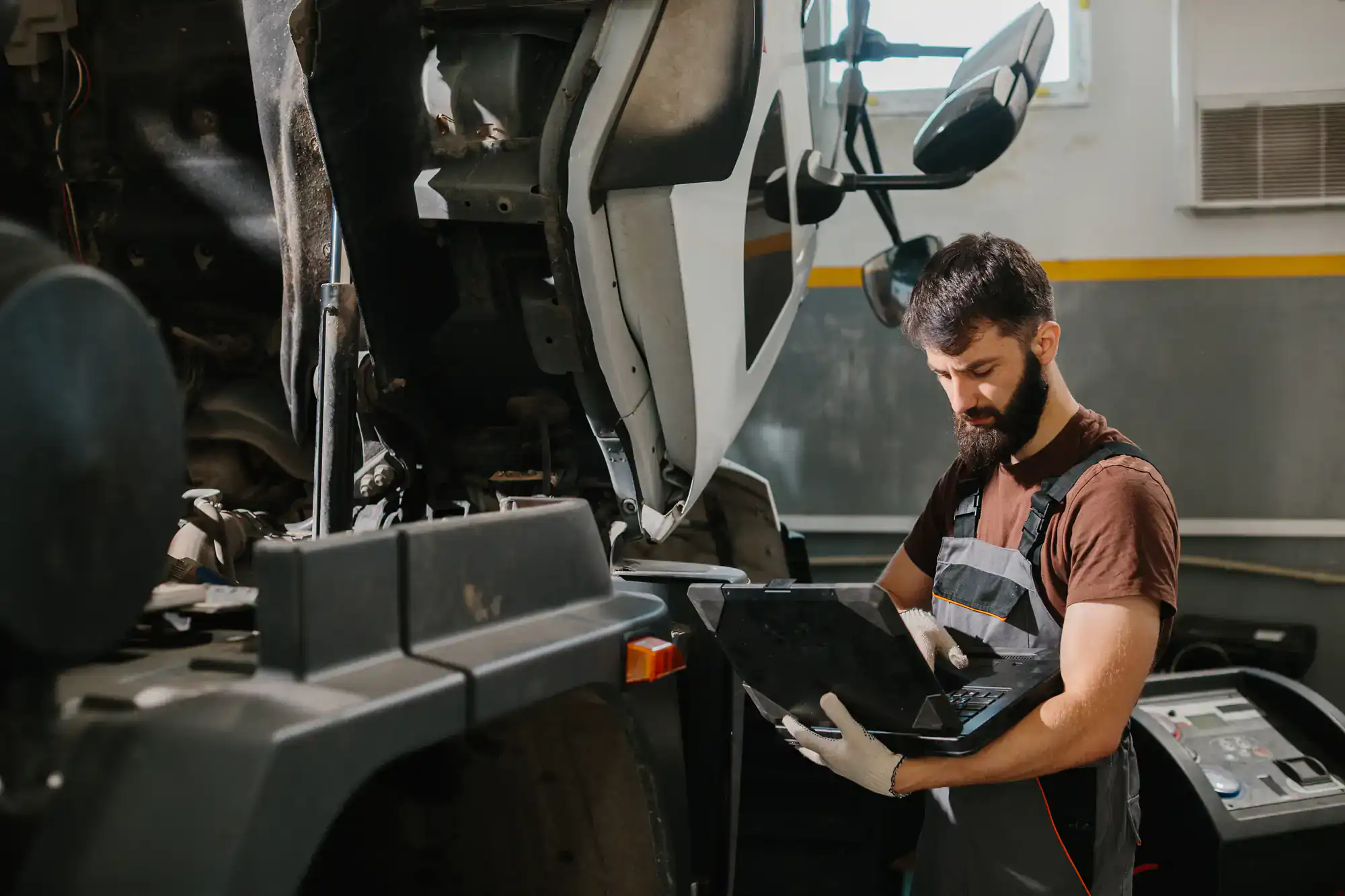
When we arrive, we connect a CARB-certified OBD device to your truck’s diagnostic port and pull the emissions data directly from the engine control unit. This is not a visual inspection it’s a data download. The process typically takes a short amount of time per vehicle, and your truck doesn’t need to be taken off-site or warmed up in a special way. For fleets with multiple trucks staged at the same location, we can work through them in sequence without requiring you to shuffle your yard.
Once the test is complete, we submit the results directly to CARB’s CTC-VIS portal. You don’t log in, upload anything, or follow up. Within 3 to 5 business days, CARB transmits the compliant VIN data to the DMV, and your registration hold if there was one clears. You can confirm your compliance status in your own CTC-VIS account anytime. The whole process is designed so that by the time we drive away, your part is already done.

Ready to get started?
California’s Clean Truck Check program officially the Heavy-Duty Inspection and Maintenance program applies to OBD-equipped trucks that are model year 2013 or newer and have a GVWR over 14,000 pounds. If your truck doesn’t meet both of those criteria, this program doesn’t apply to it. If it does, testing is currently required twice per year. Starting October 1, 2027, that frequency increases to four times per year for OBD-equipped vehicles. For a fleet running 10 trucks in Paramount, that’s 40 tests annually which is exactly why having an established mobile testing relationship before that deadline matters.
The annual compliance fee is $31.18 per vehicle, paid directly to CARB through the CTC-VIS portal. That’s separate from the cost of the OBD test itself. Fines for non-compliance can reach up to $10,000 per vehicle per day, and CARB transmits non-compliant VINs to the DMV nightly meaning a registration hold can appear faster than most people expect.
For Paramount operators running port drayage on the I-710, moving freight through the SR-91 corridor, or staging trucks in the industrial zones near Downey Avenue, our mobile testing model means no wasted drive time, no fixed-location wait, and no truck pulled from its route mid-day. Testing happens at your yard, on your schedule, with results submitted to CARB before the truck makes its next run.
If your truck is model year 2013 or newer and has a GVWR over 14,000 pounds, yes it falls under California’s Clean Truck Check program regardless of where it’s based. Paramount’s ZIP code is 90723, and the city is fully within Los Angeles County, which is covered by CARB’s HD I/M enforcement. Being based in Paramount doesn’t give you any exemption, and operating in the AB 617 Southeast Los Angeles community boundary actually puts you in one of the more actively monitored areas of the state.
If your truck is older than 2013 or under 14,000 pounds GVWR, the Clean Truck Check OBD program does not apply there are separate opacity-based testing requirements for older heavy-duty vehicles, but that’s a different program entirely. We only perform OBD testing for 2013-and-newer trucks over 14,000 pounds GVWR, so if you’re unsure whether your specific vehicle qualifies, the fastest way to find out is to call and give us the year and GVWR.
Right now, OBD-equipped trucks that fall under the program are required to test twice per year semi-annually. The first compliance testing phase began October 1, 2024, with the first hard deadline landing January 1, 2025. If you’ve been running your truck through Paramount and the I-710 corridor without a current test on record, you may already be out of compliance.
Starting October 1, 2027, the frequency increases to quarterly four tests per year. For a single owner-operator, that’s manageable. For a fleet with multiple trucks, it requires a testing schedule built into your operations well in advance. The 90-day early testing window CARB allows means you don’t have to wait until the last week before a deadline you can test ahead of time and stay ahead of the compliance calendar without scrambling.
CARB deploys roadside emissions monitoring devices along high-traffic freight corridors, and the I-710 which runs along Paramount’s western edge and handles a significant share of port-related drayage traffic is one of the most actively monitored routes in the state. If your truck registers elevated emissions at one of those monitors and you don’t have a current Clean Truck Check on record, CARB can issue a Notice to Submit to Testing.
Once you receive that notice, you have 30 days to get the test done and submitted to CTC-VIS. If you miss that window, you’re looking at potential fines that can reach up to $10,000 per vehicle per day, and your VIN gets flagged in the DMV system, which blocks registration renewal. The faster you act after receiving a notice, the better. Our mobile model means we can schedule quickly and come directly to your Paramount location no driving the truck to a fixed shop, no waiting for an open appointment slot.
Yes. If you have multiple qualifying trucks staged at the same location whether that’s an industrial yard in Paramount, a distribution center near the SR-91 corridor, or a lot off Downey Avenue we can work through them in sequence during a single visit. You don’t need to move trucks to different locations or schedule separate appointments for each vehicle.
For fleet operators, this is one of the most practical advantages of our mobile testing model. Rather than coordinating individual trucks to drive to a fixed testing location on different days, you stage the fleet, we come to you, and we work through the vehicles one by one. Results for each truck get submitted to CTC-VIS individually as we go, so every VIN is updated in CARB’s system before we leave your property. If you’re managing a fleet with staggered compliance deadlines, we can also help you build a testing schedule that keeps every truck current without creating a compliance crunch at any single point in the year.
CARB maintains a publicly accessible list of credentialed testers called the Available for Hire Credentialed Testers list, which you can find directly on arb.ca.gov. Before you book with any provider including us you can look up their name on that list and confirm their credential status. If a tester isn’t on that list, their results won’t be accepted by CARB, and you’ll still be considered non-compliant even if you paid for the test.
This matters because the Clean Truck Check market is still relatively new, and not every company advertising these services has gone through CARB’s credentialing process. An invalid test from an uncredentialed tester doesn’t just waste your money it leaves your VIN non-compliant in the system while you think you’re covered. We’re on CARB’s credentialed tester list, and our OBD test equipment carries CARB Executive Order approval the specific device certification CARB requires for results to count. Both are verifiable before you schedule anything.
There are two separate costs involved. The first is CARB’s annual compliance fee, which is $31.18 per vehicle and is paid directly to CARB through the CTC-VIS portal when you register your truck in the system. That fee is indexed to CPI and may adjust slightly over time, but it’s set by CARB not by the tester. The second cost is the OBD test itself, which is what you pay the credentialed testing provider.
In the Los Angeles area, testing rates from credentialed mobile providers generally run in the $95 to $150 range per vehicle. For Paramount’s working-class owner-operators and small fleet managers many of whom are running tight margins on drayage routes and freight hauls that per-test cost adds up, especially as testing frequency increases to four times per year in 2027. If you’re managing multiple trucks, it’s worth asking about fleet pricing upfront. The cost of staying compliant is real, but it’s a fraction of what a single DMV registration hold or a CARB fine can cost you in lost revenue and penalties.
Useful Links
Other Services we provide in Paramount