

Check Out Our Reviews!

A DMV registration hold doesn’t send you a warning. It just shows up at renewal and suddenly a truck that was running loads on I-15 yesterday is sitting idle today. That’s the reality for a lot of Murrieta owner-operators who didn’t realize the $31.18 annual CARB compliance fee and the actual emissions test are two completely separate requirements. Paying the fee doesn’t mean you’re done. The test is still required.
When you get that test done and submitted correctly, your VIN goes into CARB’s CTC-VIS database, CARB pushes compliant records to DMV nightly, and your registration hold clears within three to five business days. No paperwork on your end. No portal to navigate. No follow-up calls to figure out if it went through.
For Murrieta fleet operators running trucks out of the business parks along Winchester Road or staging rigs near the I-215 interchange, downtime isn’t an inconvenience it’s a direct hit to revenue. Getting ahead of your compliance calendar, especially with quarterly testing coming in 2027, means fewer surprises and more control over your operation.
All we do is one thing: Clean Truck Check OBD testing for heavy-duty vehicles that are model year 2013 or newer with a GVWR over 14,000 pounds. That’s it. No passenger cars, no light trucks, no opacity tests for older diesels. Just the specific service that Murrieta’s trucking community actually needs performed by a CARB-credentialed tester using state-certified equipment.
Every shop in Murrieta that advertises smog testing Jefferson Smog, Murrieta Smog Star, Smog Check Murrieta is set up for passenger cars. None of them are equipped or credentialed for Clean Truck Check. That gap is real, and it’s left a lot of local owner-operators and fleet managers without a reliable local option.
We serve Riverside County, which means Murrieta is squarely in our service area. We come to you, we run the OBD test, and we submit the results directly to CARB’s system. You don’t have to touch anything after we leave.

You schedule a time, and we come to your location in Murrieta whether that’s a commercial yard off the I-15 corridor, a loading dock in one of the city’s business parks, or a private property in Alta Murrieta or French Valley. You don’t move the truck. We work around your operation, not the other way around.
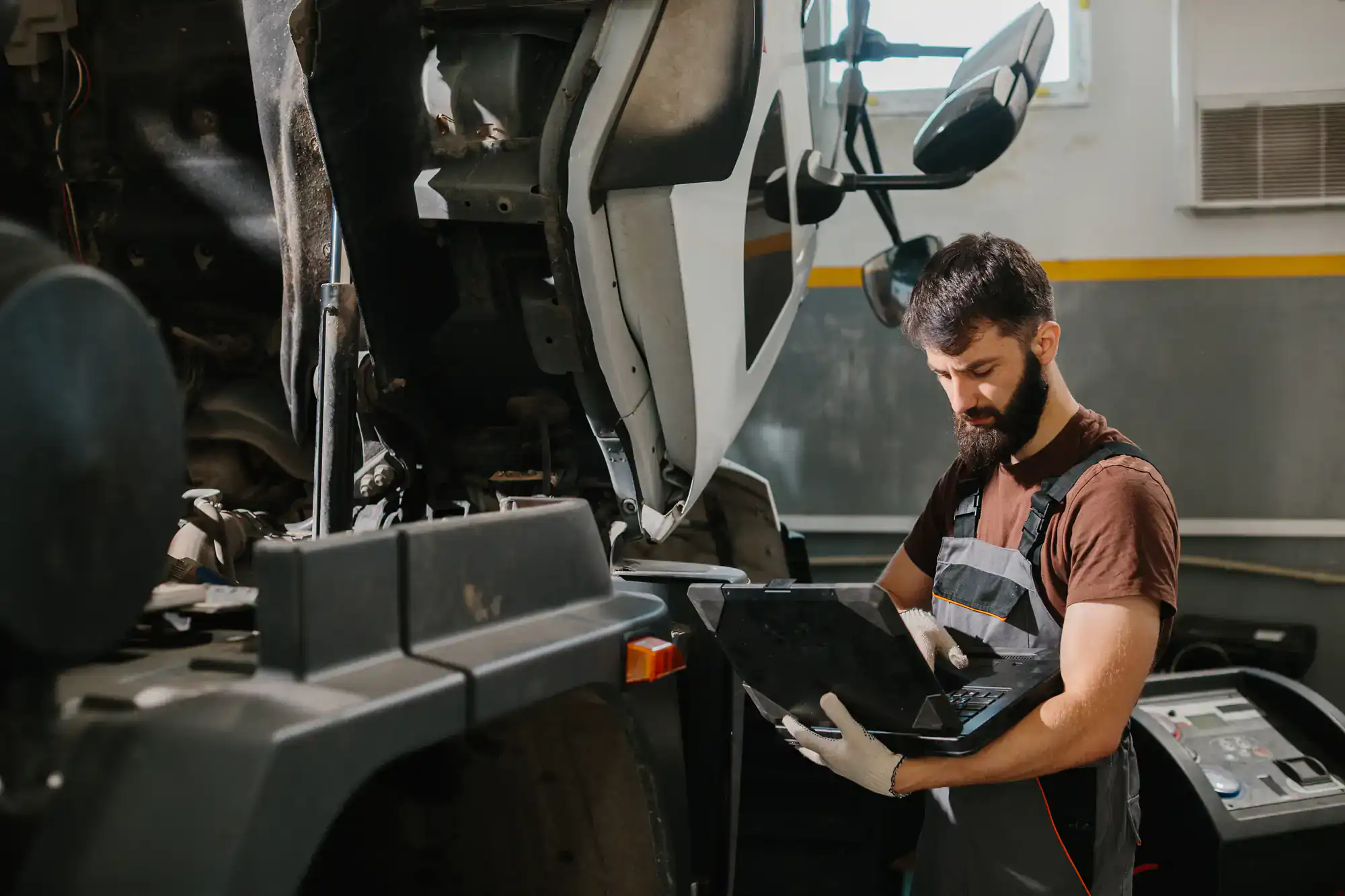
When we arrive, we connect our CARB-certified OBD test device directly to your truck’s ECU. For 2013-and-newer heavy-duty vehicles, the Clean Truck Check program reads emissions data straight from the onboard diagnostic system no tailpipe probe, no opacity meter. The connection takes a few minutes, and the data pull is fast. If your truck’s system is ready and the emissions data is within range, the test passes on the spot.
From there, we submit your results electronically to CARB’s CTC-VIS database before we leave your yard. You don’t log into anything, upload anything, or follow up with anyone. CARB transmits compliant VIN records to DMV nightly, so if you had a registration hold, it typically clears within three to five business days. If your compliance deadline is still weeks out, you can actually test up to 90 days early which is worth knowing if you want to schedule around your busiest freight periods on I-15 or I-215 rather than scrambling at the last minute.

Ready to get started?
The Clean Truck Check applies to diesel and alternative-fuel heavy-duty vehicles that are model year 2013 or newer with a GVWR over 14,000 pounds and operate on California public roads. That includes trucks registered out of state if you’re running loads through Murrieta on I-15 and your truck meets those specs, you’re subject to the same CARB requirements as any California-registered vehicle.
Every test we perform includes the OBD data download from your truck’s ECU using CARB Executive Order-approved equipment, real-time review of your truck’s emissions readiness status, and direct electronic submission to CARB’s CTC-VIS system. There’s no separate paperwork step for you, and no ambiguity about whether the result was recorded. It either went in, or we tell you why it didn’t and what to do next.
Right now, most OBD-equipped trucks in Murrieta and across Riverside County are on a semi-annual testing schedule twice per year. Starting October 1, 2027, that shifts to quarterly. Four tests per year, per truck. For a Murrieta fleet operator managing ten trucks, that’s forty testing events annually. The time to establish a reliable testing relationship isn’t when that deadline hits it’s now, while scheduling is flexible and the compliance calendar is still manageable.
If your truck is model year 2013 or newer and has a GVWR over 14,000 pounds, yes the Clean Truck Check requirement applies regardless of where in California you’re based. Murrieta falls within Riverside County, which is under CARB’s jurisdiction, and every qualifying heavy-duty vehicle operating on California public roads is subject to the program. That includes trucks running the I-15 and I-215 corridors daily out of Murrieta’s business parks and residential areas.
The program went into full periodic testing enforcement on October 1, 2024, so this isn’t something coming down the road it’s already active. If your truck hasn’t been tested yet and you’re past your compliance window, you may already have a DMV registration hold building or a Notice to Submit to Testing from CARB on the way. The sooner you get the test done and submitted, the sooner your compliance record is clean.
This is one of the most common misunderstandings in the program, and it catches a lot of Murrieta owner-operators off guard. The $31.18 annual compliance fee and the emissions test are two completely separate requirements. Paying the fee registers your vehicle in CARB’s system, but it does not substitute for the OBD test. Both are required. If you’ve paid the fee but haven’t completed a passing emissions test, your truck is not fully compliant and CARB’s records will reflect that when DMV processes your registration renewal.
The way to confirm you’re actually covered is to check your vehicle’s status in CARB’s CTC-VIS system and verify that a passing test result is on file. If there isn’t one, that’s the gap that needs to be closed. We handle the test and the CTC-VIS submission in one visit so once we’re done at your location, the record is updated and you’re not left guessing.
A failed test typically means your truck’s OBD system flagged an active fault code or one of the emissions readiness monitors wasn’t set which usually points to an issue with the exhaust aftertreatment system, most commonly the diesel particulate filter or the SCR system on 2013-and-newer trucks. In Murrieta’s climate, trucks running frequent short-haul routes on surface streets like Winchester Road or Jefferson Avenue where highway speeds aren’t sustained long enough for passive DPF regeneration can accumulate filter issues that affect OBD readiness over time.
If your truck doesn’t pass, you’ll need to address the underlying mechanical issue before retesting. We don’t perform repairs, but we can tell you exactly what the OBD system flagged so you can take that information to a diesel mechanic. Once the issue is resolved and the readiness monitors reset, we can come back to your Murrieta location and run the retest. CARB does allow a retest after repairs the key is getting the fault cleared properly, not just resetting the code without fixing the root cause.
CARB allows you to submit a passing Clean Truck Check test up to 90 days before your compliance deadline. That window exists for a reason it gives fleet managers and owner-operators the flexibility to test during slower periods rather than scrambling when a deadline is imminent. For Murrieta operators running consistent loads on I-15 toward the Inland Empire or south toward San Diego, that 90-day window is worth using strategically.
If you manage multiple trucks with staggered compliance dates, testing early also lets you batch appointments around your operation’s schedule instead of dealing with multiple last-minute calls. With quarterly testing starting October 1, 2027, that kind of proactive scheduling becomes even more important four testing cycles per year means compliance is a recurring operational item, not a one-time checkbox. Getting into a rhythm now, while the schedule is semi-annual, makes the transition to quarterly much smoother.
Yes that’s the entire model. We’re fully mobile, and Murrieta is within our Riverside County service area. Whether your trucks are staged at a commercial yard near the I-15 interchange, parked at a business park off Winchester Road, or sitting at a residential property in a neighborhood like Alta Murrieta or French Valley, we come to the truck. You don’t reposition vehicles, you don’t pull rigs off their routes, and you don’t deal with a shop waiting room.
For fleet operators with multiple trucks at a single location, we can test several vehicles in one visit which is far more efficient than scheduling individual appointments or sending trucks to a facility that may not even be equipped for heavy-duty OBD testing. Murrieta’s growing industrial and logistics sector means more fleets are operating locally every year, and mobile testing is the only model that actually fits how those operations run.
Yes. CARB’s Clean Truck Check program applies to any qualifying heavy-duty vehicle that operates on California public roads and that includes trucks registered in Arizona, Nevada, Texas, or any other state. If your truck is model year 2013 or newer with a GVWR over 14,000 pounds and you’re running loads through Murrieta on I-15 or I-215, you’re subject to the same testing requirements as a California-registered vehicle. Registration state doesn’t create an exemption.
For out-of-state operators who run California routes regularly, establishing a testing relationship with a Riverside County provider makes practical sense. You’re already passing through Southwest Riverside County having a credentialed tester who can come to your location in Murrieta, run the OBD test, and submit directly to CARB’s CTC-VIS system means you’re not scrambling to find a compliant provider every time a deadline approaches. CARB enforces this program at the vehicle level, not the registration level, so compliance is the operator’s responsibility regardless of where the truck is plated.
Useful Links
Other Services we provide in Murrieta