
Check Out Our Reviews!

Most truck operators in La Crescenta-Montrose aren’t ignoring the Clean Truck Check requirement they just can’t figure out how to fit it into a working day. Your truck is loaded, you’ve got a job site on Foothill Boulevard or a crew staged near the Angeles National Forest boundary, and the only fixed-location testing option nearby requires you to drive to Verdugo Road, wait, and drive back. That’s easily two hours of lost productivity for a test that takes a fraction of that time.
We change that math completely. We come to wherever your truck is parked your yard, your job site, your staging area anywhere in La Crescenta-Montrose or the surrounding foothill communities. You don’t reposition the truck. You don’t lose billing hours. The test gets done, the results go straight into CARB’s CTC-VIS database, and your compliance status updates without you touching a portal or filling out a form.
For owner-operators running construction, landscaping, or utility work in this area, that’s not a minor convenience it’s the difference between staying on schedule and falling behind. And with CARB’s periodic testing requirement now in full enforcement, the cost of waiting is a lot higher than the cost of a test.
We test one type of vehicle: heavy-duty trucks that are model year 2013 or newer with a GVWR over 14,000 pounds. That’s it. No passenger cars, no RVs, no general smog checks going back to 1976. Just the trucks that fall under California’s Clean Truck Check mandate tested by a credentialed specialist using CARB-certified OBD equipment that carries a valid Executive Order number.
That focus matters more than it might sound. CARB requires that testing be performed by a credentialed tester with approved equipment. A test from an uncredentialed provider regardless of how professional they appear doesn’t count. Your truck is still non-compliant. The DMV hold is still active. We’re listed on CARB’s publicly searchable “Available for Hire Credentialed Testers” database, which means you can verify our credentials before you ever pick up the phone.
We serve Los Angeles County, including unincorporated communities like La Crescenta-Montrose where LA County rules govern not a city code. If your trucks work the I-210 corridor and the foothill communities around the Crescenta Valley, we know your territory.

It starts with a call or a booking. You tell us where your truck is a job site in La Crescenta, a yard near the Glendale corridor, a staging area anywhere along the I-210 and we schedule a time that works around your operation, not the other way around. We come to the vehicle. You don’t move it.
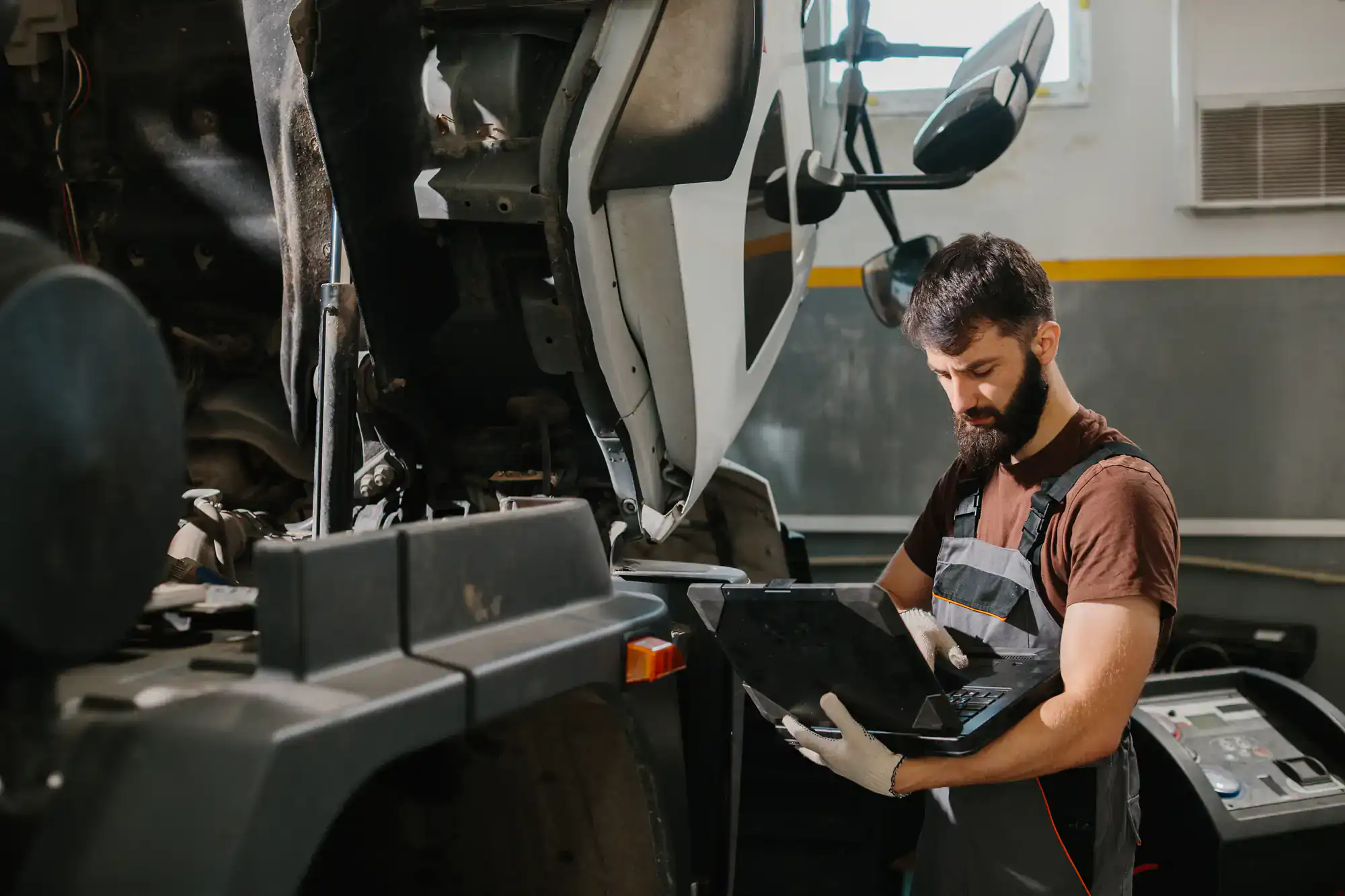
When we arrive, we connect a CARB-certified OBD device directly to your truck’s onboard diagnostics port. The device reads your truck’s emissions data in real time and generates the test result. For model year 2013 and newer heavy-duty trucks with a GVWR over 14,000 pounds, this is the test CARB requires under the Clean Truck Check program. It’s not a visual inspection or a tailpipe sniff test it’s a direct read from the truck’s own computer, which is why the equipment has to carry a specific CARB Executive Order number to be valid.
Once the test is complete, we submit your results directly to CARB’s CTC-VIS system on your behalf. You don’t log into a portal. You don’t mail anything. CARB transmits your compliant VIN data to the DMV nightly, and your registration records typically reflect the update within three to five business days. The whole process is straightforward and if you’ve got multiple trucks at the same location, we can work through the fleet in a single visit.

Ready to get started?
The Clean Truck Check applies specifically to diesel and alternative-fuel heavy-duty vehicles that are model year 2013 or newer and carry a GVWR over 14,000 pounds. If your truck is older than 2013 or lighter than that threshold, this particular program doesn’t apply to you. That distinction matters because a lot of operators in the Crescenta Valley have mixed fleets some trucks fall under the mandate, some don’t and knowing exactly which vehicles need testing saves you time and money.
For the trucks that do qualify, here’s what the current compliance picture looks like. The annual CARB compliance fee is $31.18 per vehicle, but paying that fee alone does not make you compliant. The emissions test is a separate requirement. Many La Crescenta-Montrose operators have paid the fee on time and still ended up with a DMV registration hold because the OBD test was never submitted to CTC-VIS. Both are required, and only the test result submitted by a credentialed tester satisfies the emissions side of the equation.
Right now, most OBD-equipped trucks require testing twice per year. Starting October 1, 2027, that increases to four times per year. If you’re managing even two or three trucks out of the foothill communities, that’s a meaningful increase in testing frequency. Getting a mobile testing relationship established now before the schedule doubles puts you ahead of it rather than scrambling to catch up.
It depends on two things: the model year and the weight. The Clean Truck Check program applies to heavy-duty vehicles that are model year 2013 or newer and have a GVWR over 14,000 pounds. If your truck meets both of those criteria, you’re covered under CARB’s periodic OBD testing requirement regardless of whether you’re operating in an incorporated city or an unincorporated community like La Crescenta-Montrose, which is governed by Los Angeles County rather than a municipal code.
If your truck is older than 2013 or falls under the 14,000-pound GVWR threshold, the Clean Truck Check mandate doesn’t apply to that specific vehicle. That said, if you’re running a mixed fleet which is common for contractors and landscaping operators working the Crescenta Valley it’s worth going through each vehicle individually to confirm which ones require testing. We can help you sort that out quickly before scheduling a visit.
A failed test means your truck’s onboard diagnostics flagged an emissions-related fault typically a stored trouble code that indicates something in the emissions control system isn’t functioning correctly. The most common causes are issues with the DPF (diesel particulate filter), the SCR system, or the EGR system. These are repairable issues, not automatic disqualifiers from the program.
After a failed test, the result is still submitted to CTC-VIS, which documents that a test occurred. You’ll need to have the underlying issue diagnosed and repaired by a qualified diesel mechanic, then schedule a retest. The retest follows the same process a credentialed tester with CARB-certified OBD equipment connects to the truck and reads the system again. Once the truck passes, that result gets submitted and your compliance status updates. If you’re working against a 30-day Notice to Submit to Testing deadline, getting the repair done quickly matters the clock doesn’t stop while the truck is in the shop.
This is one of the most common points of confusion in the Clean Truck Check program, and it catches operators off guard regularly. The $31.18 annual compliance fee and the OBD emissions test are two completely separate requirements. Paying the fee keeps your account current with CARB’s billing system, but it does not satisfy the emissions testing obligation. Until a passing OBD test result is submitted to CTC-VIS by a credentialed tester, your truck is not emissions-compliant and the DMV will reflect that with a registration hold at renewal time.
The fix is straightforward: get the OBD test done by a credentialed provider, have the results submitted to CTC-VIS, and then wait for the DMV’s records to update. CARB transmits compliant VIN data to the DMV nightly, but the DMV’s own records typically take three to five business days to fully reflect the change. If your registration renewal is coming up soon, don’t wait the processing window is real, and cutting it close creates unnecessary stress.
A Notice to Submit to Testing (NST) means CARB’s enforcement division has flagged your truck as a potential high emitter and is requiring you to submit a passing OBD test result within 30 calendar days of the notice date. That window is firm. If you don’t submit a passing result within those 30 days, you’re exposed to enforcement action and the fines for non-compliance can reach up to $10,000 per vehicle per day.
The first thing to do is not panic 30 days is enough time to get this resolved if you move quickly. Call a CARB-credentialed tester, confirm your truck meets the 2013-or-newer, over-14,000-pound GVWR criteria, and schedule the test as soon as possible. Our mobile model means we can come to your truck’s location in La Crescenta-Montrose or anywhere along the I-210 corridor without you needing to reposition the vehicle. If the truck passes, we submit the result immediately. If it doesn’t, you’ll know exactly what needs to be repaired before the retest.
Currently, most OBD-equipped heavy-duty trucks that fall under the Clean Truck Check program are required to test twice per year semi-annually. The exact schedule depends on your vehicle’s specific registration and compliance cycle within CARB’s CTC-VIS system, so it’s worth logging in or calling CARB to confirm your specific testing windows if you’re unsure.
What’s important to plan for is the upcoming change: starting October 1, 2027, the testing frequency for OBD-equipped vehicles increases from semi-annual to quarterly four tests per year. For operators running two, three, or more qualifying trucks out of the foothill communities, that’s a significant increase in the number of tests you’ll need to schedule annually. Establishing a mobile testing arrangement now, before the frequency doubles, means you’re not scrambling to find a credentialed provider when the new schedule kicks in.
Yes and this is something that catches out-of-state operators off guard more often than you’d expect. California’s Clean Truck Check requirement applies to any qualifying heavy-duty vehicle operating on California roads, regardless of where the truck is registered. If your truck is model year 2013 or newer, has a GVWR over 14,000 pounds, and is operating in California including routes through La Crescenta-Montrose and the I-210 corridor you are subject to the program’s testing requirements.
The process for an out-of-state truck is the same as for a California-registered vehicle. A CARB-credentialed tester connects a CARB-certified OBD device to the truck, runs the test, and submits the result to CTC-VIS. The difference is that the compliance record lives in CARB’s system rather than being tied to a California DMV registration. If you’re running a truck registered in another state but doing regular work in the Crescenta Valley or the broader Los Angeles area, it’s worth getting the test on the books to avoid enforcement exposure on California roads.
Useful Links
Other Services we provide in La Crescenta-Montrose