
Check Out Our Reviews!

A DMV registration hold doesn’t send a warning. One day your truck is running loads through Vernon or down the I-710, and the next it’s flagged at renewal with no path forward until you’ve got a passing test on file. That’s exactly how non-compliance plays out for owner-operators in Huntington Park, and it happens faster than most people expect.
Huntington Park sits in one of the most scrutinized freight corridors in California. CARB has formally designated this part of Southeast Los Angeles as a disadvantaged community with elevated cumulative pollution exposure. That means enforcement attention here isn’t theoretical trucks running loads from the food processing plants in Vernon, through Huntington Park, and down toward the Port of Long Beach on the I-710 are operating in CARB’s most-watched zone. Staying current on your Clean Truck Check isn’t just about avoiding fines. It’s about keeping your livelihood moving.
The good news is that getting compliant doesn’t have to mean pulling your truck out of rotation. We come to your location your yard, your lot, your loading dock in Huntington Park so the test gets done without costing you a run. Once the test is complete, results go straight into CARB’s CTC-VIS database. No portal. No paperwork left on your end. Your VIN shows compliant, and you move on.
We don’t test passenger cars, light-duty vehicles, or older pre-OBD trucks. The only thing on our menu is Clean Truck Check testing for 2013 and newer heavy-duty vehicles with a GVWR over 14,000 pounds. That’s it. When your entire operation is built around one service, you get very good at it and the truck owners running routes through Huntington Park, Walnut Park, and the industrial yards of Vernon and Commerce deserve a tester who actually knows this program cold.
Our CARB credentials are publicly verifiable at arb.ca.gov. We’re on that list. The equipment we use is CARB-certified not just a commercial scanner, but a device that holds an actual CARB Executive Order, which is the only kind that produces a valid compliance test. Results are submitted electronically, directly to the CTC-VIS system. You don’t have to touch a portal or follow up with anyone to confirm your status.

It starts with a booking. You give us a location a yard off Pacific Boulevard, a lot near the I-710, a loading area in Vernon, wherever your truck is sitting and we come to you. No drop-off. No driving to a facility. No waiting room. Your truck stays where it is, and our tester comes equipped with CARB-certified OBD equipment ready to connect directly to your vehicle’s ECU.
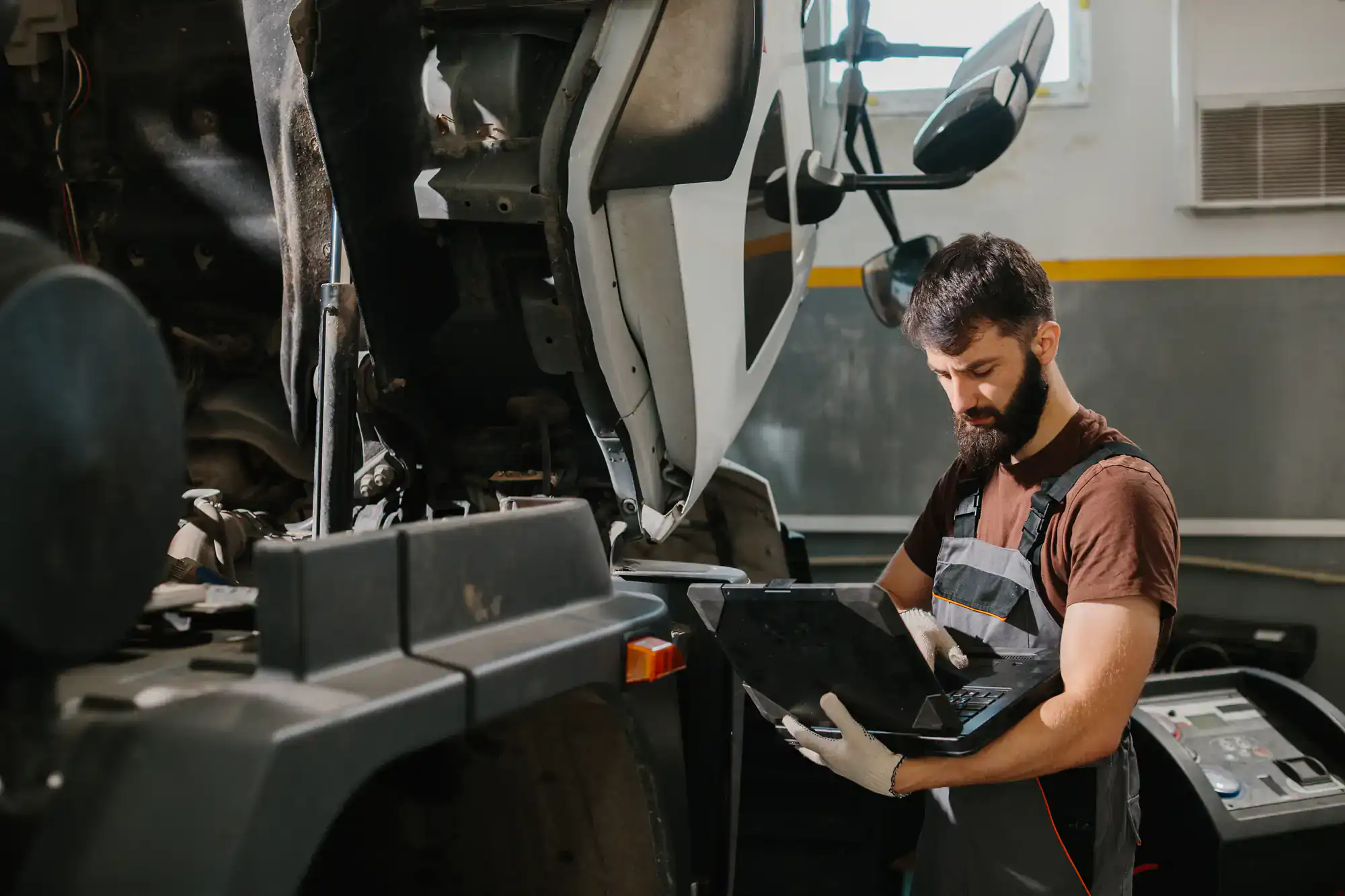
On-site, we download the OBD data from your truck’s onboard system. This is the actual emissions data CARB requires not a visual inspection, not an opacity test, but a direct electronic read from the vehicle’s own diagnostic system. The whole process is straightforward and doesn’t take long. Once the data is captured, we submit it electronically to CARB’s CTC-VIS database on the spot. There’s no manual upload step left for you to figure out.
After submission, your VIN is logged as compliant in CARB’s system. CARB transmits updated compliant VIN lists to DMV nightly, so your registration status reflects the passing test within a few business days. If you received a Notice to Submit to Testing, that 30-day clock stops when the passing result hits the database not when you call someone, not when you schedule. When the test is submitted and passed, you’re covered.

Ready to get started?
Clean Truck Check applies specifically to diesel and alternative-fuel heavy-duty vehicles that are model year 2013 or newer with a GVWR over 14,000 pounds. If your truck doesn’t meet both of those criteria, this program doesn’t apply to you. If it does, testing is currently required twice per year and starting October 1, 2027, that increases to four times per year for OBD-equipped vehicles. For fleet operators running multiple trucks on the I-710 corridor or through the Vernon and Commerce industrial belt, that frequency increase is worth planning for now.
The annual CARB compliance fee currently $31.18 per vehicle is a separate registration requirement. Paying it does not mean your truck has been tested. A lot of owner-operators in Huntington Park have paid that fee and assumed they were done, only to find out at DMV renewal that a passing OBD test was never on file. Both the fee and the test are required. One doesn’t cover the other.
We handle the full test-to-submission process. You don’t need to create a CTC-VIS account, navigate the portal, or follow up with CARB to confirm your results. The test is performed with CARB-certified equipment, submitted electronically, and your compliance status is updated in the system. If you’re managing a fleet across Huntington Park, Walnut Park, or the surrounding Southeast LA area, we can work through multiple vehicles at your location to keep the process efficient.
If your truck is a diesel or alternative-fuel heavy-duty vehicle that is model year 2013 or newer and has a GVWR over 14,000 pounds, then yes Clean Truck Check is a mandatory CARB requirement, and it applies everywhere in California, including Huntington Park. There’s no local exemption, and being based in a smaller city doesn’t reduce your compliance obligation.
What does matter about being in Huntington Park specifically is that this area sits within one of CARB’s most actively enforced freight corridors. The I-710, the Alameda Corridor, and the industrial zones in adjacent Vernon and Commerce put heavy-duty diesel trucks in CARB’s direct line of sight. Non-compliant vehicles operating in this corridor face a real and elevated risk of enforcement contact roadside inspections, NST notices, and DMV registration holds are not rare outcomes here. If your truck meets the model year and GVWR thresholds, get the test done.
A Notice to Submit to Testing is a 30-calendar-day deadline, not a suggestion. If you don’t submit a passing Clean Truck Check test within that window, CARB can escalate to enforcement action which includes fines of up to $10,000 per vehicle per day and a DMV registration hold that prevents you from renewing until the test is on file. For an owner-operator whose truck is their income, that’s not a recoverable situation to let slide.
The clock on an NST runs from the date on the notice, not from when you open it or when you decide to act. If you received one and you’re already a few days in, the time to book is now not next week. We can come to your location in Huntington Park and submit the results directly to CTC-VIS the same day. Once a passing test is in the system, the NST is resolved on CARB’s end.
No, and this is one of the most common misconceptions among truck owners in Huntington Park. The annual compliance fee currently $31.18 per vehicle is a registration requirement that’s separate from the OBD emissions test. Both are mandatory. Paying the fee does not generate a test result, and CARB’s system tracks them independently. If your truck has a paid fee but no passing test on file, you are not compliant.
This confusion has caught a lot of owner-operators off guard, particularly in working-class markets where the fee payment feels like the finish line. It isn’t. CARB transmits compliant VIN data to DMV nightly based on test results, not fee payments. If your VIN doesn’t show a passing test in the CTC-VIS system, DMV can flag your registration at renewal even if the fee was paid on time. The test is a separate step, and it has to be done by a CARB-credentialed tester using CARB-certified equipment.
Right now, OBD-equipped heavy-duty vehicles model year 2013 or newer are required to be tested twice per year semi-annually. That’s the current enforcement standard as of 2025. Starting October 1, 2027, the frequency increases to four times per year for OBD-equipped vehicles, which means quarterly testing becomes the new baseline.
For fleet operators running multiple trucks out of Huntington Park or through the Vernon and Commerce industrial corridor, that 2027 change is worth getting ahead of. Managing four annual tests per vehicle across a fleet of five, ten, or fifteen trucks adds up fast in terms of scheduling and logistics. Establishing a working relationship with a credentialed mobile tester now one who can come to your yard and process multiple vehicles at once makes that transition significantly less disruptive. Testing can also be submitted up to 90 days before a compliance deadline, so proactive scheduling is always an option.
This is exactly the right question to ask, and the answer is straightforward: CARB publishes a public list of credentialed testers on their website at arb.ca.gov. Before you pay anyone for a Clean Truck Check test, look them up. If they’re not on that list, the test they perform will not count and you’ll be just as non-compliant as if no test was done at all, except you’ll also be out the money.
Equipment certification matters just as much. Only OBD test devices that hold a CARB Executive Order are valid for Clean Truck Check compliance testing. A professional-grade commercial scanner that isn’t CARB-certified produces a result that CARB will not accept. We’re on CARB’s credentialed tester list and use CARB-certified equipment both are verifiable before you book. In a market like Huntington Park, where unlicensed service providers are a known risk, verifying credentials before handing over money is a reasonable and easy step.
Yes. If you’re managing a fleet whether it’s parked at a yard near Pacific Boulevard, staged at a facility in Walnut Park, or sitting at a lot near the Vernon border we can work through multiple vehicles at your location in a single visit. Our mobile setup is built for exactly this kind of fleet scenario, and processing several trucks at once is far more efficient than scheduling separate visits or pulling vehicles out of rotation one at a time.
For small fleet managers in the Southeast LA area who are running trucks on the I-710 corridor or servicing food processing and distribution operations in Vernon and Commerce, batching the tests at your location keeps downtime minimal and keeps your schedule intact. With quarterly testing coming in 2027, having a tester who can handle volume at your site rather than requiring each truck to travel somewhere becomes even more valuable. Reach out to discuss your fleet size and location, and we’ll work out a testing schedule that fits your operation.
Useful Links
Other Services we provide in Huntington Park