
Hear from Our Customers

Your truck needs to pass Clean Truck Check testing to stay registered with the DMV. Miss your deadline or fail your test, and you’re looking at registration holds that shut down your ability to operate legally in California. That means no port access, no railyard entry, and penalties that can hit $1,000 per day per vehicle.
You don’t have time for that. You need testing done by someone who knows the CARB HD I/M requirements, uses certified OBD testing equipment, and gets your results submitted correctly the first time.
We handle Clean Truck Check testing for 2013 and newer diesel trucks with a GVWR over 14,000 pounds. That’s semi trucks, heavy-duty buses, and commercial vehicles that fall under California’s emissions compliance program. If your truck has an OBD system and meets those specs, we test it.
You can submit passing results up to 90 days before your compliance deadline. That gives you flexibility to plan around your schedule instead of scrambling at the last minute. And if you get a Notice to Submit to Testing from CARB, you’ve got 30 days to get it done—we make sure you don’t miss that window.
We serve the Highgrove community with CARB credentialed emissions testing. We’re not a mobile outfit bouncing between counties. We’re here, and we know what truck operators in the Inland Empire deal with every day.
Highgrove sits right off the 215 corridor between Riverside and Grand Terrace. It’s a working community where nearly 80% of people drive to work, and a lot of those drivers are running commercial vehicles. You need local access to compliance testing that doesn’t eat up half your day.
We completed CARB’s Tester Training Course, passed the certification exam, and maintain current credentials. That means we’re authorized to perform official Clean Truck Check inspections using CARB certified testing devices. When we submit your results, they go straight into the system—no delays, no questions.

You bring your 2013 or newer diesel truck to us. We verify your vehicle information, confirm it’s OBD-equipped, and check that it meets the GVWR threshold of over 14,000 pounds.
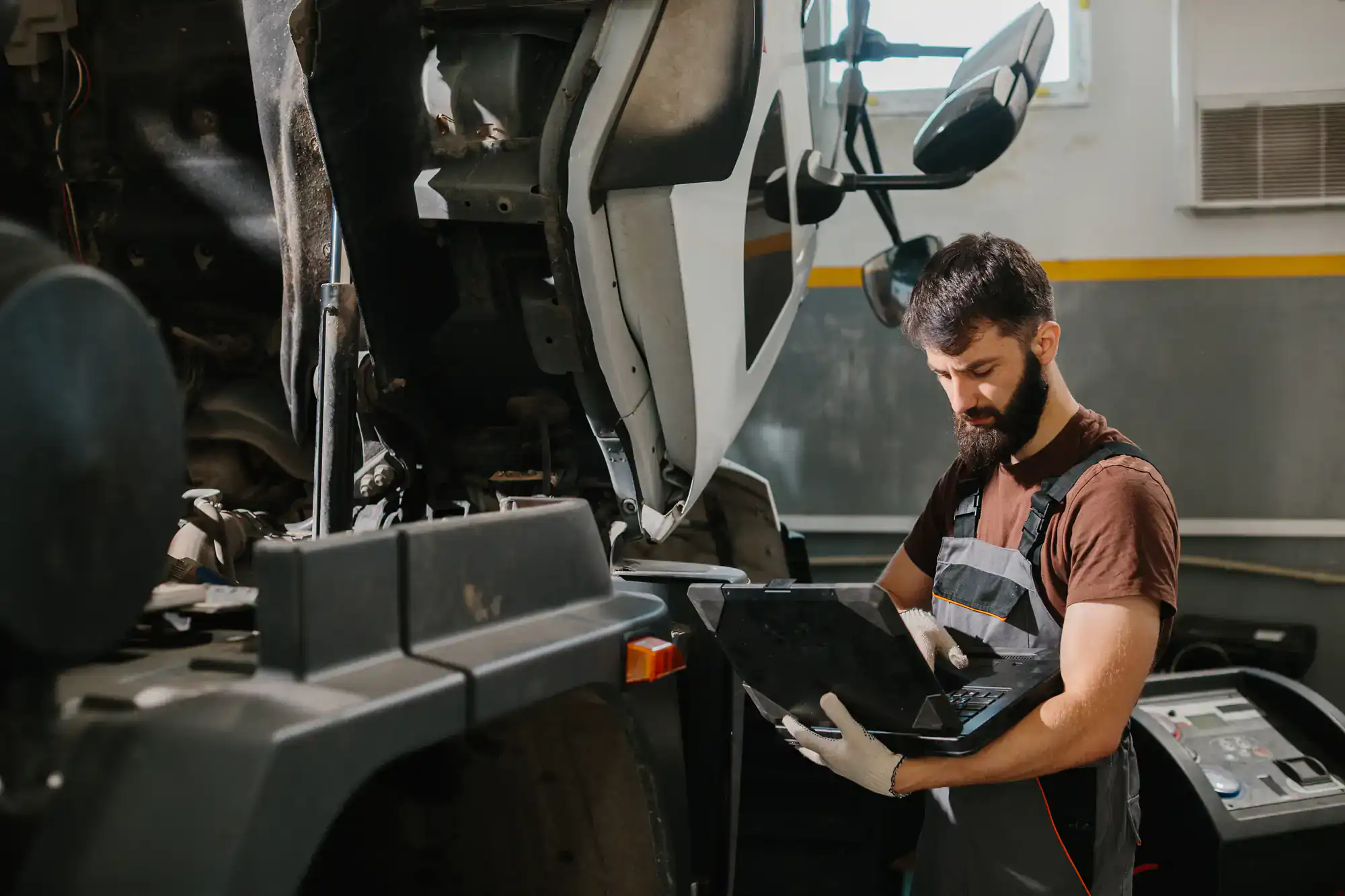
Then we connect our CARB certified OBD testing device to your truck’s diagnostic port. The device pulls data directly from your truck’s onboard computer—checking for emissions system readiness, fault codes, and compliance with California’s diesel emissions standards. This isn’t a visual inspection or a smoke test. It’s a data scan that CARB requires for newer diesel engines.
If your truck passes, we submit the results electronically to CARB’s database. You get documentation showing you’re compliant, and your record updates with the DMV. If there’s an issue flagged during testing, we’ll tell you exactly what showed up and what needs attention before you can retest.
Most tests take 30 minutes or less if your truck’s systems are ready. You’re not sitting around all day. You get tested, you get your results, and you get back to work.

Ready to get started?
Clean Truck Check became mandatory in California on October 1, 2024. If you operate a 2013 or newer diesel truck over 14,000 pounds GVWR, you’re required to test semi-annually. Starting in 2027, OBD-equipped vehicles will need testing four times per year instead of twice.
CARB sends out Notices to Submit to Testing throughout the year. When you get one, you have 30 days to complete your test and submit passing results. If you don’t, your vehicle registration gets flagged, and the DMV won’t let you renew until you’re compliant.
Here’s what matters for Highgrove operators: this area sees a lot of freight movement through the Inland Empire. Trucks running between distribution centers, ports, and cross-state routes all fall under these regulations. You can’t avoid it by staying local—if your truck meets the criteria, you’re in the program.
Heavy-duty vehicles make up only 3% of California’s vehicle fleet, but they’re responsible for over half of smog-forming pollution and particulate matter. That’s why CARB enforcement is strict and why penalties for non-compliance or tampering can reach $37,500 per violation. You don’t want to be on the wrong side of that.
It depends on the GVWR. Your truck needs testing if it’s a 2013 or newer model year diesel engine and has a gross vehicle weight rating over 14,000 pounds. That includes most semi trucks, heavy-duty buses, and large commercial vehicles.
If your truck is lighter than 14,000 pounds GVWR, it doesn’t fall under the Clean Truck Check program—even if it’s a 2013 or newer diesel. And if your truck is a 2012 or older model, it’s subject to different testing requirements that involve smoke opacity and visual inspections, not OBD testing.
Check your vehicle registration or door placard for the GVWR. If you’re not sure whether your truck qualifies, bring your registration when you call or stop by. We’ll confirm whether you need Clean Truck Check testing or a different type of emissions test.
If your truck fails, you’ll get a report showing what triggered the failure—usually a fault code, an emissions system that’s not ready, or a component that’s not functioning within CARB standards. You’ll need to get the issue repaired before you can retest.
Once repairs are done, you come back for another test. If your truck passes, we submit the results to CARB and your compliance record updates. You’re not penalized for failing the first time, but you do need to address the problem quickly—especially if you’re working against a 30-day deadline from a Notice to Submit to Testing.
Don’t ignore a failed test. If you miss your compliance deadline, the DMV puts a registration hold on your vehicle. That means you can’t renew your registration, and in some cases, you’ll be denied entry to ports and railyards until you’re compliant. The faster you handle repairs and retest, the less disruption you face.
Right now, most trucks need testing semi-annually—twice a year. CARB determines your testing schedule and sends you a Notice to Submit to Testing when it’s time. You have 30 days from the date on that notice to complete your test and submit passing results.
You can also test early. If your compliance deadline is coming up, you’re allowed to submit passing results up to 90 days in advance. That gives you flexibility to schedule around your workload instead of waiting until the last minute.
Starting in October 2027, the frequency increases. OBD-equipped vehicles will need testing four times per year instead of twice. That’s a significant change, and it means you’ll need to stay even tighter on your compliance schedule. Plan for it now so you’re not caught off guard when the requirement kicks in.
You must use a CARB credentialed tester. Not every smog shop is authorized to perform Clean Truck Check testing. The tester has to complete CARB’s Tester Training Course, pass the certification exam with at least 80%, and maintain current credentials that renew every two years.
We’re CARB credentialed and use certified OBD testing devices that meet California’s requirements for heavy-duty emissions inspections. When we submit your results, they go directly into CARB’s system and sync with the DMV. That’s what keeps your registration current and your truck legally operational.
If you use someone who’s not credentialed, your test won’t count. You’ll have to retest with a certified provider, and you’ll lose time you can’t afford to waste—especially if you’re up against a compliance deadline. Make sure whoever you go to is actually authorized to perform Clean Truck Check testing before you schedule.
Bring your vehicle registration and any notices you’ve received from CARB. We need to verify your truck’s information—VIN, model year, GVWR, and engine type—to confirm it’s eligible for Clean Truck Check testing. Your registration has most of that information.
If you received a Notice to Submit to Testing in the mail, bring that too. It includes your compliance deadline and reference numbers we may need when submitting your results. Having it on hand speeds up the process.
Make sure your truck’s emissions systems are functioning before you come in. If your check engine light is on or your OBD system isn’t ready, your truck may not pass. We can’t override fault codes or force a pass if your truck’s computer is flagging an issue. Address any warning lights or known problems before scheduling your test—it saves you time and a potential retest fee.
If you miss your compliance deadline, the DMV puts a registration hold on your vehicle. That means you can’t renew your registration until you complete a passing test and submit results to CARB. You’re also at risk of being denied entry into California ports and railyards, which can shut down your operations if you run freight routes.
CARB can issue penalties up to $1,000 per day per vehicle for non-compliance. If you’re caught tampering with emissions equipment or operating a non-compliant truck, fines can go as high as $37,500 per violation. Those aren’t scare tactics—they’re real enforcement actions that CARB takes seriously.
The simplest way to avoid all of that is to test on time. If you get a Notice to Submit to Testing, don’t sit on it. You’ve got 30 days to get it done. Schedule early, get your truck tested, and keep your registration active. It’s a lot cheaper and easier than dealing with holds, fines, and downtime.
Useful Links
Other Services we provide in Highgrove