
Check Out Our Reviews!

If your truck runs freight in Greater Los Angeles whether that’s drayage out of San Pedro, distribution runs through Vernon, or daily hauls on the I-5 and I-710 a compliance gap isn’t just a paperwork problem. It’s a DMV registration hold, a potential $10,000-per-day fine, and a truck that isn’t generating revenue. The stakes here are higher than almost anywhere else in California, and that’s not an exaggeration.
Greater Los Angeles sits at the center of the South Coast Air Basin, which carries the nation’s worst air quality among major metro areas. CARB’s enforcement presence reflects that reality. Roadside emissions monitoring devices run actively on the I-710 corridor the primary drayage route connecting the Ports of Los Angeles and Long Beach to the regional freight network. If your truck gets flagged, you have 30 calendar days to submit a passing test. That window closes fast when you’re running loads every day.
When your OBD test clears and the result goes directly into CARB’s CTC-VIS database, your VIN shows as compliant. DMV gets that data nightly. Within 3 to 5 business days, any registration hold tied to your truck is gone. That’s what compliance actually looks like not paperwork, not a certificate on the dashboard, just a truck that’s cleared to operate and a fleet that keeps moving.
All SMOG Motors is a CARB-credentialed, mobile emissions testing company serving Los Angeles and Riverside Counties. We build our entire operation around one thing: Clean Truck Check OBD testing for diesel trucks that are model year 2013 or newer with a GVWR over 14,000 pounds. That’s it. No passenger cars, no RVs, no pre-2013 opacity tests just the specific test that the heavy-duty trucks running Greater Los Angeles’s freight corridors actually need.
That focus matters in a market like Greater Los Angeles. When a fleet manager in Commerce or a drayage operator out of Wilmington calls, they’re not talking to a generalist smog shop that added heavy-duty testing as a side service. They’re talking to someone whose entire operation is built around the exact compliance requirement they’re facing. We use only CARB Executive Order-approved OBD test devices, hold verified credentials on CARB’s public tester directory, and submit every result directly to the CTC-VIS portal no manual steps, no gaps.

It starts with scheduling. You reach out, give the truck details year, make, model, GVWR and pick a location that works for you. That might be a fleet yard in Sun Valley, a container terminal near the port, a distribution center in Commerce, or wherever your truck is parked when it’s not running freight. We come to the truck. Your vehicle doesn’t leave the yard.
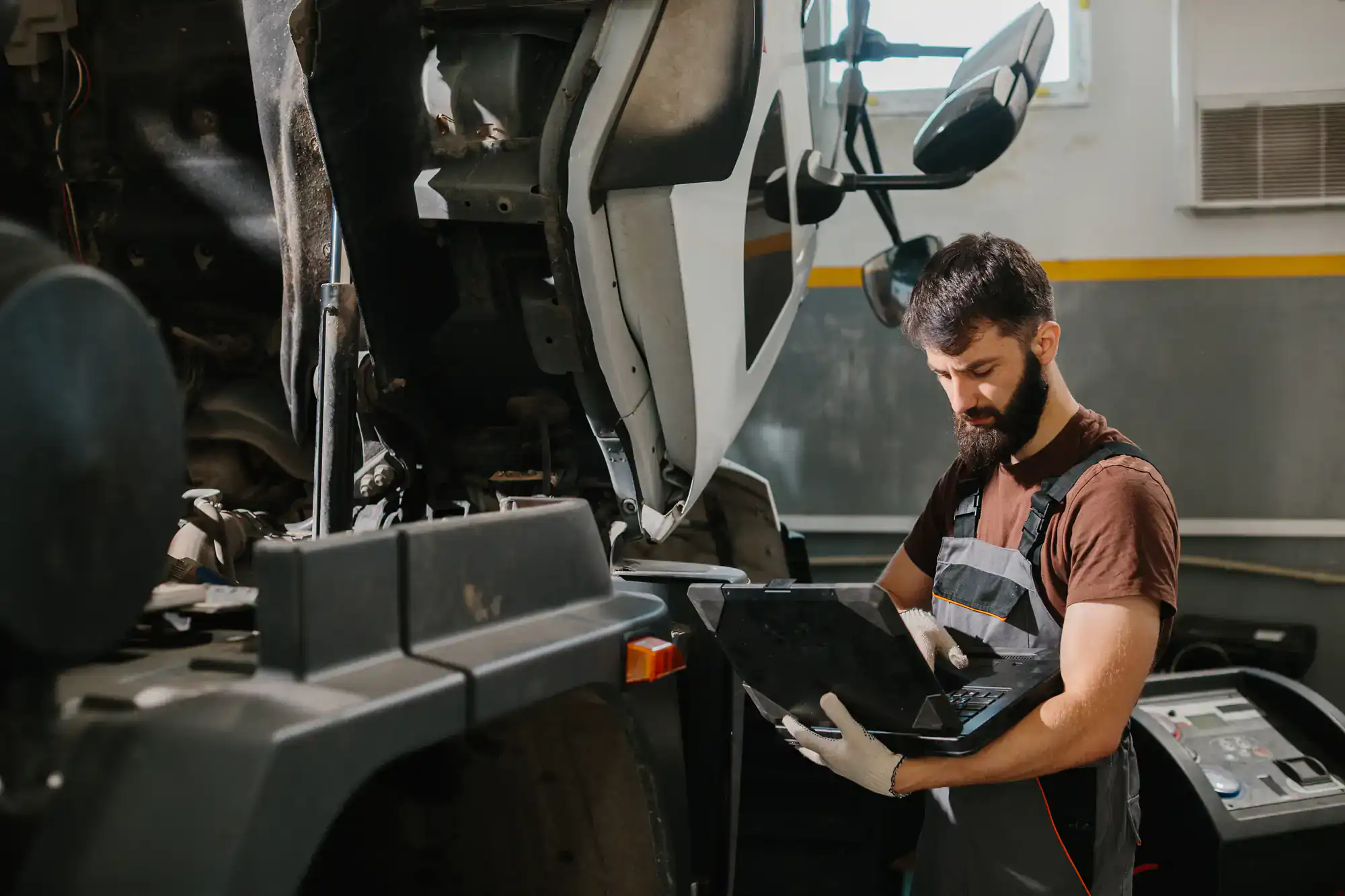
On-site, our tester connects a CARB Executive Order-approved OBD device directly to your truck’s diagnostic port. The device pulls emissions data from the truck’s onboard system no tailpipe probe, no lengthy inspection. For a single truck, the test itself takes roughly 30 to 45 minutes. Our tester verifies the data, confirms the result, and submits it electronically to CARB’s CTC-VIS portal before leaving your location.
Once the result is in the system, CARB transmits compliant VINs to the DMV nightly. If your truck had a registration hold tied to a missing Clean Truck Check, that hold clears within 3 to 5 business days. Greater Los Angeles operators running during peak port season typically mid-August through October, when freight volumes on the I-710 hit their highest point should account for that window when timing their test relative to a registration renewal deadline. Getting tested a week before you need to renew is cutting it close. Getting tested two weeks out gives you room.

Ready to get started?
The Clean Truck Check OBD test applies specifically to diesel trucks that are model year 2013 or newer with a GVWR over 14,000 pounds. If your truck meets both of those criteria and operates on California public roads including every freight corridor in the Greater Los Angeles basin it’s subject to this program. That applies whether your truck is registered in California, Nevada, Arizona, or Texas. Registration state doesn’t exempt you from CARB’s requirements when you’re running loads in Greater Los Angeles County.
Right now, most OBD-equipped heavy-duty vehicles are required to be tested twice per year. Starting October 1, 2027, that frequency increases to four times per year. For a fleet operator in the Vernon industrial corridor running 15 trucks, that’s a jump from 30 tests annually to 60. Building a reliable testing relationship before that shift makes the operational transition significantly easier.
One distinction worth knowing: the annual CARB compliance fee $31.18 per vehicle in 2025 is a separate requirement from the emissions test itself. Paying the fee does not satisfy the testing requirement. Both are required, and a truck that’s paid the fee but hasn’t submitted a passing OBD test is still non-compliant in CARB’s system. We handle the test and the direct CTC-VIS submission. The fee is your responsibility, but knowing the difference between the two keeps you from assuming you’re covered when you’re not.
Yes if your truck is model year 2013 or newer and has a GVWR over 14,000 pounds, it’s subject to CARB’s Clean Truck Check program regardless of what routes it runs or what cargo it hauls. Drayage operators working out of the Port of Los Angeles and Port of Long Beach are among the most frequently tested drivers in California, partly because the I-710 corridor the primary route connecting those terminals to the regional freight network is one of the most actively monitored truck corridors in the state. CARB deploys roadside emissions monitoring devices on major freight corridors in the Greater Los Angeles basin, and trucks flagged by that equipment receive a Notice to Submit to Testing with a 30-day compliance window.
Port-area operators in Greater Los Angeles also carry a layered compliance burden that’s worth understanding. Clean Truck Check is one requirement. CARB’s drayage truck regulations and the Advanced Clean Fleets program are separate requirements that may also apply depending on your operation. We handle the Clean Truck Check OBD test and direct CTC-VIS submission that piece of your compliance picture is straightforward to resolve.
A Notice to Submit to Testing means CARB has flagged your truck typically through roadside emissions monitoring equipment and is requiring you to submit a passing Clean Truck Check test within 30 calendar days. That clock starts from the date on the notice, not from when you open it or decide to act on it. In Greater Los Angeles, where CARB’s REMD monitoring is most active along corridors like the I-710 and I-5, NSTs are not rare. Operators running daily freight routes through the Greater Los Angeles basin have a higher exposure to this than operators in less-monitored regions.
The fastest path to resolution is getting a credentialed OBD test completed and submitted to CARB’s CTC-VIS portal before the deadline. We’re mobile, which means our tester comes to your truck your yard, your terminal, your lot and submits the result directly to the system the same day. If your truck passes, the compliant VIN data goes to DMV overnight. If there’s a repair issue that caused the flag, knowing the result early gives you time to address it before the 30 days run out.
Currently, most OBD-equipped heavy-duty diesel trucks model year 2013 or newer with a GVWR over 14,000 pounds are required to be tested twice per year semi-annually. That’s the schedule that took effect when periodic testing enforcement began on October 1, 2024, with the first compliance deadline hitting January 1, 2025. Beginning October 1, 2027, the frequency increases to four times per year quarterly. That’s a significant jump, especially for fleet operators in Greater Los Angeles managing large numbers of trucks across multiple compliance deadlines.
For context, a fleet operator in the Commerce or Vernon industrial corridor running 20 trucks is currently managing 40 tests per year. After October 2027, that same fleet requires 80 tests annually. The operational and scheduling implications are real, and they’re worth planning for now rather than scrambling to address when the new requirement kicks in. Establishing a testing relationship with a mobile, CARB-credentialed provider before the frequency doubles means the logistics are already figured out when the rules change.
No and this is one of the most common misunderstandings among truck owners in Greater Los Angeles. The annual CARB compliance fee, which is $31.18 per vehicle in 2025 and adjusted annually for inflation, is a registration-related charge collected through the DMV. It is a separate requirement from the Clean Truck Check OBD emissions test. Paying the fee does not satisfy the testing requirement, and submitting a passing test does not eliminate the fee obligation. Both are required independently.
A truck that has paid the compliance fee but has not submitted a passing OBD test is still non-compliant in CARB’s system. That non-compliant status still triggers a DMV registration hold and still exposes the owner to enforcement action. The confusion often comes from the fact that both requirements show up in the same registration renewal process, but they are handled separately. We handle the emissions test and the direct CTC-VIS submission. The compliance fee gets paid through your normal DMV registration process. Knowing the difference keeps you from assuming one covers the other.
Yes. CARB’s Clean Truck Check requirements apply to any qualifying truck operating on California public roads the truck’s state of registration does not exempt it. If you’re running loads into Greater Los Angeles from Nevada, Arizona, Texas, or any other state, and your truck is model year 2013 or newer with a GVWR over 14,000 pounds, you’re subject to the same testing requirements as a California-registered operator. The I-10 and I-5 corridors bring a significant volume of out-of-state trucks into the Greater Los Angeles basin every day, and many of those operators are unaware that California compliance obligations follow the truck, not the registration.
The practical implication is that if your truck gets flagged by CARB’s roadside monitoring equipment on the I-710 or another monitored corridor in Greater Los Angeles, you’ll receive an NST regardless of where your plates are from. Getting a Clean Truck Check completed before that happens or immediately after receiving a notice is the same process for out-of-state operators as it is for California-based ones. We’re mobile and serve Los Angeles County, so testing can happen at your location during a Greater Los Angeles run without requiring a separate trip.
After your truck submits a passing Clean Truck Check result and that result is entered into CARB’s CTC-VIS portal, CARB transmits compliant VIN data to the DMV nightly. From the point of submission, most operators see the DMV registration hold clear within 3 to 5 business days. That timeline is consistent whether you’re operating out of Wilmington, Van Nuys, or anywhere else in Greater Los Angeles County it’s driven by the CARB-to-DMV data transfer process, not by your location.
What this means practically is that timing matters. If your registration renewal deadline is coming up and your truck has an active hold tied to a missing or expired Clean Truck Check, waiting until the last few days before renewal creates real risk. Testing two weeks before your renewal date gives the system enough time to process the compliant status and reflect it in DMV records before you need to complete registration. Greater Los Angeles fleet operators managing multiple trucks with staggered renewal dates should build that 3-to-5-day buffer into their compliance calendar for every vehicle not just the ones with immediate deadlines.
Useful Links
Other Services we provide in Greater Los Angeles