
Check Out Our Reviews!

When your truck is flagged non-compliant in CARB’s system, the consequences hit fast. DMV registration holds. Fines up to $10,000 per vehicle per day. Loads you can’t haul because your truck can’t legally roll. For owner-operators and fleet managers running the Pomona Freeway and Orange Freeway corridors out of Diamond Bar, that’s not a hypothetical it’s a real operational risk on one of the nation’s busiest freight routes.
What changes after a passing Clean Truck Check with us is simple: your VIN is marked compliant in CARB’s CTC-VIS database, and you move on. No portal confusion, no wondering if the submission went through, no scrambling before a deadline. We test at your location your yard, your dock, your driveway and the results go straight to CARB electronically before we leave.
The South Coast AQMD headquarters sits right here in Diamond Bar at 21865 Copley Drive. This isn’t a city that’s far from regulatory attention it’s the city where the region’s air quality enforcement is administered. Operators in this corridor are held to the same standard as everyone else, and CARB doesn’t distinguish between trucks based in Diamond Bar and trucks passing through it. If your truck qualifies, it needs to be tested. We make that as easy as a phone call.
We are a CARB-credentialed emissions testing company that tests one thing: 2013 and newer heavy-duty trucks with a GVWR over 14,000 pounds, using OBD data download under California’s Clean Truck Check program. That’s the entire scope of what we do. Not passenger cars, not older trucks, not a dozen services with HD I/M as an afterthought.
That focus matters when you’re an owner-operator running loads through the City of Industry or a fleet manager coordinating compliance for trucks staged in Diamond Bar. You need someone who knows this test, knows this regulation, and doesn’t have to look anything up. We’re listed on CARB’s official credentialed tester registry at arb.ca.gov check it before you book anyone. Our OBD test equipment holds CARB Executive Order approval, which means the test we perform is the test CARB accepts.
We serve Los Angeles County, including Diamond Bar and the surrounding freight corridor. Mobile service only we come to you.

It starts with a call or booking. You tell us where your truck is located a yard in Diamond Bar, a staging area near the 57/60, a dock in the City of Industry, wherever it sits and we schedule a time that works for your operation. We come to you. Your truck doesn’t move.
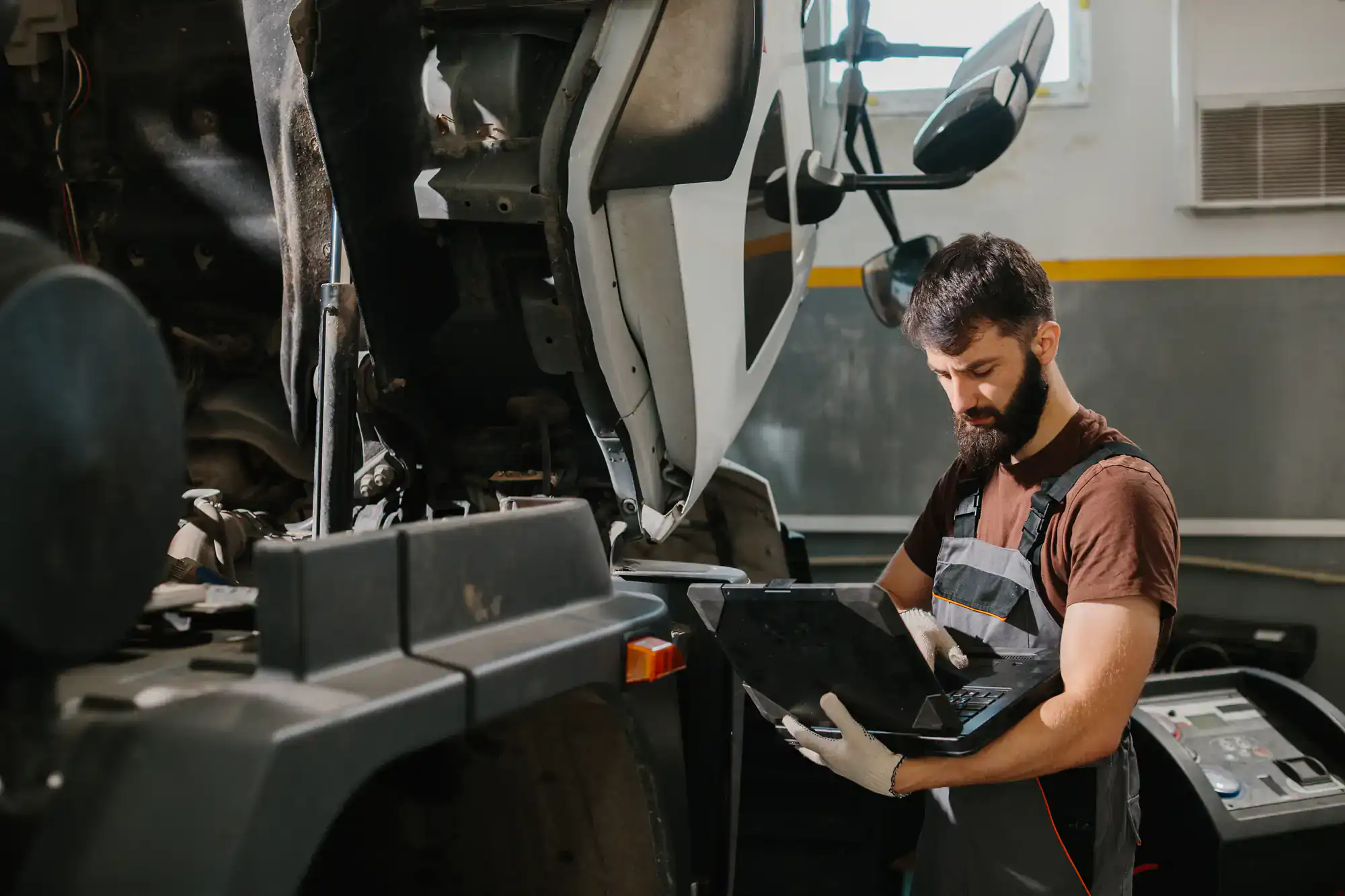
When we arrive, we connect our CARB-certified OBD device directly to your truck’s ECU and download the emissions data. The equipment we use holds CARB Executive Order approval, which is a non-negotiable requirement for a test that actually counts. The process itself is straightforward: plug in, pull the data, review the results. For most 2013 and newer OBD-equipped trucks, this takes a fraction of the time you’d spend driving to a facility and waiting in line.
Once the test is complete, we submit your results directly to CARB’s CTC-VIS system electronically, right then. You don’t log into any portal. You don’t upload anything. You can verify your compliance status in your own CTC-VIS account immediately after submission. If you’re clearing a DMV registration hold, the DMV database typically updates within 3 to 5 business days of a passing submission. For operators who can’t afford to have a truck sitting idle in the Diamond Bar area while a hold gets resolved, that timeline matters and getting the test done fast is the only way to start that clock.

Ready to get started?
The Clean Truck Check is California’s OBD-based Heavy-Duty Inspection and Maintenance program, and it applies to diesel and alternative fuel heavy-duty vehicles with a GVWR over 14,000 pounds that are model year 2013 or newer. If your truck meets both of those criteria and operates on California public roads including out-of-state vehicles it falls under this regulation. The annual compliance fee of $31.18 is separate from the emissions test itself, and paying that fee does not mean your truck has been tested. That’s a distinction that catches a lot of operators off guard at DMV renewal.
What we provide is the complete testing and submission package: we arrive at your location with CARB-certified OBD equipment, perform the data download from your truck’s ECU, and submit the results directly to CARB’s CTC-VIS database. There’s no separate step for you to handle. For fleet operators managing multiple trucks through the Pomona and City of Industry freight corridors adjacent to Diamond Bar, we can work through your vehicles on-site without pulling them from service one at a time.
Currently, most OBD-equipped trucks require semi-annual testing twice per year. Starting October 1, 2027, that increases to quarterly testing, four times annually. If you’re managing a fleet in this corridor, that change is worth planning for now. You can also submit a passing test up to 90 days before your compliance deadline, which gives proactive operators the ability to schedule testing on their terms rather than reacting to a deadline or a notice.
Yes if your truck is model year 2013 or newer with a GVWR over 14,000 pounds, CARB’s Clean Truck Check requirement applies regardless of where in California it’s based. Diamond Bar is in Los Angeles County, which falls within the South Coast Air Basin one of the most actively regulated air quality regions in the country. The South Coast AQMD, whose headquarters is located right here in Diamond Bar, works in coordination with CARB on heavy-duty vehicle emissions enforcement throughout the basin.
Being based in a residential city like Diamond Bar rather than an industrial hub doesn’t change your compliance obligation. If your truck operates on California public roads even occasionally it’s subject to the program. The same applies to out-of-state trucks that operate in California. We serve Diamond Bar and the surrounding LA County corridor, and we come to your location to handle the test and direct submission to CARB’s CTC-VIS database.
A failing result means your truck’s ECU is reporting active fault codes or readiness monitors that aren’t set both of which indicate an emissions-related issue that needs to be addressed before the vehicle can pass. The test itself doesn’t cause the problem; it just surfaces what’s already there. After a failed test, you’ll need to have the underlying issue diagnosed and repaired by a qualified heavy-duty mechanic before retesting.
What’s important to understand is that a failing result doesn’t automatically trigger a fine on the spot but it does mean your truck remains non-compliant in CARB’s system until a passing test is submitted. If you’re operating under a Notice to Submit to Testing with a 30-day deadline, a failed test still counts as an attempt, and you’ll need to retest within that window after repairs are made. For operators in the Diamond Bar area running time-sensitive loads through the SR-57/60 corridor, getting repairs handled quickly and retesting as soon as the truck is ready is the fastest path back to a compliant status.
No, and this is one of the most common points of confusion in the program. The $31.18 annual compliance fee (indexed to California’s CPI) is a registration requirement it’s separate from the emissions test itself. Paying the fee registers your vehicle in CARB’s Clean Truck Check system, but it does not satisfy the testing requirement. Your truck still needs to pass an OBD-based emissions test performed by a CARB-credentialed tester using approved equipment, with results submitted to CTC-VIS.
Many operators discover this distinction at DMV renewal when their registration is flagged despite having paid the fee. At that point, you’re dealing with a registration hold instead of a routine test which adds urgency and, depending on your schedule, potential lost revenue. The cleaner approach is to confirm both requirements are met well before your renewal date. We handle the testing and direct CTC-VIS submission, so once we’re done, your compliance status is updated in CARB’s database and you can verify it yourself before your DMV renewal comes up.
Scheduling depends on current availability, but because we operate as a fully mobile service, we’re not limited by a fixed shop location. We come to wherever your truck is a yard in Diamond Bar, a lot near the 57/60 interchange, a staging area in the adjacent City of Industry, or a residential address if that’s where your truck is parked. That flexibility generally makes scheduling faster than coordinating a trip to a fixed facility, especially for owner-operators who can’t easily move a loaded or semi-loaded truck during business hours.
If you’ve received a Notice to Submit to Testing from CARB, you have 30 calendar days to submit a passing result. That window moves fast, particularly if you’re managing other operational demands. Reaching out as soon as you receive the notice gives you the most scheduling flexibility. For operators with multiple trucks, we can work through your fleet on-site in a single visit, which reduces the coordination burden significantly compared to scheduling separate appointments for each vehicle.
Yes. CARB’s Clean Truck Check requirement applies to any heavy-duty vehicle diesel or alternative fuel, model year 2013 or newer, GVWR over 14,000 pounds that operates on California public roads. That includes trucks that are based out of state or based in other parts of California but regularly route through the SR-57/60 corridor. The program doesn’t require the truck to be registered in Diamond Bar or even in California to apply.
The SR-57/60 confluence in Diamond Bar is identified by the American Transportation Research Institute as California’s most problematic truck bottleneck, handling an estimated 26,000 goods-carrying trucks daily. That volume and the corridor’s visibility within the South Coast Air Basin make it an area where compliance matters. Out-of-state operators who run California routes frequently enough to be subject to the program need to be registered in CARB’s CTC-VIS system and maintain a current passing test on file. We can test any qualifying truck at its location including trucks staged temporarily in the Diamond Bar or City of Industry area and submit results directly to CARB before the truck continues on its route.
They’re two completely different programs targeting completely different vehicles. A standard smog check in California applies to passenger cars and light-duty vehicles and is administered through the Bureau of Automotive Repair. A Clean Truck Check formally California’s Heavy-Duty Inspection and Maintenance program applies specifically to heavy-duty vehicles with a GVWR over 14,000 pounds that are model year 2013 or newer, and it’s administered by CARB. The testing method, the equipment, the credentialing requirements, and the submission system are all different.
A regular smog station cannot perform a valid Clean Truck Check. The test requires a CARB-credentialed tester using OBD equipment that holds a CARB Executive Order, with results submitted directly to CARB’s CTC-VIS database. This distinction matters for Diamond Bar operators because the eastern San Gabriel Valley has no shortage of general smog shops but finding a tester who is actually credentialed and properly equipped for heavy-duty OBD testing is a different search entirely. We’re listed on CARB’s official credentialed tester registry, use only CARB-approved OBD equipment, and handle the complete CTC-VIS submission. That’s the only combination that produces a test result CARB will accept.
Useful Links
Other Services we provide in Diamond Bar