
Hear from Our Customers

You’re running a business, not a compliance department. But CARB doesn’t care about your schedule—they care about deadlines. Miss one, and you’re looking at fines up to $10,000 per vehicle per day, plus DMV registration blocks that ground your trucks until you’re compliant.
Clean Truck Check testing became mandatory for all compliance deadlines on or after January 1, 2025. If your truck is a 2013 or newer model and weighs over 14,000 pounds GVWR, you need a passing emissions test submitted through the CTC-VIS system. No exceptions.
Here’s what passing that test actually gets you. Your trucks stay registered with the DMV. You avoid penalties that can cripple your cash flow. Your drivers keep moving instead of sitting in a yard waiting for paperwork to clear. And you get 90 days before your deadline to submit results—which means if something fails, you have time to fix it without scrambling.
We handle the testing, the submission, and the certification. You show up, we plug in, we upload the data, and you’re done. That’s it.
We’re a CARB credentialed testing facility in Diamond Bar, CA. That means we’ve completed the state-required training, passed the exam, and we’re authorized to submit emissions data directly into the CTC-VIS system on your behalf.
Diamond Bar sits right in the trucking corridor between LA County and the Inland Empire. We see fleet operators daily—guys running routes to the ports, distribution centers, railyards. You know the drill. CARB’s watching those routes with roadside monitoring, REMD devices, and license plate readers. If your truck gets flagged, you’ve got 30 days to submit a passing test. We’re here to make sure that doesn’t turn into a crisis.
We’re not new to emissions testing. We’ve been doing smog checks and compliance work for years, and when CARB rolled out the Clean Truck Check program, we got certified immediately. You need someone who knows the regulations and can get it done right the first time. That’s what we do.

You bring your 2013 or newer semi truck to our Diamond Bar location. We start by confirming your vehicle is registered in the CTC-VIS system and your compliance fee is paid—that’s $31.18 per vehicle for 2025. If you haven’t done that yet, we’ll walk you through it.
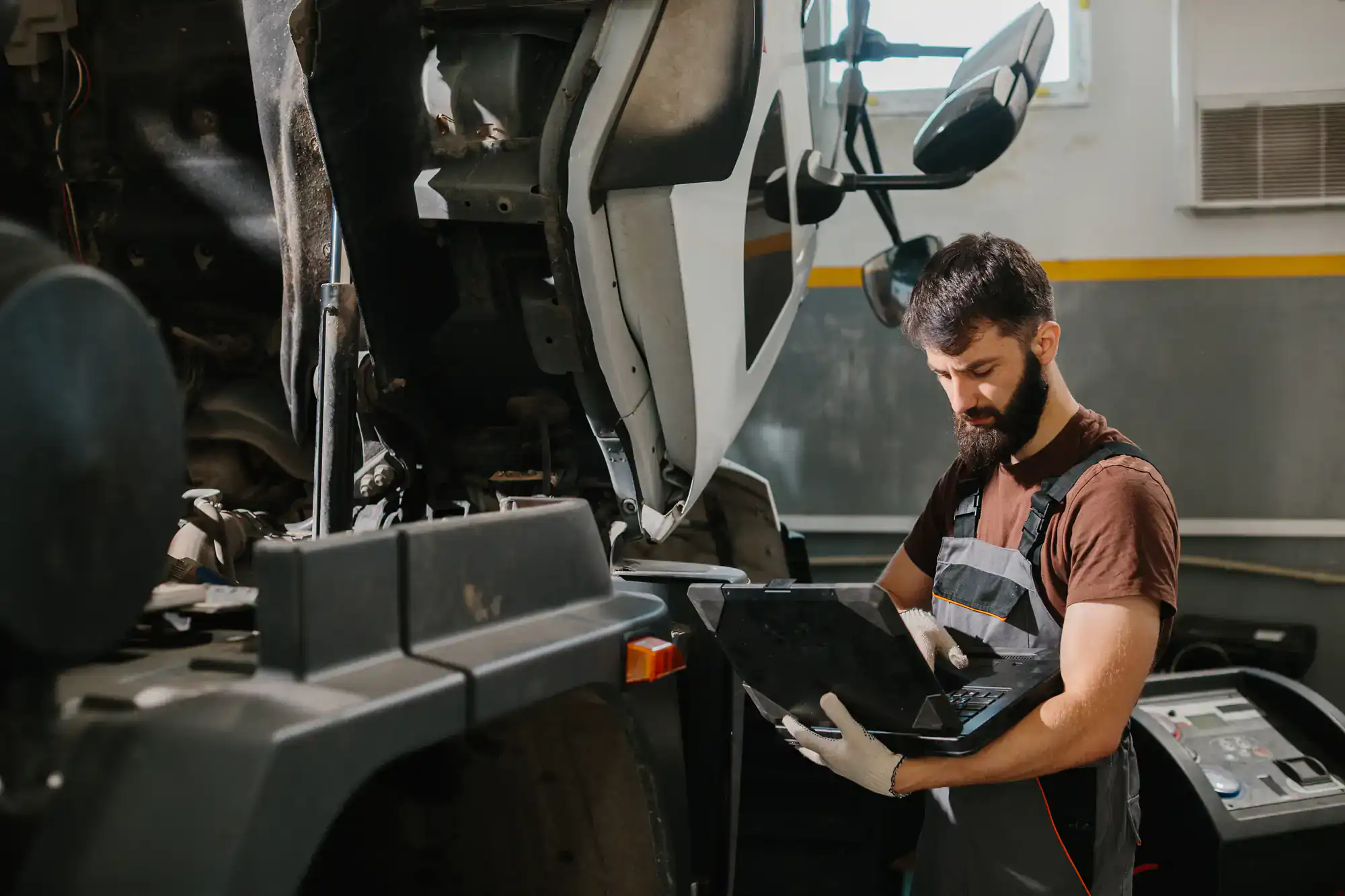
Next, we connect our certified OBD testing equipment to your truck’s diagnostic port. For trucks model year 2013 and up, this is a digital process—no tailpipe smoke test, no manual inspection. We pull the emissions data directly from your truck’s onboard computer. The test itself takes minutes, not hours. No sitting around. No lost revenue from a truck that’s off the road all day.
Once we have the data, we submit it through the CTC-VIS system to CARB. If your truck passes, you’re compliant. If it doesn’t, you’ll know exactly what failed and what needs repair. And because you can submit results up to 90 days before your deadline, you’ve got time to handle repairs without the pressure of an expired registration or a looming fine.
You’ll get documentation showing your test results and submission. Keep that handy. CARB tracks everything, but it’s smart to have your own records in case you get pulled over or audited.

Ready to get started?
This isn’t just a smog test. It’s a full CARB-compliant emissions inspection for heavy-duty vehicles. You get OBD data extraction using state-certified equipment, direct submission to the CTC-VIS system, and a compliance certificate if your truck passes.
We also verify your vehicle’s registration status and make sure your compliance fee is current. If there’s an issue—like your truck was flagged during a roadside inspection—we’ll help you understand what CARB is asking for and how to resolve it.
Diamond Bar is home to over 314 trucking companies, including major fleets like Southern Counties Express. CARB knows this area is a hub, which is why they monitor it heavily. Roadside inspections happen at border crossings, near the ports, and along major freight routes. If your truck gets a Notice to Submit Testing, you’ve got 30 days to comply. We can turn that around fast.
One thing to be clear about: this service only applies to trucks that are 2013 or newer and have a GVWR over 14,000 pounds. Older trucks and lighter vehicles aren’t part of the Clean Truck Check program. If you’re not sure whether your truck qualifies, call us before you come in. We’ll confirm eligibility and save you the trip if it doesn’t apply.
Any diesel, alternative fuel, or hybrid truck with a gross vehicle weight rating over 14,000 pounds and a model year of 2013 or newer must comply with Clean Truck Check testing. This applies to almost all heavy-duty trucks operating on California public roads, even if they’re registered out of state.
The program started October 1, 2024, but testing only became mandatory for compliance deadlines on or after January 1, 2025. Right now, testing happens twice a year. Starting in October 2027, it increases to four times per year for OBD-equipped vehicles.
If your truck doesn’t meet those criteria—say it’s a 2012 model or weighs under 14,000 pounds—you’re not subject to Clean Truck Check. But if you’re running a semi truck or a heavy-duty commercial vehicle built in 2013 or later, you need to be compliant. CARB doesn’t make exceptions based on how often you drive in California or where your truck is registered.
The state compliance fee for 2025 is $31.18 per vehicle, and that’s paid directly to CARB through the CTC-VIS system. That fee covers the administrative side of the program. The actual emissions test at our facility is a separate service fee—contact us for current pricing.
Now, the penalties for non-compliance are where things get expensive. CARB can fine you up to $10,000 per vehicle per day if you’re operating without a valid Clean Truck Check. On top of that, the DMV will place a registration hold on non-compliant trucks, which means you can’t renew your registration until you’re compliant. That effectively grounds your vehicle.
If your truck gets flagged during a roadside inspection and you receive a Notice to Submit Testing, you have 30 days to get a passing test submitted. Miss that window, and you’re looking at penalties plus the registration block. The cost of staying compliant is a fraction of what you’ll pay if you ignore it. And downtime from a blocked registration can cost you $300 to $900 per vehicle per day in lost revenue, depending on your operation.
Yes. You can submit a passing emissions test up to 90 days before your compliance deadline. That’s actually one of the smartest moves you can make, because it gives you a buffer if something fails.
Let’s say your deadline is in March. You can come in as early as December, get tested, and submit the results. If your truck passes, you’re done—no stress, no last-minute scramble. If it fails, you’ve got three months to make repairs and retest before the deadline hits.
This is especially useful for fleet operators managing multiple trucks with different deadlines. You can stagger your testing schedule, avoid bottlenecks, and keep your trucks on the road instead of all sitting in a shop at once. CARB built this 90-day window into the program specifically to reduce the operational burden on trucking companies. Take advantage of it. Waiting until the last minute just increases your risk of downtime and penalties if something goes wrong.
For trucks model year 2013 and newer, the test is done through your vehicle’s onboard diagnostics system. We connect a CARB-certified OBD device to your truck’s diagnostic port and pull the emissions data directly from the computer. There’s no tailpipe smoke test, no manual inspection—it’s a digital data transfer.
The test itself takes just a few minutes. We’re checking for fault codes, emissions system performance, and whether your truck meets CARB’s standards for NOx and particulate matter. Once we have the data, we submit it through the CTC-VIS system to CARB in real time.
If your truck passes, you’re compliant and you’ll receive documentation confirming that. If it fails, we’ll tell you exactly what triggered the failure—whether it’s a sensor issue, an emissions system fault, or something else. You’ll need to get the repairs done and then come back for a retest. The key difference between this and older testing methods is speed. Traditional manual inspections could take one to three hours and cost you hundreds in downtime. OBD testing is fast, accurate, and keeps your truck moving.
Yes. If your truck meets the criteria—2013 or newer, over 14,000 pounds GVWR—and you’re operating on California public roads, you need to comply with the Clean Truck Check program. It doesn’t matter where your truck is registered.
CARB enforces this through roadside inspections at border crossings, weigh stations, ports, and along major freight corridors. They use remote emissions monitoring devices and license plate readers to flag non-compliant vehicles. If you get pulled over and you’re not compliant, you’ll receive a Notice to Submit Testing. That gives you 30 days to get a passing test submitted, or you face penalties.
Out-of-state operators sometimes assume they’re exempt because they’re just passing through. That’s not how it works. If you’re driving in California, you’re subject to California regulations. The good news is that the testing process is the same whether you’re based here or not. You register your vehicle in the CTC-VIS system, pay the compliance fee, get tested at a credentialed facility like ours, and you’re done. Just plan ahead so you’re not scrambling after a roadside stop.
You can check your vehicle’s registration status by logging into the CTC-VIS system on CARB’s website. You’ll need your VIN and some basic vehicle information. If your truck isn’t registered yet, you’ll need to create an account and add your vehicle before you can submit any test results.
The registration process itself is straightforward, but it has to be done before you come in for testing. If you show up and your truck isn’t in the system, we can’t submit your results—even if the truck passes the emissions test. That just delays your compliance and wastes your time.
When you register, you’ll also pay the annual compliance fee, which is $31.18 per vehicle for 2025. Once that’s done, your truck is in the system and you’re ready to test. If you’re managing a fleet, you can register multiple vehicles under one account, which makes tracking deadlines and compliance status a lot easier. If you’re not sure how to navigate the CTC-VIS system or you run into issues, we can walk you through it when you come in. It’s not complicated, but it’s a required step that a lot of operators forget about until the last minute.
Useful Links
Other Services we provide in Diamond Bar