
Check Out Our Reviews!

A DMV registration hold doesn’t slow down a fleet it shuts down an owner-operator. In Coachella, where most trucking operations are one truck, one driver, and one source of income, that’s not a bureaucratic inconvenience. That’s a real financial hit.
Running loads between the Imperial Valley and I-10 on SR-86 one of the most actively monitored freight corridors in Southern California puts you in front of CARB enforcement more often than most operators realize. Trucks screened by roadside emissions monitoring on that corridor can receive a Notice to Submit to Testing with a 30-day clock. Waiting until that notice arrives is the most expensive way to handle this.
The desert operating environment adds another layer. When your truck has been running through a Coachella Valley summer 110-degree heat, dusty roads off Avenue 52 or Avenue 54, back-to-back loads during date harvest your diesel emissions systems take a beating. DPF, EGR, SCR these are exactly what the OBD scan checks. Getting tested before your deadline gives you time to fix anything the scan catches, rather than scrambling to find a repair shop with a compliance clock already ticking.
We do one thing: Clean Truck Check OBD testing for model year 2013 and newer heavy-duty trucks over 14,000 lbs GVWR. That’s it. No passenger cars, no opacity tests, no side services. Every piece of equipment, every credential, and every process is built around this specific test which means when you call, you’re not talking to a generalist who added heavy-duty testing as an afterthought.
Our CARB credentials are publicly verifiable at arb.ca.gov. You don’t have to take anyone’s word for it. The test equipment we use holds CARB Executive Order approval the specific certification required for results that CARB will actually accept and log into CTC-VIS.
We serve Riverside County and the entire Coachella Valley from the farm operations around Thermal to the freight yards near the I-10 interchange in Indio and we’re mobile by design. The truck doesn’t come to us. We come to it.

It starts with a quick booking. You tell us where the truck is a farm yard off Avenue 50, a staging lot near Spotlight 29, a packing house in Thermal, a driveway in Navarra and we schedule a time that doesn’t pull the truck out of rotation any longer than necessary.
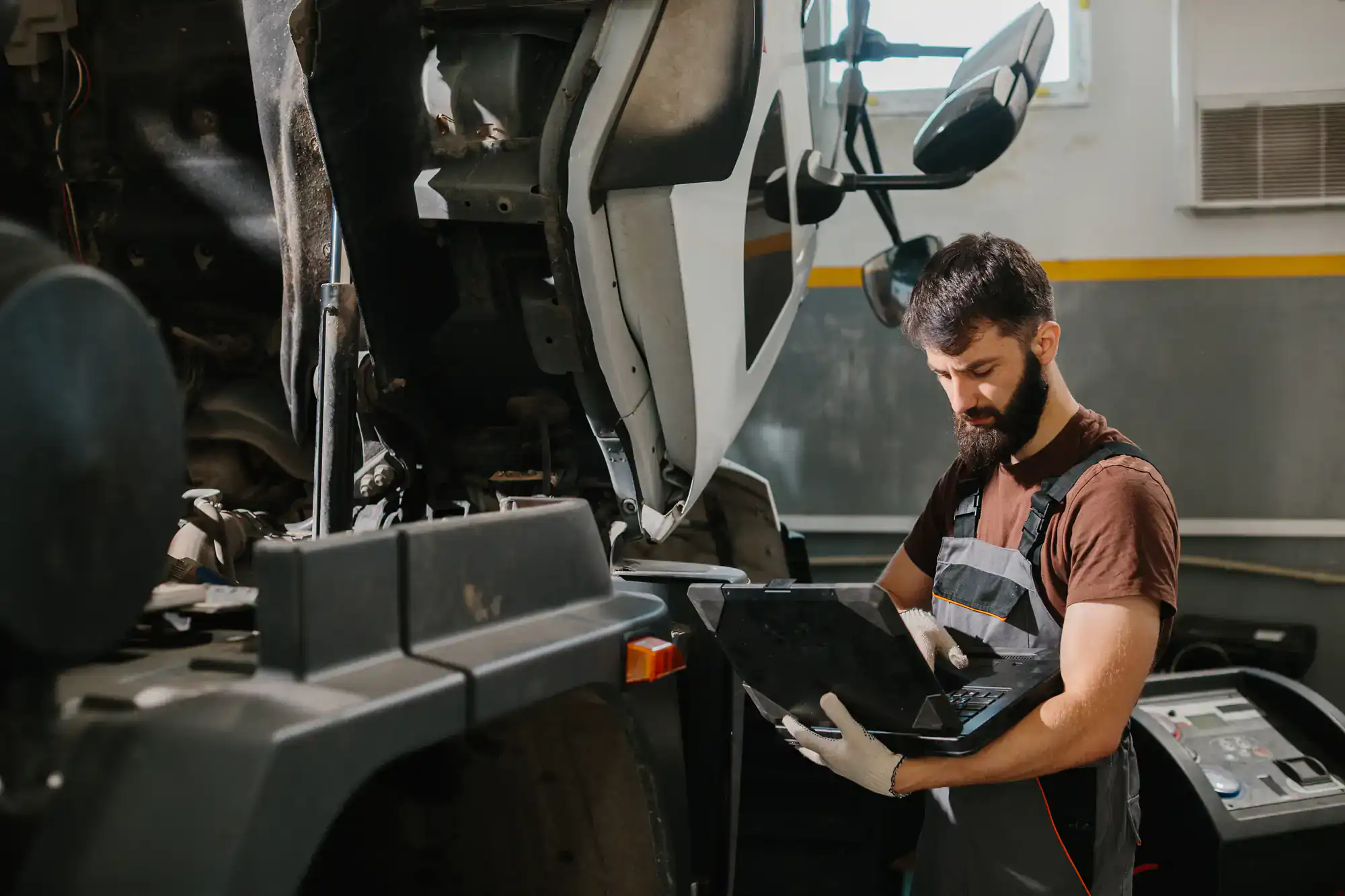
When we arrive, we connect CARB-certified OBD test equipment directly to the truck’s ECU and pull the diagnostic data. For 2013 and newer trucks over 14,000 lbs GVWR, this is the test. No tailpipe probe, no opacity meter just a direct read of what the truck’s own onboard systems are reporting. The scan itself doesn’t take long. What matters is that it’s done with the right equipment by a credentialed tester, because an uncertified device produces a result CARB won’t accept and you’d still be non-compliant.
Once the scan is complete, we submit results directly into CARB’s CTC-VIS database electronically. You don’t log into a portal. You don’t submit anything manually. CARB transmits updated compliant VIN lists to DMV nightly, so your truck’s status reflects in the system within a few business days. If the scan catches a fault code, you’ll know exactly what it is and you’ll have time to address it before your deadline, especially if you tested proactively within that 90-day advance window.

Ready to get started?
Clean Truck Check applies to diesel and alternative fuel heavy-duty vehicles that are model year 2013 or newer with a GVWR over 14,000 pounds. If your truck doesn’t meet both of those criteria model year and weight this program doesn’t apply to it. That distinction matters, and it’s one of the more common points of confusion among operators in the Coachella Valley who are still getting familiar with the program.
What you get with us is a mobile OBD scan using CARB Executive Order-approved equipment, direct electronic submission to CTC-VIS, and a clear explanation of what the results mean. If the truck passes, compliance is logged and you’re done. If there’s a fault code that causes a failure, you’ll know what it is, what it affects, and what your options are before the clock becomes a problem.
For operators in the Eastern Coachella Valley an AB 617 community with an active CARB-approved Community Emissions Reduction Program targeting diesel truck emissions enforcement here is not hypothetical. CARB and SCAQMD treat this valley as a priority area. The annual compliance fee is $31.18 per vehicle, but the fee alone doesn’t satisfy the requirement. A passing test submitted to CTC-VIS is what actually keeps your registration clean and your truck on the road.
It depends on the truck itself, not what it hauls. If the vehicle is model year 2013 or newer and has a GVWR over 14,000 pounds, it’s subject to Clean Truck Check regardless of whether it’s hauling dates from a farm off Avenue 54, transporting produce to a packing house in Thermal, or moving equipment between agricultural operations in the Eastern Coachella Valley. The program doesn’t carve out exemptions based on cargo type or industry.
That said, CARB does maintain a list of specific vehicle exemptions certain specialty vehicles, government-owned vehicles in some categories, and vehicles that don’t operate on public roads. If you’re genuinely unsure whether a specific truck in your operation qualifies, the safest move is to check the vehicle’s model year and GVWR against CARB’s current exemption list, or ask when you book. Getting that answer wrong in either direction testing when you don’t need to, or not testing when you do both have consequences.
A failed scan means the truck’s OBD system reported a fault code or emissions-related issue that CARB’s program flagged. It does not mean your truck is immediately grounded or that you’re facing a fine but it does start a clock. You’ll need to address the underlying issue and submit a passing test within your compliance window.
This is exactly why testing proactively up to 90 days before your deadline is the smarter play for Coachella-area operators. Trucks that have been running hard through a desert summer, hauling loads on SR-86, or sitting through harvest season without a DPF or EGR service are more likely to surface fault codes on a scan. Finding that out with 60 days to spare gives you time to get the repair done, retest, and still hit your deadline clean. Finding it out three days before your registration renewal is a different problem entirely.
Right now, OBD-equipped trucks that qualify for Clean Truck Check are required to test twice per year semi-annually. That frequency increases to four times per year quarterly beginning October 1, 2027. That’s not far off, and it’s worth building a testing relationship now rather than scrambling to find a credentialed mobile tester when the schedule tightens.
For operators in the Coachella Valley, the semi-annual schedule actually lines up reasonably well with natural breaks in the agricultural freight calendar. Testing before the fall date harvest push and again before the spring festival season near the Empire Polo Club gives you clean compliance windows without pulling the truck during peak demand. Planning around those rhythms is something most operators don’t think about until they’re already behind.
Yes and this is one of the most commonly misunderstood aspects of the program. Clean Truck Check applies to any qualifying heavy-duty vehicle operating on California public roads, regardless of where it’s registered. An Arizona-plated truck, a Nevada-registered semi, a Texas carrier running cross-border loads on SR-86 if the vehicle is model year 2013 or newer, over 14,000 lbs GVWR, and it’s operating on California roads, it needs to comply.
SR-86 through Coachella carries substantial cross-border freight traffic between the Imperial Valley, Mexico, and the I-10 interchange at Indio. That corridor sees real CARB enforcement activity. Out-of-state operators who assume they’re exempt because they’re not California-registered are the most likely to receive a Notice to Submit to Testing and the 30-day clock runs the same for them as it does for anyone else.
No, and this is probably the most common misconception in the entire program. The annual compliance fee is a separate requirement from the emissions test itself. Paying the fee does not satisfy the testing requirement. You still need a passing OBD scan submitted to CARB’s CTC-VIS database to be considered compliant under Clean Truck Check.
We submit results directly into CARB’s CTC-VIS database, and CARB transmits a list of compliant VINs to DMV nightly. If your truck has a passing test on file, it shows up on that list and your registration processes normally. If you’ve paid the fee but never submitted a passing test, your truck is still flagged as non-compliant in the system and DMV will reflect that at registration renewal. Both requirements need to be met. The fee and the test are not interchangeable.
The Eastern Coachella Valley which includes Coachella, Thermal, Oasis, Mecca, and North Shore has been formally designated as an AB 617 community by CARB. AB 617 is California’s Community Air Protection Program, and it targets areas with the highest cumulative pollution burden for enhanced monitoring and emissions reduction. CARB and SCAQMD have approved a Community Emissions Reduction Program specifically for this area, and diesel truck emissions on local roads are explicitly identified as a priority target within that plan.
The valley also sits in a severe ozone nonattainment zone with a federally mandated attainment deadline of July 20, 2027. That deadline creates ongoing regulatory pressure to reduce diesel emissions in this specific air basin which means enforcement of programs like Clean Truck Check is more active here than in many other parts of California. For operators based in or regularly running through Coachella, that’s the real-world context behind why compliance matters more here than the paperwork alone might suggest.
Useful Links
Other Services we provide in Coachella