
Check Out Our Reviews!

The Castaic Commercial Vehicle Enforcement Facility on northbound I-5 screens around 2.3 million commercial vehicles every year. That’s not a statistic that’s the checkpoint your truck passes through on a regular basis. CHP officers at the CVEF verify registration, qualifications, and compliance. A CARB hold on your registration doesn’t just create a DMV problem it can put your truck out of service at the roadside before you ever make it up the Grapevine.
Running heavy loads through Castaic means your diesel engine is already working hard. The steep grades north of town on the Tejon Pass push emissions systems to their limits, and in the summer heat which regularly climbs above 100°F in this part of northern Los Angeles County components like your DPF and EGR wear faster than they would in milder climates. That kind of operating environment is exactly why testing early, rather than waiting on a deadline, makes practical sense for operators in this area.
When your truck passes a Clean Truck Check, the results go directly into CARB’s CTC-VIS system and DMV records update within a few business days. That’s compliance you can actually count on not paperwork you’re hoping went through.
We test one thing: model year 2013 and newer heavy-duty trucks with a GVWR over 14,000 pounds. That’s it. No passenger cars, no light trucks, no side services. Every piece of equipment we use carries CARB Executive Order approval, and our credentials are publicly listed on CARB’s official tester registry at arb.ca.gov you can verify us before you ever pick up the phone.
We serve Los Angeles County, and Castaic sits squarely in that footprint. Whether your truck is staged near the I-5 and SR-126 interchange, parked at a yard off The Old Road, or sitting in your driveway in Hasley Canyon between runs, we come to you. The test happens where your truck already is no repositioning, no detour, no wasted hours.

When you reach out, the first thing we confirm is whether your truck qualifies model year 2013 or newer, GVWR over 14,000 pounds, OBD-equipped. If it does, we schedule a time that works around your operation, not ours. For operators running loads on I-5 through Castaic, that flexibility matters. You’re not pulling a truck off a route to sit in a shop waiting room.
On the day of the test, we come to wherever your truck is parked a yard, a staging area, a truck stop, or your property. We connect CARB-certified OBD testing equipment directly to your truck’s diagnostic port and download the emissions data. The process is straightforward and doesn’t require your truck to be running a route or warmed up in any special way just accessible.
Once the test is complete and your truck passes, we submit the results directly to CARB’s CTC-VIS database on your behalf. You don’t need to log into a portal or upload anything. CARB transmits compliant VIN data to DMV nightly, so your registration status typically clears within three to five business days. If there’s an issue that causes a failure, we’ll tell you exactly what the OBD data shows so you know what needs to be addressed before retesting.

Ready to get started?
The Clean Truck Check program built on California SB 210 and enforced by CARB applies to OBD-equipped diesel trucks from model year 2013 and newer, and alternative fuel engines from 2018 and newer, with a GVWR above 14,000 pounds. If your truck doesn’t meet both of those thresholds, this program doesn’t apply to it. We won’t test it, and we won’t take your money for something you don’t need.
For trucks that do qualify, the current requirement is two passing tests per year semi-annually. Starting October 1, 2027, that increases to four times per year. If you’re running a fleet out of a facility near the I-5 and SR-126 interchange in Castaic, or you’re an owner-operator based in the area, now is the time to get a testing relationship in place before the quarterly schedule kicks in. The annual compliance fee is $31.18 per vehicle, but that fee and the emissions test are two completely separate requirements. Paying the fee does not satisfy the testing obligation both are required for full compliance.
One thing worth knowing if you’ve received a Notice to Submit to Testing from CARB: you have 30 days from the date of that notice to submit a passing test. CARB’s roadside emissions monitoring devices are active on California highways, including the I-5 corridor that runs directly through Castaic. If your truck was flagged, the clock is already running. You can also test up to 90 days before your compliance deadline which means there’s no reason to wait until you’re up against it.
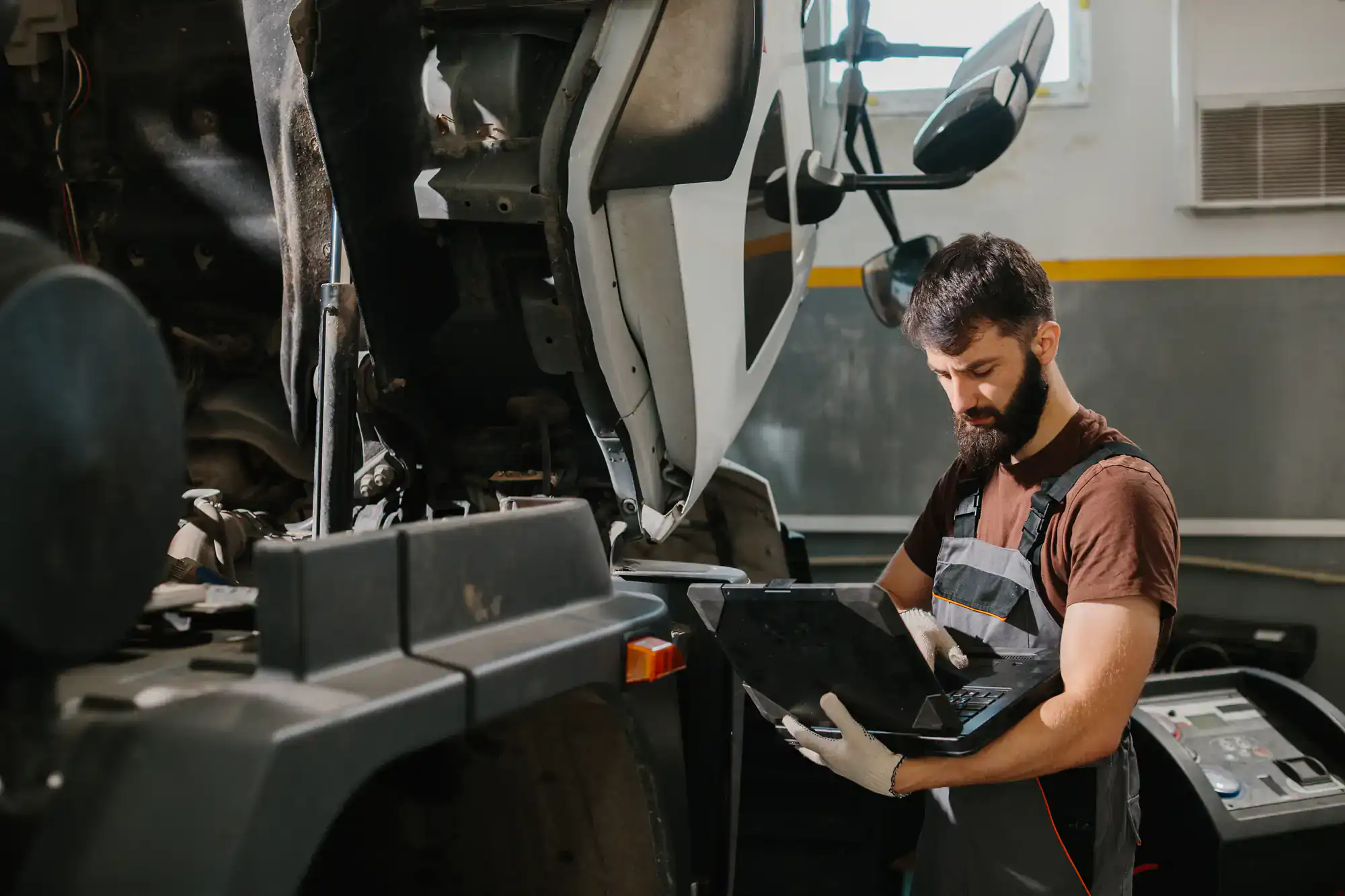
The Castaic Commercial Vehicle Enforcement Facility on northbound I-5 is a CHP-operated inspection station, and its primary focus is safety driver qualifications, hours of service, weight, registration, and mechanical condition. CHP officers at the CVEF aren’t conducting Clean Truck Check emissions tests on-site, but registration holds tied to CARB non-compliance show up in the same DMV records they’re checking. If your truck has a CARB-related registration hold, that can surface during a routine inspection and result in your truck being placed out of service.
The practical risk for operators running I-5 through Castaic regularly is that the CVEF creates a recurring enforcement touchpoint. Most long-haul and regional operators pass through it multiple times per month. Staying current on your Clean Truck Check compliance means that touchpoint stays routine not a problem.
The Clean Truck Check program applies to heavy-duty vehicles that are model year 2013 or newer AND have a Gross Vehicle Weight Rating over 14,000 pounds. Both conditions have to be true the truck needs to meet the model year threshold and the weight threshold. Diesel engines from 2013 forward are covered. Alternative fuel engines are covered starting with model year 2018. If your truck is older than 2013 or comes in under 14,000 pounds GVWR, it falls outside the program entirely.
This matters because a lot of operators in the Castaic area run mixed fleets some trucks qualify, some don’t. We’ll confirm eligibility before we schedule anything. If your vehicle doesn’t qualify, we’ll tell you upfront and you won’t be charged for a test that doesn’t apply to you.
No, and this is one of the most common misunderstandings in the program. The $31.18 annual compliance fee and the emissions test are two completely separate requirements. Paying the fee registers your vehicle in the CTC-VIS system, but it does not substitute for a passing OBD emissions test. If you’ve paid the fee but haven’t submitted a passing test result, CARB still considers your truck non-compliant and your DMV registration is still at risk of a hold.
Think of it this way: the fee gets your truck into the system, and the test is what keeps it there in good standing. Both are required. If you’re not sure whether your truck has a passing test on record, you can check your vehicle’s status directly in the CTC-VIS portal using your VIN. If there’s a gap, that’s what we’re here to close.
Right now, the requirement is two passing tests per year semi-annually. That cadence has been in place since the program’s enforcement phase began, with the first compliance deadline landing on January 1, 2025. Starting October 1, 2027, the frequency increases to four times per year for OBD-equipped vehicles. That’s a quarterly schedule, and it’s coming up faster than most fleet managers realize.
For operators based in or around Castaic who are running multiple trucks, getting ahead of that 2027 shift is worth doing now. Establishing a reliable testing relationship before the quarterly requirement kicks in means you’re not scrambling to find a credentialed tester when four deadlines a year start hitting back to back. You can also submit a test up to 90 days before your compliance deadline, which gives you a real planning window if you want to stay ahead of the schedule.
A failed test means the OBD data pulled from your truck’s diagnostic system flagged something an active fault code, a readiness monitor that didn’t complete, or an emissions-related issue the system detected. When that happens, we’ll walk you through exactly what the data shows. We’re not a repair shop, so we won’t be the ones fixing it, but you’ll leave with a clear picture of what needs to be addressed before you can retest.
Once the repair is made, you can schedule a retest. There’s no penalty for a failed test itself the compliance clock is tied to whether a passing result is on file by your deadline, not to how many attempts it takes to get there. The more important thing is not to let a known issue sit. If your truck is running the Grapevine grades north of Castaic regularly under heavy load, and there’s an underlying emissions system problem, it’s not going to fix itself and the longer it goes, the closer you get to a deadline without a passing test on record.
Yes that’s the entire point of our mobile model. We come to wherever your truck is parked in Castaic or the surrounding area. That could be a yard near the I-5 and SR-126 interchange, a staging area off The Old Road, a distribution facility, a truck stop, or your property in one of Castaic’s residential neighborhoods like Hasley Canyon or Live Oaks. As long as the truck is accessible and we can connect to the OBD port, we can run the test on-site.
For operators running tight schedules on the I-5 corridor, this isn’t just a convenience it’s a real operational advantage. Pulling a truck off a route to drive it to a shop costs time and fuel, and in a corridor this active, that time has a dollar value. The test comes to you, takes what it takes, and the truck goes right back to work once it’s done.
Useful Links
Other Services we provide in Castaic