
Check Out Our Reviews!

A DMV registration hold doesn’t care that you’re 98 miles from the nearest metro area. It doesn’t care that you’ve got a load to run on I-10 or a harvest window closing in the Palo Verde Valley. When CARB flags your truck as non-compliant, your registration is at risk and the fines run up to $10,000 per vehicle, per day.
What Clean Truck Check compliance does is straightforward: it keeps your truck legal, your registration current, and your operation moving. If you’ve received a Notice to Submit to Testing, you have exactly 30 days to submit a passing result. Mobile testing means you don’t have to pull your truck off a job, burn half a day driving to Coachella or the Inland Empire, and limp back. We come to wherever your truck is in Blythe or the surrounding valley.
Blythe’s desert heat is also worth thinking about. Summer temperatures regularly hit 100–110°F out here, and that kind of sustained heat accelerates wear on the emissions control components DPFs, EGR systems, SCR catalysts that OBD testing evaluates. Trucks that run clean in cooler conditions can start throwing fault codes after a hard Palo Verde summer. Testing proactively, before a deadline forces your hand, gives you time to address any issues before they become a compliance failure.
All Smogged Motors is a CARB-credentialed emissions testing company serving Riverside County, including Blythe and the broader Palo Verde Valley. We focus narrowly by design: 2013-and-newer OBD-equipped heavy-duty trucks with a GVWR over 14,000 pounds. That’s it. No passenger cars, no older opacity-test vehicles, no generalist shop work split across a dozen service categories.
That specialization matters because Clean Truck Check is a specific program with specific equipment requirements. CARB requires OBD test devices that have received Executive Order approval not just any professional diagnostic scanner. We use only certified equipment, and every result is submitted electronically to CARB’s CTC-VIS database directly. You don’t touch a portal, you don’t file anything manually, and there’s no gap between the test happening and CARB knowing about it.
For operators running freight on I-10, hauling produce out of the valley, or supporting the cannabis and solar sectors that have been growing around Blythe this is the compliance path that actually fits how you work.

It starts with a call or booking. You tell us where your truck is your yard, your lot, your job site anywhere in the Blythe area and we schedule a time to come to you. There’s no drop-off, no repositioning, no half-day trip across the desert.
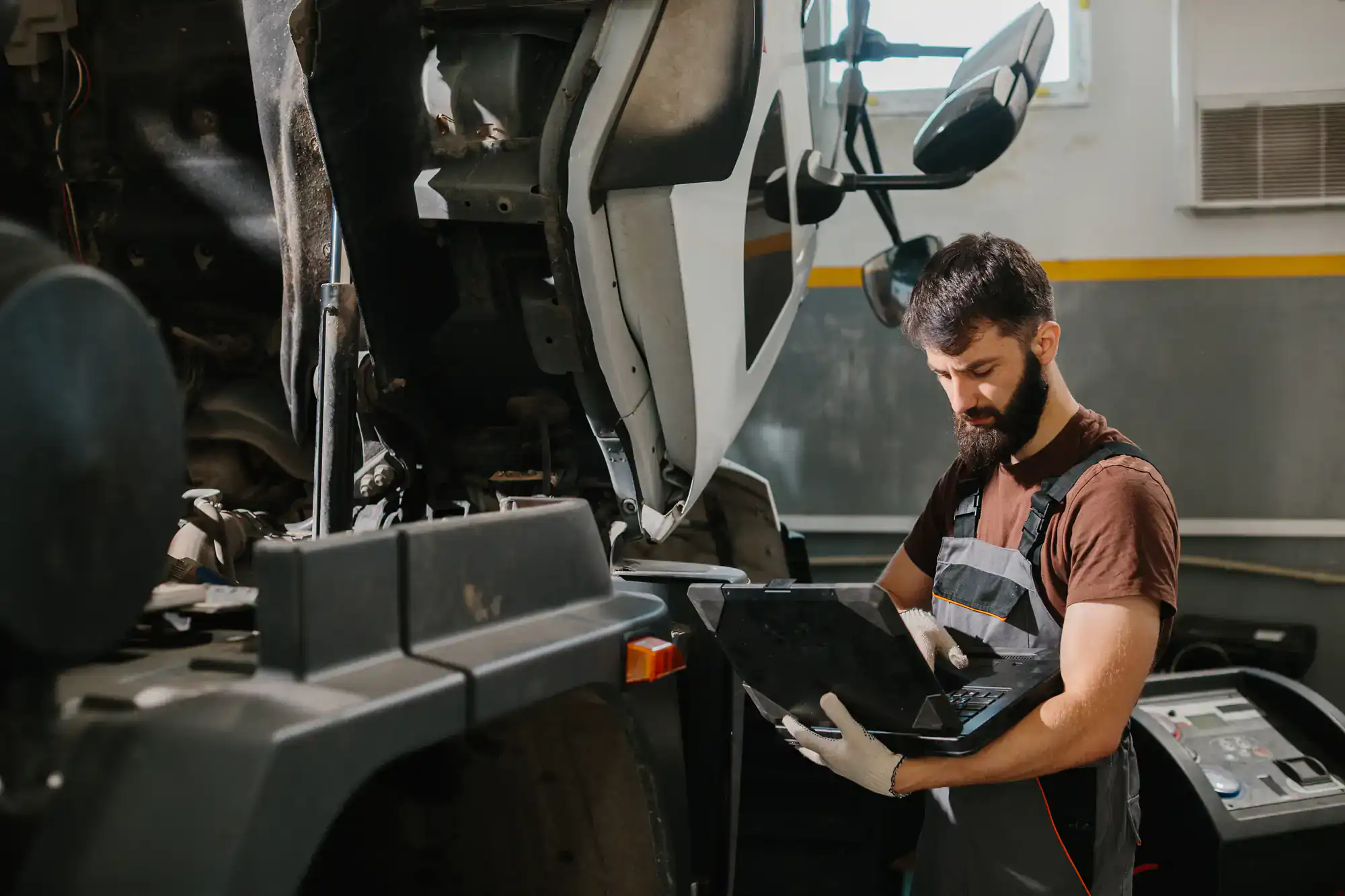
When we arrive, we connect directly to your truck’s ECU using CARB-certified OBD test equipment. The device pulls real-time emissions data and readiness monitor status from the truck’s onboard system. This is not a visual inspection or a tailpipe test it’s a direct read of the truck’s own emissions reporting. The entire on-site process is straightforward and doesn’t require the truck to be taken anywhere or kept out of service for long.
Once the test is complete, we submit the results electronically to CARB’s CTC-VIS database. That’s the step that actually makes you compliant not just having the test done, but having it recorded in the system. After submission, CARB’s data transmits to the DMV, and your vehicle’s compliance status updates within a few business days. If you’ve been operating under a Notice to Submit to Testing, that 30-day clock stops when the passing result hits CTC-VIS. One test. One submission. Done.

Ready to get started?
The Clean Truck Check program applies to diesel and alternative-fuel heavy-duty vehicles that are model year 2013 or newer with a GVWR over 14,000 pounds. If your truck meets both of those criteria and operates on California public roads, it’s subject to the program regardless of whether it’s registered in California, Arizona, Nevada, or anywhere else. That last point catches a lot of operators off guard in Blythe, given how much cross-border commercial traffic moves through here on I-10 and US-95.
What the service includes: on-site OBD testing using CARB-approved equipment, direct electronic submission to the CTC-VIS database, and a clear result you can reference for your own records. Currently, most OBD-equipped trucks require testing twice per year. Starting October 1, 2027, that increases to quarterly four times per year. For a Blythe operator running several trucks, that frequency increase is worth planning around now, not in 2027.
One thing worth clarifying: the $31.18 annual CARB compliance fee and the emissions test are two separate requirements. Paying the fee doesn’t mean you’ve tested. If you’ve paid but haven’t had an OBD test submitted through a credentialed tester, your truck is still non-compliant in CARB’s system. Both steps are required. We handle the test and the submission the fee side is yours to manage through your CTC-VIS account.
Yes and this is one of the most common points of confusion for operators in the Blythe area. CARB’s Clean Truck Check program applies to any qualifying heavy-duty vehicle that operates on California public roads, regardless of where the vehicle is registered. If your truck is registered in Arizona, Nevada, or any other state, but you’re running loads on I-10 through Blythe or hauling up US-95 toward Needles, you’re subject to the same compliance requirements as a California-registered truck.
The qualifying criteria are the same: model year 2013 or newer, GVWR over 14,000 pounds. If your truck meets both, you need to be in CARB’s CTC-VIS system with a current passing test on record. Out-of-state operators who aren’t aware of this often find out the hard way through a Notice to Submit to Testing or a roadside inspection on the I-10 corridor. The CHP Blythe office actively patrols this stretch. Getting tested proactively is the easier path.
No, and this is probably the most important distinction to understand about the program. The annual CARB compliance fee currently $31.18 per vehicle in 2025 and the emissions test are two completely separate requirements. Paying the fee registers your vehicle in CARB’s system and covers the administrative cost of the program. It does not satisfy the testing requirement.
To be fully compliant, your truck also needs a passing OBD emissions test submitted by a CARB-credentialed tester using approved equipment. That result has to be recorded in the CTC-VIS database. Until that happens, CARB’s system still shows your vehicle as non-compliant and your DMV registration is still at risk of a hold at renewal. Both the fee and the test are required. If you’ve only done one, you’re halfway there.
A failed test means your truck’s OBD system reported emissions-related fault codes or incomplete readiness monitors that don’t meet CARB’s compliance threshold. This doesn’t automatically result in a fine but it does mean your vehicle remains non-compliant in CTC-VIS until a passing test is submitted. If you’re operating under a Notice to Submit to Testing with a 30-day deadline, a failed test doesn’t stop that clock.
The practical path after a failure is to address whatever the OBD data flagged typically emissions control components like the DPF, EGR system, or SCR catalyst and then retest once repairs are complete. In Blythe’s heat, these components wear faster than in milder climates, so a failure isn’t always a surprise. What matters is moving quickly. We can retest after repairs are done, and once a passing result is submitted to CTC-VIS, your compliance record updates within a few business days.
You can submit a Clean Truck Check test up to 90 days before your compliance deadline. That’s one of the more useful features of the program that most operators don’t take advantage of. Instead of waiting until CARB sends a Notice to Submit to Testing and scrambling against a 30-day window, you can test early, on your own schedule, and have the result sitting in CTC-VIS well before any deadline pressure hits.
For Blythe-area operators, this matters more than it might in a city with multiple local testing options. There’s no credentialed HD I/M tester with a fixed shop in the Palo Verde Valley. Scheduling proactively rather than reactively means you’re not trying to get a mobile tester out to eastern Riverside County under a tight deadline during harvest season or a busy freight period on I-10. Testing ahead of time is just the smarter play from an operations standpoint.
The on-site portion of the test is relatively quick. Once the technician connects to your truck’s ECU with the CARB-certified OBD device, the data pull typically takes a matter of minutes. The total time on-site depends on factors like whether the truck’s readiness monitors are fully set meaning the truck has completed enough drive cycles for its onboard system to have current data across all monitored components. If a truck has recently had repairs or a battery disconnect, some monitors may be incomplete, which can affect the test outcome.
For most trucks that have been running regularly which describes most working trucks in Blythe, whether they’re hauling produce in the valley, running I-10 freight, or supporting operations at Ironwood State Prison the monitors are typically set and the test moves quickly. If you have any concerns about your truck’s readiness status before scheduling, it’s worth asking when you call. A little prep on your end can make the on-site visit as efficient as possible.
Yes the program has specific applicability criteria, and not every commercial truck qualifies. Clean Truck Check applies only to vehicles that are model year 2013 or newer AND have a GVWR over 14,000 pounds. Both conditions have to be met. A 2015 truck with a GVWR under 14,001 pounds doesn’t qualify. Neither does a pre-2013 heavy-duty truck, regardless of weight those older vehicles fall under different CARB oversight programs that use opacity testing rather than OBD.
In the Palo Verde Valley agricultural context, this means some lighter farm support vehicles or older fleet trucks may not be subject to Clean Truck Check at all. But most modern production diesel trucks used for produce hauling, cannabis distribution, solar facility logistics, or long-haul freight on I-10 are going to meet both thresholds. If you’re unsure whether a specific vehicle in your fleet qualifies, the model year and GVWR are both on the registration or call and we can help you figure it out before you schedule anything.
Useful Links
Other Services we provide in Blythe