
Hear from Our Customers

You keep your trucks registered. You avoid DMV blocks that shut down your operation. You stay clear of CARB enforcement and fines that can hit $10,000 per vehicle per day.
If your truck is model year 2013 or newer and has a GVWR over 14,000 pounds, California requires you to submit passing compliance tests twice a year starting in 2025. Miss a deadline and you’re looking at registration holds, roadside violations, and lost revenue while your rig sits.
This isn’t about checking a box. It’s about keeping your business moving without the stress of wondering if CARB’s going to come knocking. You get your compliance certificate, your paperwork gets submitted to the state, and you’re clear until your next deadline.
We’re a CARB credentialed testing facility in Artesia. That means we’ve completed the state’s training course, passed the exam, and we’re authorized to perform Clean Truck Check compliance testing on OBD-equipped diesel trucks.
Artesia sits right in the heart of Southern California’s trucking corridor. We see owner-operators, fleet managers, and out-of-state drivers who need to stay compliant while operating in California. We know the regulations, we know the deadlines, and we know what CARB’s looking for when they review test results.
You’re not getting a sales pitch here. You’re getting a straightforward service from people who understand that downtime costs you money and compliance confusion wastes your time.

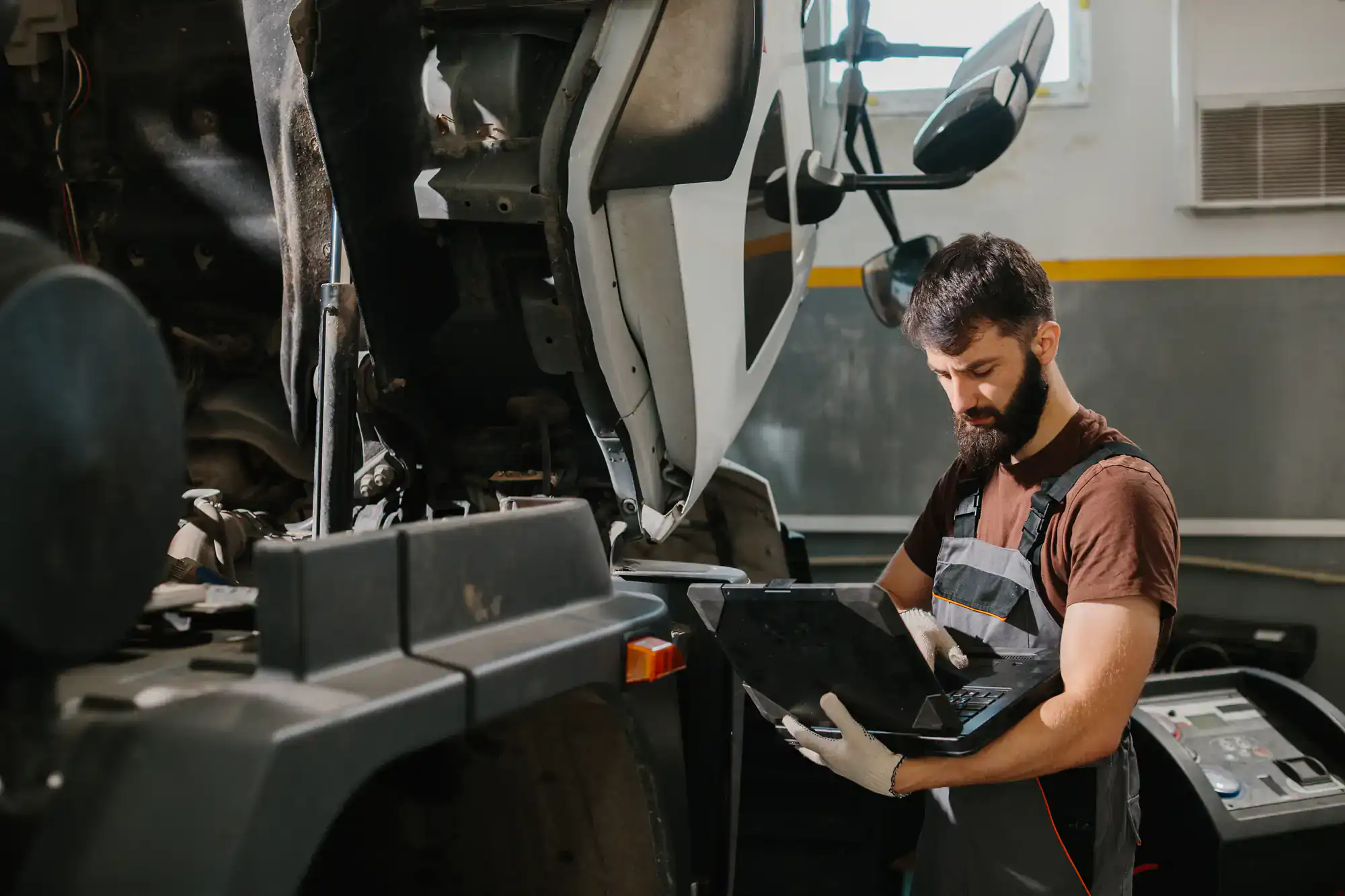
You bring your truck in—2013 or newer diesel with a GVWR over 14,000 pounds. We connect CARB-approved OBD diagnostic equipment to your vehicle and pull the emissions data that the state requires.
The test checks your truck’s onboard diagnostics system for emissions-related faults. If everything’s clean, you pass. If there are issues flagged, we’ll tell you exactly what needs attention before you can get a passing result.
Once you pass, we generate your compliance certificate and submit the test results directly to CARB. You can test up to 90 days before your deadline, which gives you time to handle repairs if something comes up. If you get a Notice of System Test from CARB, you’ve got 30 days to submit a passing test—so don’t wait until the last minute.

Ready to get started?
You get a full OBD emissions scan using CARB-certified testing equipment. We check for diagnostic trouble codes, monitor readiness status, and verify that your truck’s emissions systems are functioning as required by California regulations.
You receive an individual compliance certificate for your vehicle once you pass. We handle the electronic submission to CARB so your test results are on file with the state. If you’re managing a fleet, we can help you track compliance deadlines across multiple vehicles.
Artesia’s location puts you close to major freight routes and distribution centers throughout Los Angeles County. That means you’re not driving hours out of your way to find a credentialed tester. The annual compliance fee for 2025 is $31.18 per vehicle—that’s set by CARB, not us—and it’s a small price compared to the penalties for non-compliance.
This service only applies to trucks that meet both criteria: model year 2013 or newer AND GVWR over 14,000 pounds. If your truck doesn’t fit that description, this isn’t the test you need.
Starting in 2025, you’ll need to pass a Clean Truck Check twice a year. CARB assigns each vehicle a compliance deadline based on its VIN, and you’ll have two deadlines annually—roughly six months apart.
You can submit a passing test up to 90 days before your deadline. That window exists so you have time to address any repairs if your truck doesn’t pass on the first attempt. If you wait until the deadline hits and then fail, you’re in a tight spot with potential registration consequences.
Check your compliance deadline through CARB’s online system or wait for a Notice of System Test in the mail. If you get that notice, you have 30 days to submit a passing test. Missing that deadline can trigger DMV registration blocks.
If your truck fails, we’ll give you a detailed report of what triggered the failure. Usually it’s a diagnostic trouble code related to emissions systems—things like DPF issues, NOx sensor faults, or SCR system problems.
You’ll need to get those issues repaired before you can pass. Once the repairs are done, bring the truck back for a retest. The 90-day advance testing window is designed for exactly this scenario—it gives you time to fix problems without missing your compliance deadline.
If your deadline is approaching and you’re still dealing with repairs, that’s when penalties start becoming a real risk. CARB can block your registration with the DMV, and operating a non-compliant vehicle can result in fines up to $10,000 per vehicle per day. Get ahead of your deadlines.
Yes. If your truck operates in California—even if it’s registered in another state—you’re subject to CARB’s Heavy-Duty Inspection and Maintenance program. That includes Clean Truck Check requirements for 2013 and newer diesel trucks over 14,000 pounds GVWR.
CARB doesn’t care where your plates are from. If you’re running loads into or through California, you need to comply. Out-of-state operators get assigned compliance deadlines just like California-registered vehicles.
You can complete your testing at any CARB credentialed facility in the state. If you’re based out of state but regularly run California routes, it makes sense to plan your testing around your schedule here. Ignoring the requirement doesn’t make it go away—it just increases your risk of enforcement action during roadside inspections or weigh station stops.
Absolutely. You don’t need to wait for a Notice of System Test to get tested. In fact, it’s smarter to stay ahead of it.
You can check your compliance deadline online through CARB’s system using your VIN. Once you know your deadline, you can schedule testing up to 90 days in advance. That proactive approach gives you a cushion if repairs are needed.
If you do receive a notice in the mail, that means CARB is specifically flagging your vehicle and you have 30 days to submit a passing test. But waiting for that notice puts you on a tighter timeline. Testing early—especially if you’re managing multiple trucks—keeps you out of scramble mode when deadlines start piling up.
A CARB credentialed tester has completed California’s official training course on Heavy-Duty Inspection and Maintenance requirements, passed the exam with at least 80%, and received certification from the state. That credential has to be renewed every two years.
Only credentialed testers are authorized to perform Clean Truck Check compliance testing. If you go to someone who isn’t credentialed, your test won’t count—CARB won’t accept the results, and you’ll still be out of compliance.
We’re listed on CARB’s official database of credentialed testers available for hire. That means we’ve met the state’s standards and we’re authorized to submit test results directly into CARB’s system. It’s not just about having the equipment—it’s about being trained on the specific protocols CARB requires for valid compliance testing.
No. Clean Truck Check applies specifically to diesel and alternative fuel trucks that are model year 2013 or newer AND have a GVWR over 14,000 pounds. Both conditions must be met.
If your truck is older than 2013, it’s not subject to this program—those older trucks fall under different CARB regulations. If your truck is 2013 or newer but weighs less than 14,000 pounds GVWR, this doesn’t apply either.
The 2013 cutoff exists because that’s when OBD systems became standard on heavy-duty diesel engines. The testing relies on pulling data from those onboard diagnostic systems. Older trucks without OBD capability aren’t part of the Clean Truck Check program, though they may still have other emissions compliance requirements depending on their weight class and use.
Useful Links
Other Services we provide in Artesia