Two different tests, two different agencies, two very different consequences if you miss one. Here's what every commercial truck operator in Los Angeles County needs to know.

If you run a commercial truck in Los Angeles County, you’ve probably dealt with DOT inspections, CHP weigh stations, and the usual compliance paperwork that comes with operating in California. But there’s a newer requirement that’s been catching operators off guard since 2023 — and it has nothing to do with your brakes, tires, or lights.
California’s Clean Truck Check is a standalone vehicle emissions testing program, and it operates completely separately from any safety inspection you’ve already passed. Getting these two confused has real consequences: registration holds, daily fines, and trucks that can’t legally run. Here’s what you need to know to keep yours moving.
In some states, safety and emissions testing are bundled into a single annual inspection. You drive in, they check the brakes and the tailpipe, and you leave with one sticker. California doesn’t work that way — not for heavy-duty commercial vehicles.
Here, these are two entirely separate programs run by two entirely separate agencies. The California Highway Patrol oversees commercial vehicle safety inspections, checking mechanical components like brakes, steering, lighting, and tires. The California Air Resources Board runs the Clean Truck Check, which focuses exclusively on whether your truck’s emissions control systems are functioning properly. Passing one has zero bearing on the other. A truck can roll through a CHP inspection without a single violation and still be flagged as non-compliant by CARB — and vice versa.
The Clean Truck Check — officially called the Heavy-Duty Inspection and Maintenance program, or HD I/M — uses an OBD scan device to pull data directly from your truck’s Engine Control Unit. For 2013 and newer diesel trucks with a GVWR over 14,000 pounds, this is the required test method. The device connects to your truck’s OBD port, downloads the ECU data, and checks for active fault codes, readiness monitor status, and whether your emissions control systems are operating as designed.
What it’s not checking is anything mechanical. The test doesn’t care about your tire tread, your brake pad thickness, or whether your turn signals work. It’s entirely focused on your engine’s emissions output and the systems designed to control it — things like your diesel particulate filter, your NOx aftertreatment system, and your engine management software.
This matters because a truck can look and drive perfectly fine and still fail a Clean Truck Check. If your engine has stored fault codes related to emissions systems — even codes you’ve never seen a warning light for — those will show up in the ECU download. Readiness monitors that haven’t completed their cycles, often because codes were recently cleared, can also cause a failure. The test is looking at data your truck has been quietly logging, not just what’s visible from the outside.
Heavy-duty trucks and buses make up only about 3% of vehicles on California roads, but they’re responsible for more than half of the nitrogen oxides and fine particle diesel pollution from all mobile sources in the state. That’s the reason CARB built an entire separate compliance program around this vehicle class — and why the testing requirements are more demanding than a standard passenger car smog check.
A lot of operators hear “emissions test” and assume they can just pull into any smog station. That’s a costly assumption. The Clean Truck Check is not the same as California’s standard smog check, and most smog stations are neither equipped nor authorized to perform it.
Standard smog checks for passenger vehicles are administered through the Bureau of Automotive Repair and conducted at BAR-licensed stations. They’re required every two years for most cars over eight model years old. The Clean Truck Check is administered directly by CARB, requires a CARB-credentialed tester and CARB-certified OBD equipment, and results must be submitted electronically to CARB’s CTC-VIS database — not to any DMV or BAR system. If you take your qualifying truck to a regular smog shop, you’ll walk out with a receipt but no valid compliance record. Your truck will still be flagged as non-compliant in CARB’s system.
The testing frequency is also more demanding. Most subject vehicles are now required to test twice a year under the semi-annual schedule, and starting in 2027, OBD-equipped trucks will move to quarterly testing — four times per year. Compare that to the biennial schedule for most passenger cars, and you get a sense of how seriously California treats this vehicle class from an air quality standpoint.
The annual compliance fee is $31.18 per vehicle in 2025, which is modest. What’s not modest is the penalty for ignoring the program. Non-compliance can result in fines of up to $10,000 per vehicle per day, and as of August 2024, the California DMV began placing registration holds on non-compliant vehicles. A registration hold doesn’t just mean paperwork trouble — it means your truck can’t legally operate, which means it can’t generate revenue.
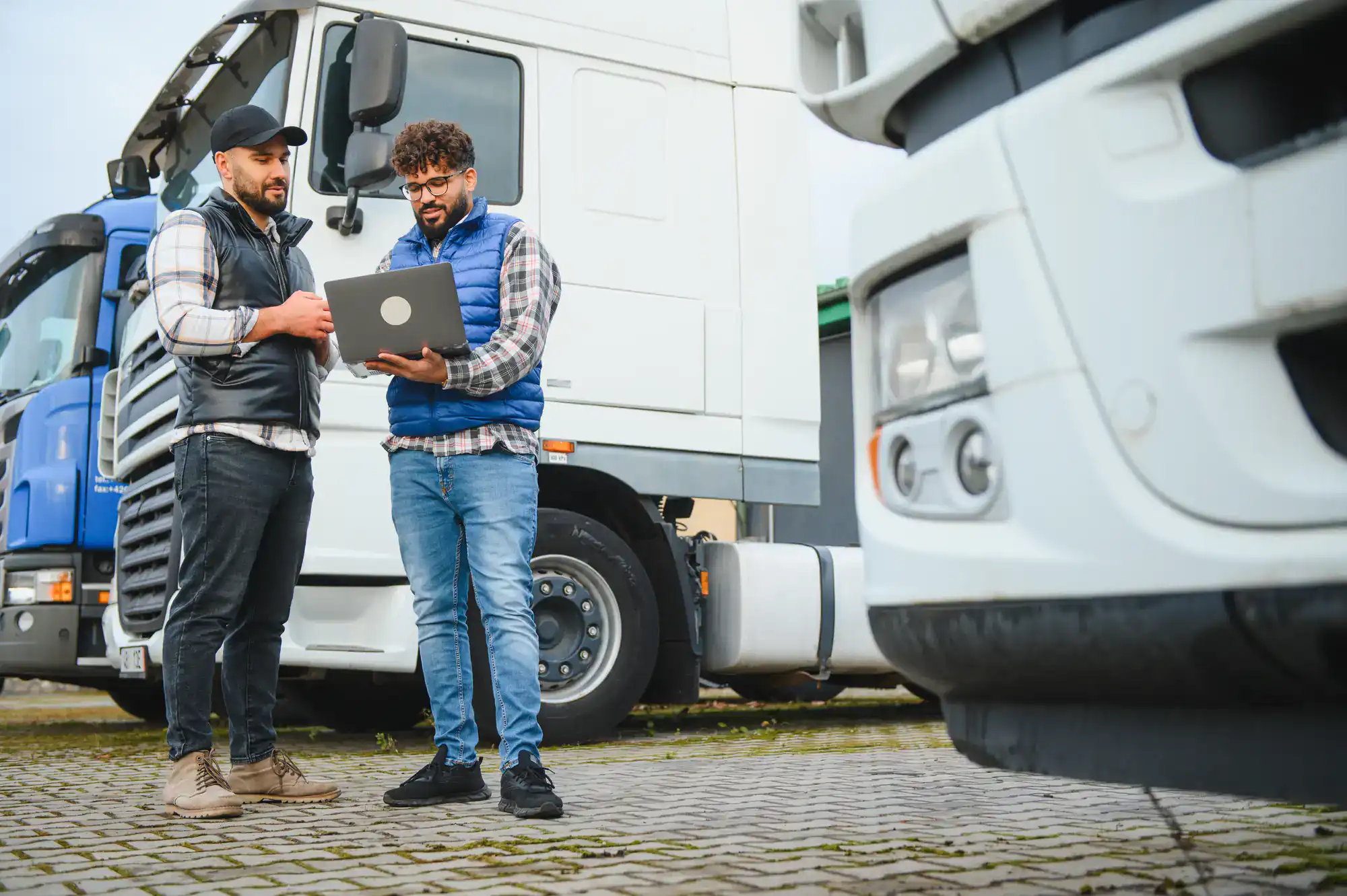
Los Angeles County sits at the center of California’s freight network. The ports of Los Angeles and Long Beach together handle roughly 40% of all containerized imports entering the United States, and the trucks moving that freight — along the 710 corridor, through the South LA warehouse district, up into the Inland Empire — are exactly the vehicles we built this program around.
If you operate a diesel or alternative-fuel truck with a GVWR over 14,000 pounds and a 2013 or newer engine in Los Angeles County, Clean Truck Check compliance isn’t optional. That applies whether your truck is registered in California or not. Out-of-state carriers running freight into Los Angeles County are subject to the same requirements as locally registered fleets.
The OBD test applies to diesel-engine trucks with model year 2013 or newer and a GVWR over 14,000 pounds. If your truck has a 2013 or newer engine and was manufactured with an OBD system — which CARB required on heavy-duty vehicles starting that year — this is your test. Alternative-fuel engines from 2018 and newer also fall under the OBD requirement.
Older trucks aren’t off the hook, but they go through a different process. Diesel trucks with 2012 and older engines require an opacity and visual inspection instead — a smoke test using the SAE J1667 snap acceleration method, plus a visual check of emissions control equipment. The test type depends entirely on your engine’s model year, not the truck’s model year, so it’s worth confirming which applies to your specific vehicle before scheduling anything.
For drayage operators running containers out of the Port of Los Angeles or Port of Long Beach, this is especially relevant. CARB has conducted enforcement events directly at the port — the program’s very first enforcement action took place at the Port of Los Angeles on January 1, 2023, where more than 1,200 trucks were screened in a single day. Port operators who are flagged as potential high emitters at one of these events receive a Notice to Submit to Testing, which gives them just 30 calendar days to submit a passing test result. That’s not a lot of runway, particularly if you’re trying to track down a credentialed tester for the first time.
One thing worth knowing: test results can be submitted up to 90 days before your compliance deadline. If you know your deadline is coming, testing early gives you time to address any issues before the clock runs out. Waiting until the week your registration is due is the scenario most operators regret.
When the Clean Truck Check program launched, a lot of general automotive shops started advertising HD emissions testing as an add-on service. Some of them were doing it without proper CARB credentials. Some were using OBD scanners that hadn’t been validated by CARB. In both cases, the test results were invalid — and the operators who paid for those tests found out the hard way when their trucks still showed as non-compliant in CTC-VIS.
A valid Clean Truck Check requires a CARB-credentialed tester using CARB-certified equipment, with results submitted directly and electronically to CARB’s CTC-VIS database. The credential is publicly verifiable — CARB maintains a list of credentialed testers, and you can look up any tester by their credential number before booking. Our credential is E164983.
The reason specialization matters here goes beyond credentials. A tester who works exclusively with 2013-and-newer trucks over 14,000 pounds knows the specific readiness monitor criteria that determine pass/fail, the fault code categories that will trigger a failure, and how to communicate clearly with an operator when something comes up. A general shop that handles the occasional HD truck between passenger car smog checks doesn’t have that depth — and when your truck’s registration is on the line, depth matters.
We operate as a mobile service, which means we come to your location — your yard, your terminal, wherever the truck is. The OBD download takes about 15 minutes per vehicle, and results are submitted to CTC-VIS the same day. For fleet operators in Los Angeles County who can’t afford to pull trucks off their routes for a shop visit, that combination of speed and mobility is the practical difference between a truck that runs and one that sits.