When your heavy-duty truck fails emissions in California, registration blocks immediately. Discover fast mobile retesting options and what steps to take next.
Your truck failed emissions. Now you’re staring at a registration block, a compliance deadline, and the reality that every day off the road costs money. An emission fail in California isn’t just paperwork—it’s an immediate halt to legal operation until you fix the problem and pass a retest.
If you’re running a heavy-duty truck over 14,000 lbs in Los Angeles County or Riverside County, you already know California doesn’t play around with emissions. The state’s Clean Truck Check program requires semi-annual testing, and a failed test means your DMV registration won’t renew until you’re compliant. Here’s what you need to know about moving from failure to passing, fast.
The moment your truck fails emissions testing in California, the DMV places a registration hold on your vehicle. You can’t renew your registration. You can’t legally operate on public roads. And if you’re caught driving with expired tags, you’re looking at citations, fines, and the possibility of your vehicle being searched during a traffic stop.
The testing station hands you a Vehicle Inspection Report that outlines exactly why your truck failed. Maybe it’s an OBD fault code. Maybe it’s a sensor reading that’s out of range. Either way, the report tells you what needs fixing before you can retest. California law requires you to make those repairs at a licensed facility, then return for another emissions test before your registration hold lifts.
There’s no limit to how many times you can fail. But each failure delays your compliance, racks up potential late fees, and keeps your truck parked when it should be earning. The clock starts ticking the moment you get that failed result.
Los Angeles County consistently ranks among the cities with the worst air quality in the United States. Diesel particulate matter and nitrogen oxides from heavy-duty trucks are major contributors to smog, respiratory illness, and cardiovascular problems. California’s Clean Truck Check program exists because the health consequences are real and measurable.
The California Air Resources Board requires all diesel and alternative fuel trucks over 14,000 lbs GVWR to undergo emissions testing twice a year. Starting in October 2027, trucks with OBD systems will test quarterly. These aren’t suggestions. They’re enforceable regulations backed by roadside emissions monitoring, automated license plate readers, and coordination with California Highway Patrol.
When you fail an emissions test, it’s not just about your truck. It’s about whether your vehicle is contributing to pollution levels that cause thousands of premature deaths, hospitalizations, and asthma cases every year in California. The state takes this seriously because the air quality crisis is that severe. Between 2005 and 2007 alone, air pollution led to almost 30,000 hospital and emergency room visits in California for respiratory and cardiovascular issues, costing over $193 million in medical care.
That’s why the penalties for non-compliance are harsh. Registration holds. Daily fines that can exceed $1,000 per vehicle. Denial of entry to ports and railyards. California has built an enforcement infrastructure designed to keep polluting trucks off the road, and an emission fail puts you squarely in the crosshairs of that system until you fix the problem and pass.
Most emission failures on heavy-duty trucks come down to a handful of issues. If your check engine light is on, you’re going to fail automatically. No exceptions. The OBD system flags that something in your emissions control equipment isn’t working correctly, and California won’t pass a truck with active fault codes.
Faulty oxygen sensors are another common culprit. When your O2 sensor isn’t reading correctly, your engine’s air-fuel mixture gets thrown off, which increases emissions beyond acceptable limits. Catalytic converter problems will also tank your test. The catalytic converter’s job is to turn harmful pollutants into less harmful gases before they exit your tailpipe. If it’s malfunctioning, your emissions readings spike.
EVAP system failures happen when your truck’s evaporative emission control system—which prevents raw fuel vapors from escaping—develops leaks or valve problems. Tampering with emissions equipment is an automatic fail and can trigger additional penalties. If there’s evidence someone tried to bypass or remove emissions controls, you’re not passing until it’s fixed and documented.
For trucks model year 2013 and newer, the OBD test pulls data directly from your engine computer. It’s checking whether your emissions control systems are functioning as designed. For older trucks, smoke opacity tests measure the density of exhaust particulates. Either way, if your truck is producing emissions above California’s thresholds, you’re not getting a passing certificate until repairs bring you back into compliance.
The repair costs vary. Sometimes it’s a simple fix like replacing a gas cap or resetting a sensor. Other times you’re looking at expensive catalytic converter replacements that can run $1,000 to $2,000 or more. The Vehicle Inspection Report you receive after failing will point you toward what needs attention. Get those repairs done at a licensed facility, then schedule your retest.
If you operate a heavy-duty truck in Los Angeles County, you’re subject to California’s Clean Truck Check program. That means registering your vehicle in the CTC-VIS database, paying an annual compliance fee of $32.13 per truck, and submitting passing emissions tests twice a year. These aren’t optional steps. They’re legal requirements enforced by CARB and the DMV.
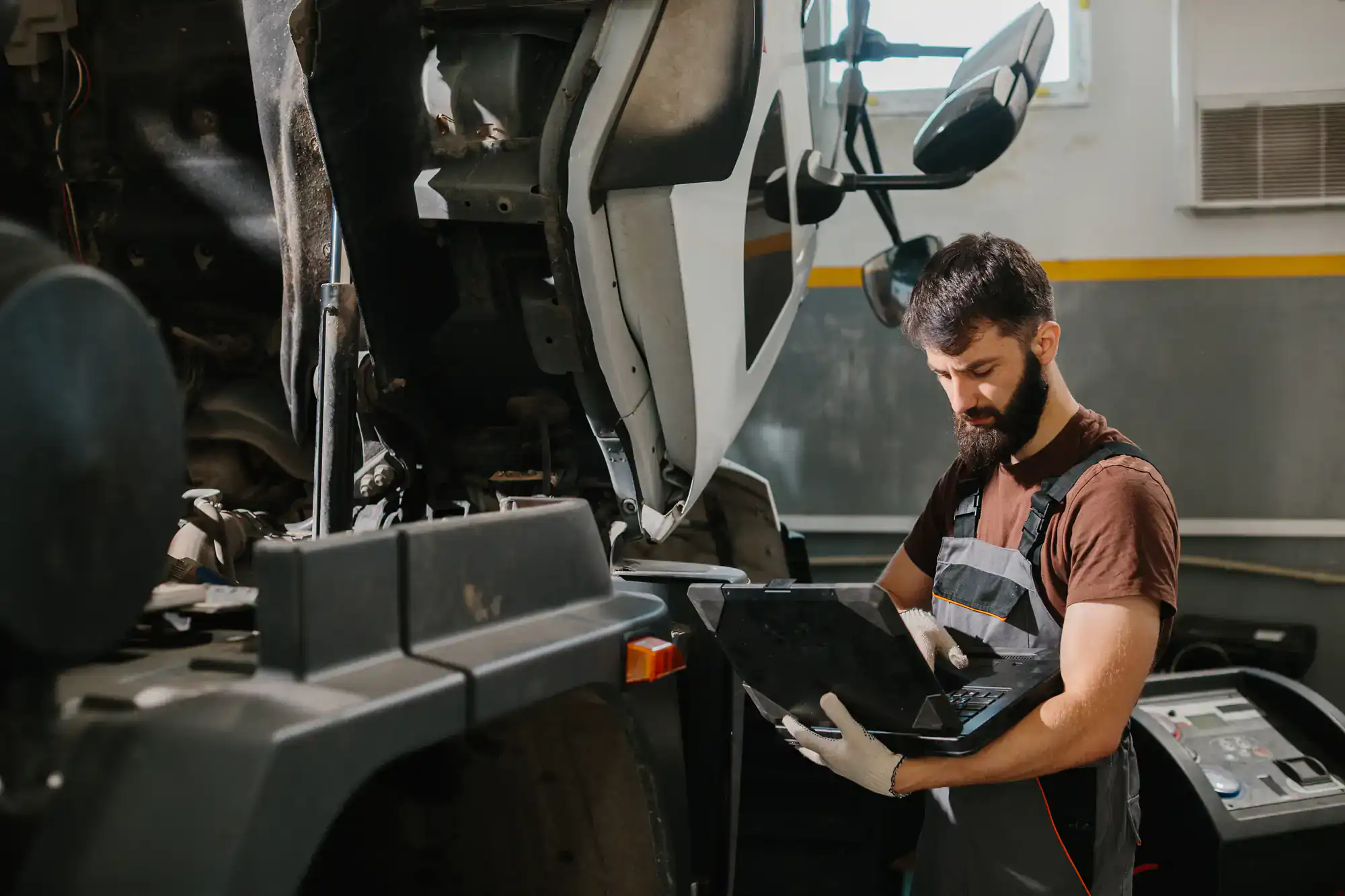
The testing process depends on your truck’s engine model year. Trucks with 2013 or newer diesel engines get OBD scans using CARB-certified devices. We plug into your truck’s diagnostic port, download emissions data from your engine computer, and submit the results electronically to CARB’s CTC-VIS system. The whole process takes about 10 to 15 minutes when everything’s working correctly.
Older trucks without OBD systems go through smoke opacity testing, which measures visible exhaust emissions and checks for excessive particulate matter. That test takes longer—sometimes up to an hour—and requires your truck to be at operating temperature. Either way, you need a CARB-credentialed tester who’s completed the official training and passed the certification exam. Not every smog check shop can test heavy-duty trucks, which is why finding qualified testers becomes a pain point for many operators.
When your truck fails emissions and you need to retest fast, finding a qualified facility becomes urgent. Not every smog check shop handles heavy-duty vehicles over 14,000 lbs. You need a CARB-credentialed tester with the right equipment and certification to perform Clean Truck Check inspections.
The California Bureau of Automotive Repair maintains a searchable database of authorized testing facilities. You can search by station name, city, county, or zip code. But here’s the problem: most of those facilities are fixed locations. That means you have to drive your truck there, wait in line, hope they can fit you in, and then drive back. If you’re managing a fleet, that process multiplies across every truck that needs testing.
That’s where mobile emissions testing changes the game. Mobile services bring CARB-certified testers and state-approved OBD equipment directly to your location. Your trucks never leave your yard, warehouse, or job site. You’re not burning fuel or paying drivers to sit in smog check waiting rooms. We come to you, run the inspection on-site, and submit results electronically to CARB’s database before we leave.
For operators in Los Angeles County and Riverside County, mobile testing eliminates the logistical headache of finding the nearest smog check facility and coordinating schedules. You can test multiple trucks in a single visit. The inspection takes 10 to 15 minutes per truck. Results upload immediately. Your compliance status updates within a few business days, and you get proof for your records on the spot.
If you’ve just failed an emissions test and need to retest after repairs, we can return to your location and verify that the fixes worked. No need to hunt down another facility or waste more time driving. We bring the smog check to you. You stay focused on your operation.
Not all smog check shops are created equal, especially when it comes to heavy-duty diesel trucks. You need a facility or service with CARB-credentialed testers, state-approved OBD testing devices, and experience handling trucks over 14,000 lbs GVWR. The credentials matter because only authorized testers can submit results to California’s CTC-VIS database in a way that clears your registration hold.
When you’re evaluating a smog check shop or mobile testing service, ask about their certification. CARB requires testers to complete official training and pass an exam before they can perform Clean Truck Check inspections. The testing equipment must also meet CARB standards. If a shop is using uncertified devices or hasn’t kept their credentials current, your test results won’t be accepted by the DMV.
Response time is another factor. If your registration deadline is approaching or you’ve already got a hold on your account, you can’t afford to wait days for an appointment. Look for services that offer same-day or next-day testing. Emergency and after-hours availability can be a lifesaver when you’re up against a compliance deadline and every day off the road costs revenue.
Owner-operated businesses often provide more personalized service and accountability than large chains. When you’re dealing with the owner directly, you get faster communication, more flexibility on scheduling, and someone who’s invested in making sure your trucks pass. That level of responsiveness matters when you’re trying to get back on the road quickly after an emission fail.
Mobile services have another advantage: they can handle high volumes. If you’re running a fleet and need to test 15, 20, or 40 trucks, a mobile tester can work through your entire fleet in a day or two without disrupting your operations. Fixed facilities can’t match that convenience. You’re not coordinating multiple trips or juggling driver schedules. The testing comes to you, gets done fast, and your trucks stay on-site the entire time.
Pricing varies, but expect to pay between $80 and $180 per truck depending on whether you need OBD testing or smoke opacity testing. Mobile services may charge slightly more than fixed facilities, but the savings in time, fuel, and operational disruption usually make up the difference. When you factor in the cost of taking trucks out of service and driving them across Los Angeles County to find a smog check shop, mobile testing often comes out ahead.