Some emission test locations simply aren't built for heavy-duty trucks. Here's how to spot the difference before it costs you time, money, or your registration.
You need your truck tested. You search for emission test locations nearby, call a shop, and they say yes — sure, we can do that. But can they? Not every shop that answers the phone is actually authorized to perform a Clean Truck Check for a heavy-duty commercial vehicle. And if you get tested by someone who isn’t properly credentialed, your truck stays flagged as non-compliant in CARB’s database — even though you paid for a test. In Los Angeles County, where enforcement is aggressive and port access depends on your compliance status, that’s a problem you can’t afford. Here’s what to watch for before you book.
California’s Clean Truck Check program — officially the HD I/M (Heavy-Duty Inspection and Maintenance) regulation — requires that all heavy-duty vehicles over 14,000 lbs GVWR undergo testing by a CARB-credentialed tester using CARB-certified OBD equipment. Results must be submitted electronically to CARB’s CTC-VIS database. That’s the only chain of events that actually updates your compliance status and lifts a DMV registration hold.
The problem is that this program is relatively new, and plenty of general smog shops throughout Los Angeles County haven’t gone through CARB’s credentialing process for heavy-duty vehicles. They may have OBD scanners — but not the right ones. They may offer to test your truck — but lack the authorization to submit results to CTC-VIS. CARB maintains a public list of credentialed testers at ww2.arb.ca.gov. Checking that list before you book takes two minutes and can save you a lot of grief.
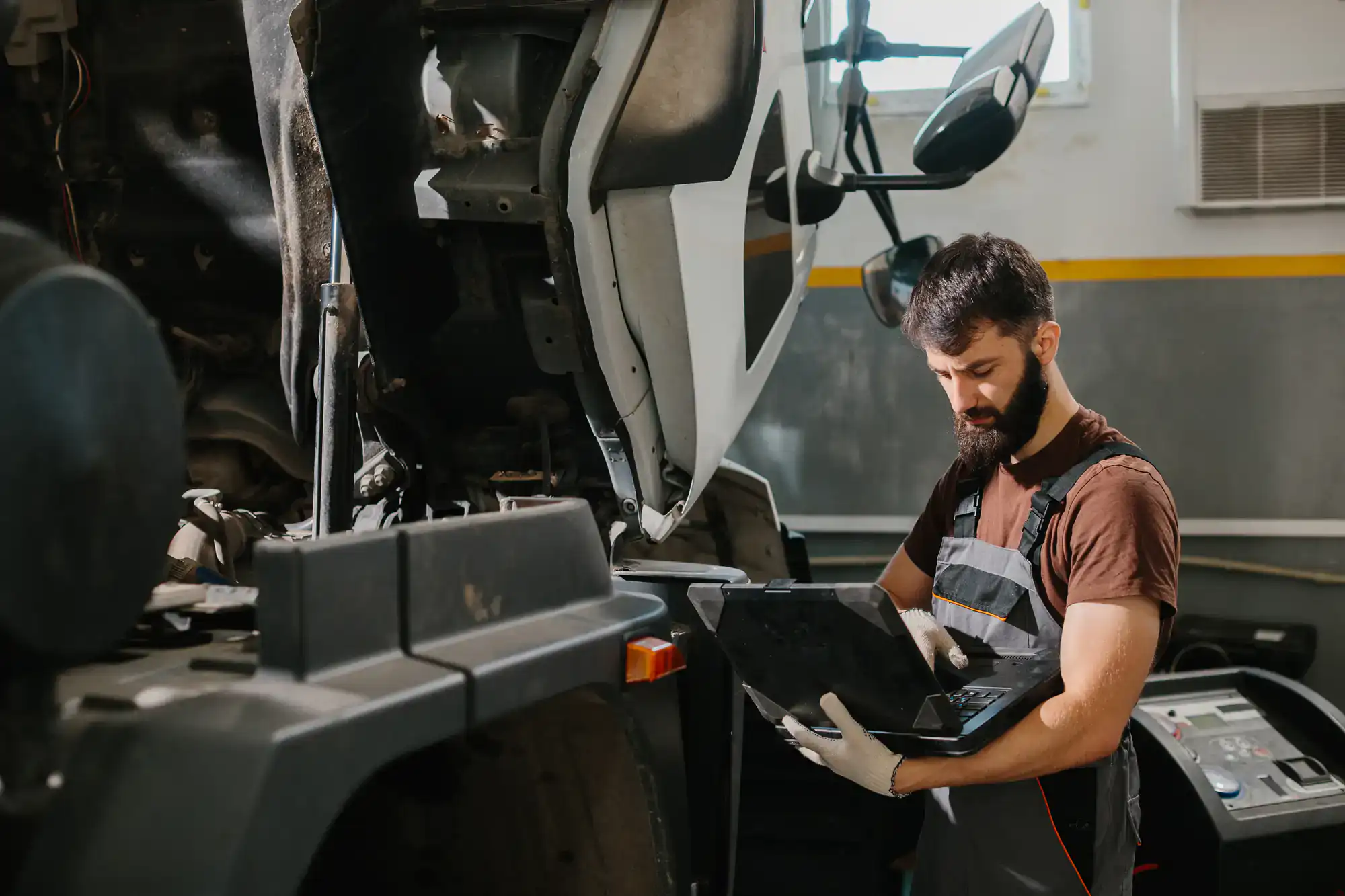
For a 2013 or newer diesel truck, the Clean Truck Check is an OBD data download — not a smoke opacity test. A technician connects a CARB-certified scanning device to the truck’s diagnostic port, pulls a snapshot of the engine’s ECU data, and transmits it encrypted and directly to CARB’s CTC-VIS system. The whole thing takes about 15 minutes. That’s it.
Opacity testing — the kind where a truck is revved and smoke emissions are measured — applies to 2012 and older diesel engines. If a shop tries to perform an opacity test on your 2013 or newer truck, they’re running the wrong test entirely. It won’t satisfy your Clean Truck Check requirement, and it won’t do anything to your compliance status in the database.
This distinction matters more than most operators realize. A lot of the confusion in the market comes from shops that are experienced with older diesel testing but haven’t updated their equipment or credentials for the OBD-based program. They’re not necessarily trying to mislead you — they just aren’t set up for what your truck actually needs.
There are also a few technical details worth knowing before you show up anywhere for testing. If your check engine light is on, the test will automatically fail — the MIL (malfunction indicator lamp) being active is an immediate disqualifier under the OBD protocol. Similarly, if you’ve recently disconnected the battery or cleared diagnostic codes, your truck’s readiness monitors may not be fully set, which can also cause a failure. A qualified tester should ask about this before running the test, not after.
The takeaway here is simple: diesel emissions testing for heavy trucks is a specific, technical process that requires specific credentials and equipment. The fact that a shop does smog checks for cars or runs opacity tests on older diesels doesn’t mean they can handle your 2013+ commercial vehicle.
Driving a semi-truck to a testing station, waiting in line, and driving back isn’t just inconvenient — it’s a real operational cost. For an owner-operator running loads out of Carson or Compton, a half-day off the road is lost revenue. For a fleet manager with 10 or 15 trucks in a yard near the port, sending each one out individually is a logistical headache that compounds fast.
Mobile emissions testing solves this directly. A credentialed tester comes to wherever your truck is — your yard, your terminal, a distribution center, wherever the truck is sitting — runs the OBD download on-site, and submits the results to CTC-VIS the same day. The truck doesn’t move. The driver doesn’t lose a shift. The compliance record updates within one to three business days, and any DMV registration hold lifts automatically once the passing result is in the system.
Some operators assume that mobile testing is somehow less official than going to a fixed location. It isn’t. The test is digital — it’s an ECU data download. A credentialed mobile tester using CARB-approved equipment submits results through the exact same CTC-VIS system as any fixed-location shop. The location of the test has no bearing on its validity. What matters is the credential and the equipment.
For fleet operators in the LA logistics corridor — particularly those running drayage in and out of the Port of Los Angeles or the Port of Long Beach — mobile testing is often the only practical option. These operators can’t afford to have trucks sitting idle, and they can’t afford to have trucks denied port entry because a compliance record didn’t update in time. Speed and reliability matter more than convenience here. A mobile tester who submits results same-day is genuinely the faster path to compliance, not just a more comfortable one.
Los Angeles County isn’t a typical market for this kind of work. The Port of LA and the Port of Long Beach together handle roughly 40% of all containerized imports entering the United States. The I-710 corridor — the Long Beach Freeway — is one of the most heavily traveled diesel freight routes in the country, and CARB has roadside emissions monitoring devices deployed along it. Enforcement here is not theoretical.
When CARB launched public enforcement of the Clean Truck Check program at the Port of Los Angeles on September 1, 2023, they screened more than 1,200 trucks in a single day. Operators throughout Los Angeles County felt that immediately. Non-compliant trucks face fines of up to $10,000 per vehicle per day — and a fleet of 10 trucks out of compliance for one week represents a potential $700,000 fine exposure. The stakes are real, and the enforcement infrastructure to back them up is already in place.
There’s a meaningful difference between a shop that handles heavy trucks among everything else it does and one that has stopped doing everything else specifically to focus on heavy trucks. When a testing operation has walked away from passenger cars entirely and built its entire process around 2013-and-newer OBD trucks over 14,000 lbs GVWR, that’s not a limitation — that’s a signal.
Specialization means the equipment is right. It means the technician has run hundreds of these specific tests, knows what readiness monitor issues look like before they become failures, and understands the CTC-VIS submission process well enough to catch problems before they affect your compliance record. It means you’re not the edge case — you’re the only case.
For drayage operators working the port corridor in Los Angeles County, for fleet managers with yards in Commerce or Vernon, for owner-operators hauling freight between LA County and the Inland Empire — the cost of a botched test isn’t just the test fee. It’s the compliance hold that doesn’t get lifted in time, the port access that gets denied, the registration that can’t be renewed. Choosing a tester who specializes exclusively in this type of vehicle and this specific program isn’t overcautious. It’s the practical choice.
We serve Los Angeles County and Riverside County — the full corridor that connects the ports to the distribution centers in Perris, Fontana, and Ontario. Many fleet operators in this region have trucks and yards in both counties. We cover both, which means one call handles your entire operation regardless of where the trucks are sitting.
The first sign is that they can’t give you a CARB credential number. Every authorized Clean Truck Check tester has a specific credential issued by CARB after completing official training and passing a credentialing exam. Ours is E164983 — you can verify it on CARB’s public tester list at ww2.arb.ca.gov. If a shop can’t tell you their credential number, or gets vague when you ask, that’s your answer.
The second sign is that they’re offering an opacity test for your 2013 or newer truck. If someone is quoting you a smoke opacity test for a truck that has an OBD system, they either don’t understand the program or they’re not equipped for it. The two test types are not interchangeable, and performing the wrong one accomplishes nothing for your compliance status.
The third sign is that they can’t confirm direct electronic submission to CTC-VIS. A paper report is not compliance. Results must be submitted electronically to CARB’s database by the credentialed tester. If a shop is handing you documentation and telling you to submit it yourself, the compliance record isn’t getting updated — and your registration hold isn’t going anywhere.
The fourth sign is that they service every type of vehicle. A shop that tests passenger cars, light trucks, motorcycles, and heavy-duty semis is spreading its expertise thin. The Clean Truck Check program has specific technical requirements that reward focus. A shop trying to do everything is less likely to have the right OBD equipment, the right training, and the right submission process for your specific truck.
The fifth sign is that they can’t tell you what happens if your truck fails. A qualified tester should be able to explain — before you pay — what a check engine light means for your test outcome, what permanent diagnostic trouble codes are and why they matter, and what your options are if readiness monitors aren’t fully set. If they can’t answer those questions, they’re not the right fit for a commercial vehicle with real compliance stakes.