
Check Out Our Reviews!

Pico Rivera sits right in the middle of one of the busiest freight corridors in the country. The I-605 runs along your eastern edge, the I-5 to the south, and the CA-60 less than two miles north and trucks running between the Port of Long Beach, City of Industry, and Santa Fe Springs pass through this area constantly. CARB knows it too. Enforcement pressure along these corridors is real, and it’s not letting up.
What a passing Clean Truck Check actually gives you is simple: your truck’s VIN shows as compliant in CARB’s database, the DMV registration hold risk disappears, and you’re not scrambling to get a test done inside a 30-day Notice to Submit window. That’s the difference between a truck that’s working and one that’s parked.
For owner-operators running out of Pico Rivera’s industrial corridor along Slauson Avenue or fleet managers coordinating routes across Southeast LA County the cost of non-compliance isn’t just a fine. It’s a truck that can’t move freight, a load you can’t pick up, and a client relationship you can’t afford to damage. Getting this handled proactively is the move that keeps all of that off the table.
We’re a CARB-credentialed emissions testing company focused exclusively on 2013-and-newer heavy-duty trucks. That’s not a tagline it’s a deliberate choice. No passenger cars, no older opacity-test vehicles, no divided attention. Just OBD-equipped trucks with a GVWR over 14,000 pounds, tested with CARB-certified equipment by a credentialed tester you can verify on CARB’s own website before you ever book.
Pico Rivera is part of Los Angeles County’s Gateway Cities region a freight-dense community with real industrial roots, from the old Ford assembly plant to the active rail lines still running through the city today. The truck operators here aren’t managing fleets from a corporate office. They’re owner-operators and small business owners who need compliance handled right the first time, without having to chase paperwork or log into government portals afterward.
That’s exactly what we’re built for. We come to your location in Pico Rivera, run the test, and submit directly to CTC-VIS. Your job is to keep the truck moving. Ours is to make sure CARB’s records say you’re good to go.

It starts with a quick booking. You give us your truck’s VIN, model year, and location whether that’s a yard off Slauson Avenue, a dock near the I-605 corridor, or anywhere else in the Pico Rivera area. We confirm a time that works around your schedule, not the other way around.
When we show up, we connect our CARB-certified OBD device directly to your truck’s diagnostic port. The device pulls emissions data from the engine control unit no test drive required, no lengthy inspection process. For 2013-and-newer heavy-duty trucks, this is the exact method CARB requires for Clean Truck Check compliance. The whole on-site process typically takes under an hour.
Once the test is complete, we handle the CTC-VIS submission directly. Your results go into CARB’s system electronically, and your VIN gets updated as compliant. DMV records typically reflect that update within 3 to 5 business days. You don’t log into any portal, you don’t upload any files, and you don’t need to follow up with anyone. The only thing left for you to do is get back to work which, if you’re running freight between Pico Rivera and the Port of Long Beach or City of Industry, probably means sooner rather than later.

Ready to get started?
Clean Truck Check applies to diesel and alternative-fuel heavy-duty vehicles that are model year 2013 or newer and have a GVWR over 14,000 pounds. If your truck meets both of those criteria and operates in California, it needs to test. That includes semi-trucks, box trucks, delivery trucks, flatbeds, and other commercial vehicles in that weight class the kind of equipment that moves freight through Pico Rivera’s industrial zone and along the Southeast LA freight corridors every day.
Right now, OBD-equipped trucks are required to test twice per year. That changes in October 2027, when the schedule moves to quarterly four tests per year. For fleet operators managing multiple trucks in the 90660, 90661, or 90662 ZIP codes, that’s a significant jump in compliance volume. Getting a testing relationship established now, before the frequency increases, is the kind of planning that saves headaches later.
One thing worth knowing clearly: the $31.18 annual compliance fee and the emissions test are two completely separate requirements. Paying the fee does not satisfy the testing requirement. Both are required, and many truck owners in the area have been caught off guard by this at DMV renewal. We handle the test and the CTC-VIS submission but make sure your fee is also current so there are no loose ends on the compliance side.
If your truck is model year 2013 or newer and has a GVWR over 14,000 pounds, yes it needs a Clean Truck Check regardless of where it’s based or where it operates in California. Pico Rivera falls within Los Angeles County, which is one of the most actively monitored regions in the state for heavy-duty diesel emissions. The South Coast Air Quality Management District the strictest air quality jurisdiction in the country covers this area, and Southeast LA has been designated as an AB 617 community air protection priority zone. That means enforcement here isn’t hypothetical.
If your truck runs freight along the I-605, hauls loads to the Port of Long Beach, or makes regular runs between Pico Rivera and City of Industry distribution centers, it’s operating in corridors where CARB enforcement presence is consistent. Getting your Clean Truck Check done proactively rather than waiting for a Notice to Submit or a DMV registration hold is always the better position to be in.
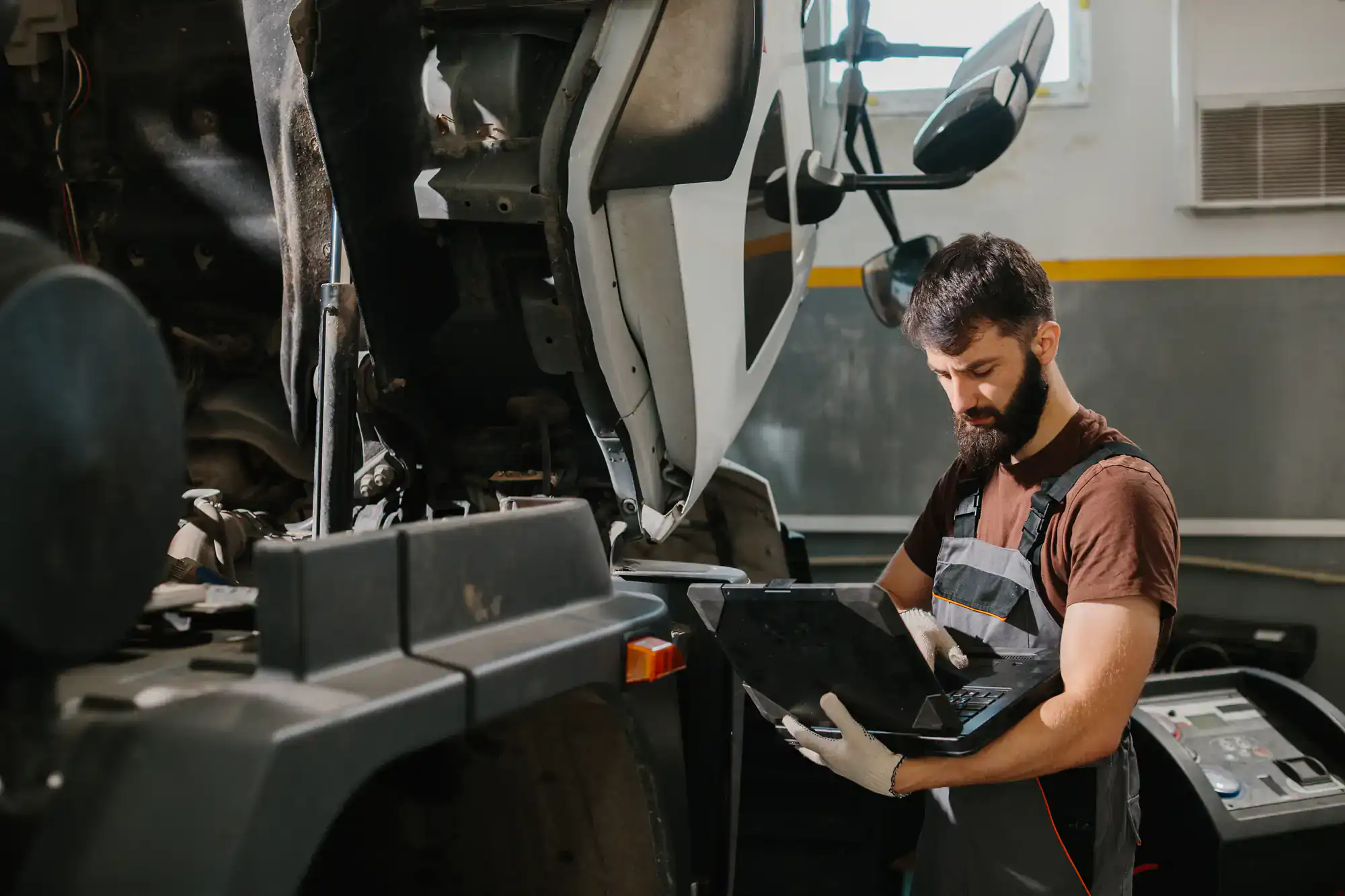
The Clean Truck Check test is an OBD data download not a visual inspection, not a tailpipe emissions test, and not a mechanical evaluation. A CARB-certified OBD device connects to your truck’s diagnostic port and pulls data directly from the engine control unit. That data tells CARB what your engine’s emissions control systems are doing and whether everything is functioning within acceptable parameters.
The process itself is straightforward and doesn’t require the truck to be driven. For most heavy-duty vehicles, the on-site portion takes under an hour. What matters most is that the tester uses a device that holds a CARB Executive Order because only CARB-certified equipment produces a result that CTC-VIS will accept. An OBD scanner that isn’t on CARB’s approved list generates a test that simply doesn’t count, no matter how professional the tester looks. We use certified equipment, and the results go directly into CTC-VIS after every test.
A DMV registration hold means CARB has flagged your truck as non-compliant and transmitted that status to the DMV. You won’t be able to renew your registration until a passing Clean Truck Check result is on file in CTC-VIS. CARB updates the DMV’s compliant VIN list nightly, so once a passing test is submitted, the hold clears within 3 to 5 business days but the clock doesn’t start until the test is actually in the system.
For owner-operators in Pico Rivera who depend on their truck to generate income, a registration hold isn’t just a paperwork problem. It’s a truck that can’t legally operate, which means loads you can’t take and revenue you can’t recover. The fastest path out of a hold is a same-week or same-day mobile test from a CARB-credentialed tester who submits results directly to CTC-VIS which is exactly how we operate. Don’t wait on this one. The longer the hold sits, the longer the truck sits.
A Notice to Submit to Testing gives you exactly 30 calendar days to submit a passing Clean Truck Check result to CARB. That’s 30 days from the date on the notice not 30 business days, not 30 days from when you open it. If your truck needs a repair before it can pass, that repair window comes out of the same 30 days.
For truck operators in the Pico Rivera area, 30 days can disappear fast when you’re managing a freight schedule, coordinating repairs, and trying to keep loads moving between Southeast LA and the port. The safest approach is to book the test as soon as you receive the notice even if you think the truck will pass easily. If it does pass, your VIN is in CTC-VIS within days and the notice is resolved. If it doesn’t pass, you still have time to address whatever’s flagged and retest before the deadline expires. Waiting until day 25 to find out the truck needs a repair is a position nobody wants to be in.
Currently, OBD-equipped heavy-duty vehicles are required to test twice per year semi-annually. That’s the schedule that’s been in place since the Clean Truck Check program entered full enforcement in 2024. But that frequency is going up. Starting October 1, 2027, the requirement moves to quarterly testing four times per year.
For a single owner-operator in Pico Rivera running one truck, that means going from two tests a year to four. For a fleet manager handling five or ten trucks across the 90660 to 90662 ZIP codes, that’s a significant increase in scheduling and compliance overhead. The operators who are going to handle that transition smoothly are the ones who already have a credentialed, mobile tester they trust not the ones scrambling to find someone reliable when the new schedule kicks in. Establishing that relationship now, while the frequency is still manageable, is the practical move.
No and this is one of the most common misunderstandings among truck operators across Los Angeles County, including Pico Rivera. The $31.18 annual compliance fee and the Clean Truck Check OBD emissions test are two completely separate requirements. Paying the fee does not satisfy the testing requirement. You need both.
The fee is paid to CARB annually and is essentially a program participation fee. The emissions test is a separate event a physical OBD data download performed by a CARB-credentialed tester using CARB-certified equipment, with results submitted electronically through CTC-VIS. Many truck owners in the area have paid the fee on time, assumed they were covered, and then hit a DMV registration hold at renewal because the test was never done. If you’re not sure whether your truck has a current passing test on file, the safest thing to do is check your CTC-VIS record or contact a credentialed tester directly. We can help you figure out where your compliance stands before it becomes a problem at the DMV window.
Useful Links
Other Services we provide in Pico Rivera