

Check Out Our Reviews!

Perris is one of the busiest freight corridors in the Inland Empire. With over 1,500 registered trucking companies operating in the area and major distribution centers for Amazon, Ross Stores, and Home Depot running trucks in and out daily, the pressure to stay compliant is real and CARB enforcement in Riverside County is active, not theoretical.
The biggest thing most truck owners in Perris get wrong is thinking the $31.18 annual compliance fee covers everything. It doesn’t. That fee and the emissions test are two separate requirements. If you’ve only paid the fee, your VIN still shows non-compliant in CARB’s system and DMV will put a hold on your registration at renewal. That hold doesn’t lift until a passing test result is submitted directly to CTC-VIS.
What changes when you get tested and cleared: your truck stays on the road, your registration renews without a fight, and you’re not staring down fines that can reach $10,000 per vehicle per day. For owner-operators running drayage from the ports of LA and Long Beach up I-215 into Perris, that’s not a hypothetical risk. It’s the kind of thing that ends a business.
We are a CARB-credentialed emissions testing company that works exclusively with model year 2013 and newer heavy-duty vehicles with a GVWR over 14,000 pounds. That’s the Clean Truck Check program and it’s the only thing on our menu. No passenger cars. No RVs. No opacity tests for older diesels. Just OBD-equipped heavy-duty trucks, tested right.
Perris has smog stations that will test your semi alongside a Civic and call it done. That’s not what we do. We use only CARB-certified OBD test devices the kind that hold CARB Executive Orders and submit results directly and electronically to CTC-VIS after every test. You can verify our credentials yourself on CARB’s public tester database at arb.ca.gov. We’re listed.
Our service area covers both Los Angeles and Riverside Counties, which means operators running freight along the I-215 corridor through Perris, staging near Ramona Expressway, or hauling out of the distribution centers off SR-74 are squarely in our coverage zone.

You don’t bring your truck to us. We come to wherever your truck is your yard, your dock, your staging area off Ramona Expressway, wherever it lives between runs. For operators in Perris who are running loaded semis on tight dispatch schedules, that matters. Repositioning a truck to a fixed location costs time and money you don’t have to waste.
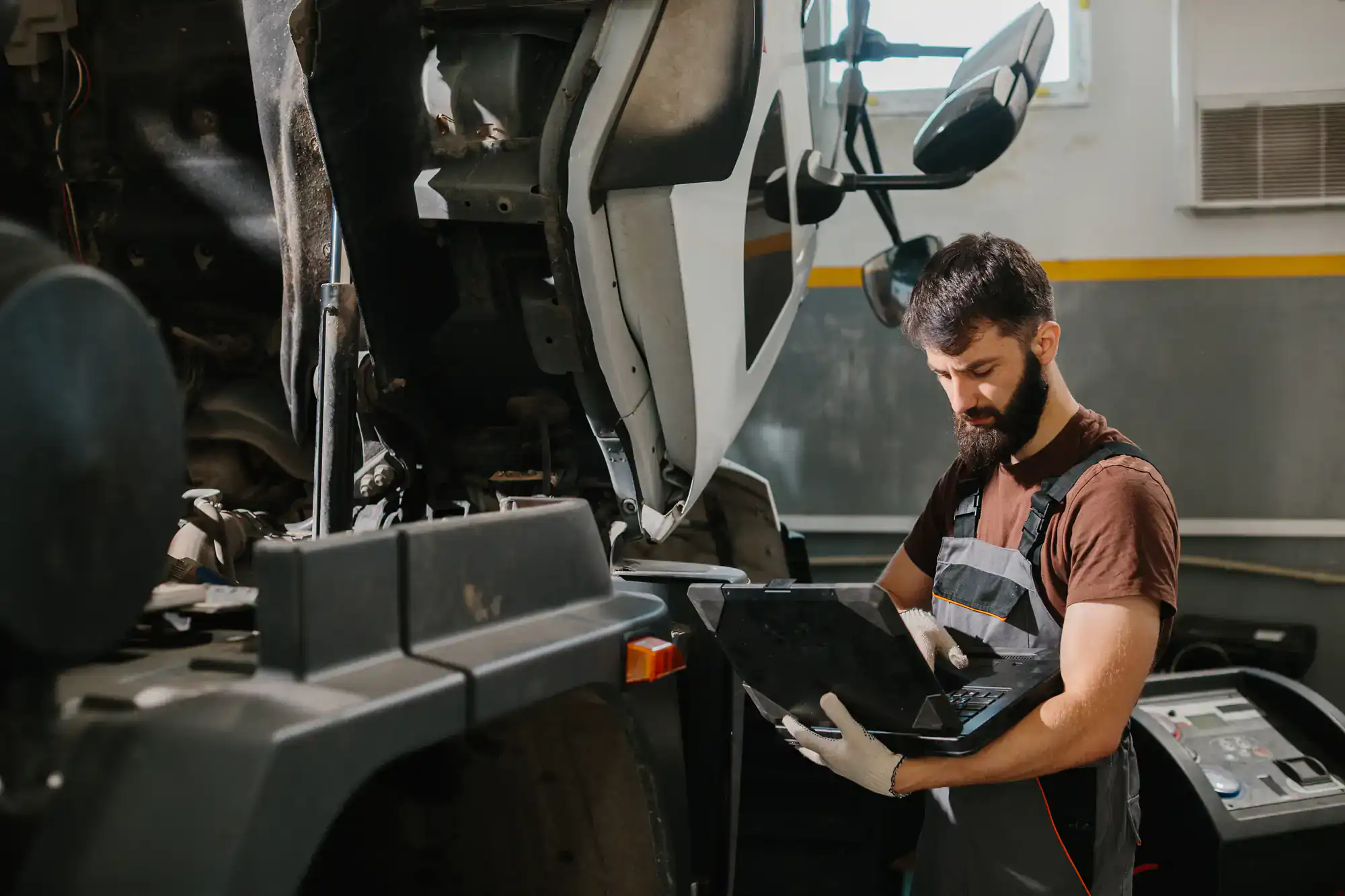
When our tester arrives, we connect a CARB-certified OBD device directly to your truck’s diagnostic port. The system reads your emissions data in real time no smoke test, no visual inspection theater. It’s a direct read of what your engine management system is actually reporting. The whole process typically takes less than an hour per truck, and if your truck passes, results go straight into CARB’s CTC-VIS database electronically the same day.
Once that submission hits CTC-VIS, CARB transmits compliant VIN data to DMV on a nightly basis. That means your registration status updates as fast as the system allows usually within 3 to 5 business days. If you received a Notice to Submit to Testing from CARB, you have 30 calendar days to get a passing result on record. Mobile testing in Perris means you don’t lose days driving to a shop and waiting. The clock’s already running the test comes to you.

Ready to get started?
The Clean Truck Check OBD program applies specifically to model year 2013 and newer diesel-engine trucks and model year 2018 and newer alternative fuel trucks both with a GVWR over 14,000 pounds. If your truck doesn’t meet both of those criteria, this program doesn’t apply to you. We won’t test a truck that doesn’t need this test, and we won’t miss one that does.
Right now, most qualifying trucks in Perris and throughout Riverside County are required to test twice per year semi-annually. That changes in October 2027, when OBD-equipped heavy-duty vehicles will move to quarterly testing: four times a year. For fleet managers running multiple trucks out of Perris distribution centers or logistics yards along the I-215 corridor, that’s a significant jump in testing volume. Building a relationship with us now before that mandate hits means your scheduling, your records, and your compliance process are already dialed in when the frequency doubles.
Every test we perform includes direct electronic submission to CTC-VIS, so there’s no manual step left to you. The SCAQMD has been actively engaged with diesel particulate emissions in Perris as recently as June 2025 which signals that regulatory attention in this area isn’t slowing down. Staying ahead of compliance isn’t just smart operations. In this freight market, it’s how you stay in business.
It depends on two things: the model year and the weight. The Clean Truck Check OBD program applies to diesel-engine trucks that are model year 2013 or newer and have a GVWR over 14,000 pounds. It also applies to alternative fuel trucks that are model year 2018 or newer with the same GVWR threshold. If your truck meets both criteria, you’re in the program regardless of whether you’re based in Perris, running drayage from the ports up I-215, or staging at a distribution center off Ramona Expressway.
If your truck is older than 2013, or if it falls under 14,000 pounds GVWR, the Clean Truck Check OBD program does not apply to it. There are separate CARB regulations that may cover older vehicles, but that’s a different program entirely. We work exclusively with the 2013-and-newer OBD segment so if you’re not sure whether your truck qualifies, a quick call can clear that up before you schedule anything.
This is one of the most common points of confusion in the Clean Truck Check program, and it catches a lot of Perris operators off guard at DMV renewal time. The $31.18 annual compliance fee and the emissions test are two completely separate requirements. Paying the fee registers your vehicle in the program and keeps you current on the administrative side but it does not substitute for a passing OBD emissions test. CARB requires both.
Until a passing test result is submitted to CTC-VIS CARB’s compliance tracking system your VIN will still show as non-compliant. That’s what DMV sees when you go to renew your registration. The hold won’t lift until the test is done and the result is submitted electronically. If you’ve already paid the fee and assumed that was sufficient, the fix is straightforward: schedule the OBD test, pass it, and the submission clears your record. We handle the CTC-VIS submission directly after every test, so there’s no additional step on your end.
A Notice to Submit to Testing an NST means CARB has flagged your vehicle as overdue for a Clean Truck Check emissions test. From the date on that notice, you have 30 calendar days to submit a passing result to CTC-VIS. That’s not 30 business days. It’s 30 calendar days, including weekends.
In Perris, where a significant portion of truck operators are running drayage routes connected to the Ports of Los Angeles and Long Beach, CARB enforcement visibility is higher than in many other markets. Port-connected carriers are among the most actively monitored. If you’ve received an NST, the mobile testing model matters more than ever you don’t lose days arranging to get your truck to a fixed location. We can come to your Perris yard, test your truck, and submit results to CTC-VIS the same day. If your truck passes, that result starts moving through the system immediately. Waiting on this one has real consequences fines can reach $10,000 per vehicle per day for continued non-compliance.
Currently, most OBD-equipped heavy-duty trucks 2013 and newer diesel, 2018 and newer alternative fuel, both over 14,000 pounds GVWR are required to test twice per year, on a semi-annual schedule. That’s the current requirement for operators in Perris and throughout Riverside County.
Starting October 1, 2027, that frequency increases to four times per year quarterly. For a small owner-operator running one truck, that’s a manageable change. For a fleet manager at one of the Perris distribution centers handling 10, 20, or more trucks, that’s a significant increase in scheduling and compliance overhead. Building a testing relationship with us now before the quarterly mandate takes effect means your process is already established when the change hits. You’ll know us, we’ll know your yard, and the scheduling won’t be a scramble. It’s worth thinking about now, not in 2027.
Yes, and for fleet operators in Perris, this is exactly the scenario our mobile model is built for. Whether you’re running a yard off Ramona Expressway, managing a fleet at a logistics center near I-215, or operating out of a warehouse in the SR-74 corridor, scheduling multiple trucks in a single visit is far more efficient than sending them out one at a time to a fixed location.
When you book for a fleet, the process is the same for each truck CARB-certified OBD device connected to the diagnostic port, real-time emissions read, direct electronic submission to CTC-VIS for each passing vehicle. The difference is that it’s done on-site, on your schedule, with minimal disruption to dispatch. With the 2027 quarterly testing mandate on the horizon which will require four tests per year per qualifying truck establishing a fleet testing routine now makes the transition significantly smoother. Reach out to us to discuss scheduling for multiple vehicles.
Once your truck passes the Clean Truck Check OBD test and the result is submitted electronically to CARB’s CTC-VIS system, CARB transmits updated compliance data to DMV on a nightly basis. In most cases, the DMV record updates within 3 to 5 business days of the submission. That’s not a delay caused by us it’s the standard processing window between CARB’s system and DMV’s database.
What matters most is that the submission happens correctly and immediately after the test. We submit results directly to CTC-VIS the same day as the test there’s no manual step left to you, no portal to navigate, and no risk of a missed submission that leaves your truck in limbo. For Perris operators who are up against a registration renewal deadline or working through an NST window, that same-day submission is what starts the clock on your DMV update. The sooner the test is done and submitted, the sooner your record clears so if you’re close to a deadline, don’t wait another week to schedule.
Useful Links
Other Services we provide in Perris