
Check Out Our Reviews!

When you’re running 2013 or newer heavy-duty diesel trucks out of Lancaster whether that’s at Fox Field Commerce Center on Avenue G, across the North Valley Industrial Center, or anywhere else along the freight corridor Clean Truck Check compliance isn’t optional. CARB is actively issuing Notices to Submit to Testing, and a 30-day window moves fast when you’ve got loads to run and routes to manage on SR-14.
The bigger risk most operators don’t see coming is the fee trap. You can pay the $31.18 annual compliance fee, think you’re covered, and still be sitting on a non-compliant vehicle because the fee and the emissions test are two completely separate requirements. Both are mandatory. Missing one means you’re still exposed to DMV registration holds and fines that can reach $10,000 per vehicle per day.
What mobile testing actually solves here is the downtime problem. Lancaster’s freight operators can’t afford to pull trucks off productive routes and drive 45 miles south to a fixed-location shop in Valencia. When we come to you, compliance becomes a scheduled task instead of an operational disruption. That’s the difference between running a tight fleet and scrambling at deadline.
We do one thing: Clean Truck Check testing for model year 2013 and newer heavy-duty vehicles with a GVWR over 14,000 pounds. That’s the entire scope of our work. No passenger cars, no opacity tests for older trucks, no general smog inspections just the specific OBD-based emissions test that Lancaster’s fleet operators are required to complete under California’s HD I/M program.
Our CARB credentials are publicly verifiable on arb.ca.gov, which matters in Lancaster because the Antelope Valley Air Quality Management District headquartered right here at 2551 W Avenue H actively directs truck owners to check that list before hiring anyone. We’re on it. Our equipment carries CARB Executive Orders. Results are submitted electronically, directly to CARB’s CTC-VIS database, with no manual steps and no submission gaps.
If you’re managing a fleet at Fox Field, running loads on SR-138 toward Victorville, or operating anywhere in the Antelope Valley, you’re working with a tester who knows this corridor not one treating Lancaster as a distant service stop.

It starts before we arrive. You confirm the truck is a 2013 or newer diesel or alternative fuel vehicle with a GVWR over 14,000 pounds those are the vehicles subject to California’s Clean Truck Check program. If you’re not sure whether a specific truck in your fleet qualifies, that’s a quick conversation before we schedule anything.
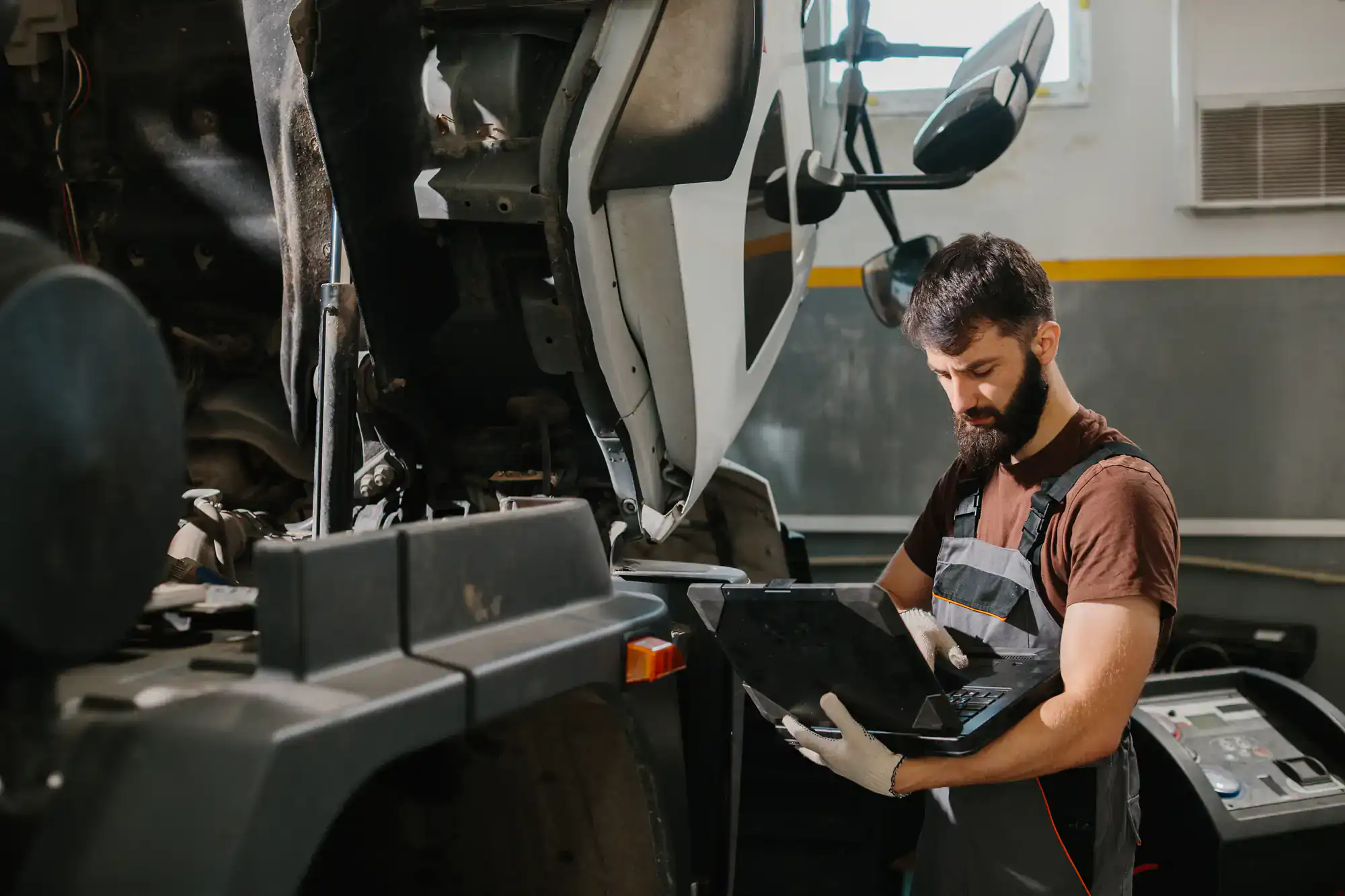
On the day of service, we come to your location your yard, your dock, your lot along the Fox Field Industrial Corridor or wherever your trucks are staged in the Lancaster area. We connect CARB-certified OBD diagnostic equipment directly to the vehicle’s ECU, download the emissions data, and review it on-site. Lancaster’s desert environment the heat, the dust, the wind events that roll through the Antelope Valley doesn’t affect the test itself, but it does mean you want a tester running certified equipment that’s built to perform in these conditions, not consumer-grade hardware that wasn’t designed for field use in extreme heat.
Once the test is complete, results go directly into CARB’s CTC-VIS database electronically. CARB transmits compliant VINs to DMV nightly, and DMV records typically update within three to five business days. You can verify your vehicle’s compliance status in CTC-VIS before you ever call DMV. No paper forms, no manual uploads, no wondering whether the submission went through.

Ready to get started?
Every Clean Truck Check we perform in Lancaster covers the full OBD data download from the vehicle’s ECU using CARB-certified diagnostic equipment, direct electronic submission to CARB’s CTC-VIS system, and on-site confirmation that the submission was received. You’re not handed paperwork and told to figure out the portal the compliance loop closes before we leave your location.
This service applies strictly to vehicles that meet both thresholds: model year 2013 or newer and a GVWR over 14,000 pounds. If a truck in your Lancaster fleet doesn’t meet both criteria, it falls under a different testing requirement or none at all and we’ll tell you that upfront rather than test a vehicle that doesn’t belong in this program.
For fleet operators in the Antelope Valley, particularly those running multiple trucks out of Fox Field Commerce Center or the industrial parks along Avenue G, advance testing is a tool worth using. CARB allows you to submit a passing test up to 90 days before your compliance deadline. With quarterly testing starting October 1, 2027 up from the current semi-annual schedule getting ahead of the calendar now is a real operational advantage. Lancaster’s freight volume is growing, the North Lancaster Industrial Specific Plan could add tens of millions of square feet of new warehouse space, and the compliance workload will scale with it.
If your trucks are model year 2013 or newer and have a GVWR over 14,000 pounds, yes Clean Truck Check applies regardless of where in California they operate, including Lancaster and the broader Antelope Valley. The program covers diesel-powered vehicles in that range starting with 2013 model years, and alternative fuel engines starting with 2018 model years. Registration location doesn’t change the requirement.
The Antelope Valley Air Quality Management District, based right here in Lancaster at 2551 W Avenue H, has been actively promoting the program and directing local truck owners to our credentialed tester list. If you’ve received any outreach from the AVAQMD about Clean Truck Check, that’s your signal that local enforcement awareness is already in place. The question isn’t whether it applies it’s whether your fleet is current.
These are two completely separate requirements, and confusing them is one of the most common compliance mistakes Lancaster truck operators make. The annual compliance fee $31.18 per vehicle in 2025 is required, but paying it does not satisfy your emissions testing obligation. You still need to submit a passing OBD test through a CARB-credentialed tester. Both are mandatory. Paying the fee without completing the test leaves your vehicle non-compliant.
The consequences of that gap are real: DMV registration holds, potential fines of up to $10,000 per vehicle per day, and a 30-day Notice to Submit to Testing window if CARB flags your vehicle. For fleet operators running trucks on the SR-14 corridor or out of the Fox Field Commerce Center, a registration hold doesn’t just mean paperwork it means a truck that can’t legally operate. Get both done, and verify your status in the CTC-VIS portal after the test is submitted.
Right now, OBD-equipped vehicles which includes 2013 and newer diesel trucks are required to be tested twice per year, on a semi-annual schedule. That’s the current requirement as of 2025. Starting October 1, 2027, that frequency increases to four times per year, meaning quarterly testing for all OBD-equipped vehicles in the program.
For Lancaster fleet operators, that shift is worth planning for now. If you’re running five, ten, or twenty trucks out of the Antelope Valley, quarterly testing across your entire fleet is a significant administrative and scheduling load. Establishing a testing relationship before 2027 and using CARB’s 90-day advance testing window to stay ahead of deadlines puts you in a much better position than trying to scramble four times a year when the new schedule hits. The freight volume in Lancaster is growing, and compliance obligations will grow with it.
A failed test means the vehicle is non-compliant and cannot be cleared until a passing test is submitted. CARB’s system won’t update DMV with a compliant status until a passing result is recorded in CTC-VIS. That means a failed truck is sitting on a registration hold until the underlying emissions issue is resolved and a passing test is submitted by a CARB-credentialed tester.
The practical path forward is to identify what’s causing the failure typically an engine fault code or emissions system issue get it repaired by a qualified diesel mechanic, and then retest. We handle the testing side; we don’t do repairs. But we can tell you on-site what the OBD data showed and what the truck’s ECU is reporting, which gives your mechanic a clear starting point. For Lancaster operators running trucks in high-heat desert conditions, it’s worth knowing that thermal stress on diesel systems can push marginal trucks toward failure proactive testing before your deadline gives you time to address issues without a compliance clock running.
Yes that’s our entire model. We’re a mobile Clean Truck Check provider, which means we come to your location. Your yard, your dock, your lot wherever your trucks are staged in Lancaster or the surrounding Antelope Valley. You don’t reposition trucks, you don’t lose route time, and you don’t deal with the 45-mile drive down SR-14 to a fixed-location shop in Valencia or further south.
For fleet operators at Fox Field Commerce Center on Avenue G, or anywhere else along Lancaster’s industrial corridors, mobile testing is the practical option. Pulling a working truck off the dock for a compliance appointment costs real money in lost productivity. Scheduling us to come to your location during a natural downtime window between loads, during a maintenance window, at shift change keeps the truck in service and the compliance box checked. If you’re managing multiple vehicles, we can test them in sequence at the same location in a single visit.
A CARB-credentialed tester is a testing provider that has been vetted and approved by the California Air Resources Board to perform Clean Truck Check inspections. Credentials are publicly listed on CARB’s official website at arb.ca.gov it’s a searchable, government-maintained list, not a self-reported certification. Testing performed by an uncredentialed provider doesn’t count. The result won’t be accepted by CARB, it won’t submit to CTC-VIS, and your truck remains non-compliant even if you paid for the test.
This matters specifically in Lancaster because the Antelope Valley Air Quality Management District has been actively educating local truck owners about the program and part of that education includes telling operators to verify credentials before hiring anyone. The AVAQMD is Lancaster’s own local air quality regulator, separate from the South Coast AQMD that covers most of LA County, and it takes diesel emissions compliance seriously in this region. We hold verified CARB credentials, use only CARB-certified OBD equipment bearing CARB Executive Orders, and submit results directly to CTC-VIS. That’s the standard the program requires, and it’s the standard applied on every test in the Antelope Valley.
Useful Links
Other Services we provide in Lancaster