
Check Out Our Reviews!

Lake Mathews isn’t a town with a truck stop on every corner or a testing facility down the street. It’s an unincorporated community off Cajalco Road where most owner-operators park their rigs at home, run loads out to the I-15 or I-215 corridor, and can’t afford to burn a day driving to a shop just to get an OBD test done. That’s exactly the problem mobile Clean Truck Check testing solves.
When your compliance deadline hits or when a Notice to Submit to Testing lands in your mailbox with a 30-day clock you don’t want to be hunting for a credentialed tester across the county. You want someone who shows up at your property in Lake Mathews, connects the certified equipment to your truck’s ECU, and submits the results directly into CARB’s CTC-VIS database before the day is over.
That’s what we do. No portal confusion, no wasted drive time, no wondering whether your test actually counted. Your VIN shows compliant in CARB’s system, DMV records update within a few business days, and your registration renewal goes through clean. For an owner-operator running loads through one of the busiest freight corridors in Southern California, that kind of certainty is worth a lot.
We are a CARB-credentialed emissions testing company serving Los Angeles and Riverside Counties. Our work is narrow by design OBD testing for model year 2013 and newer heavy-duty trucks with a GVWR over 14,000 pounds. That’s it. No passenger cars, no light-duty smog checks, no general auto service. Just the one test that keeps your commercial truck legally on the road in California.
Operating out of Riverside County means this isn’t a statewide company dropping a templated page with your zip code in it. The Cajalco Road corridor, the unincorporated communities between Lake Mathews and Perris, the routes connecting this area to the I-15 and the 91 that’s our territory. You can verify us on CARB’s public credentialed tester list at arb.ca.gov before you book a single thing.

You reach out, share your truck’s year, make, and GVWR, and confirm it qualifies model year 2013 or newer, over 14,000 pounds. If it does, you pick a time and a location. For most Lake Mathews operators, that means your driveway, your yard, or wherever the truck is staged. No need to move it anywhere.
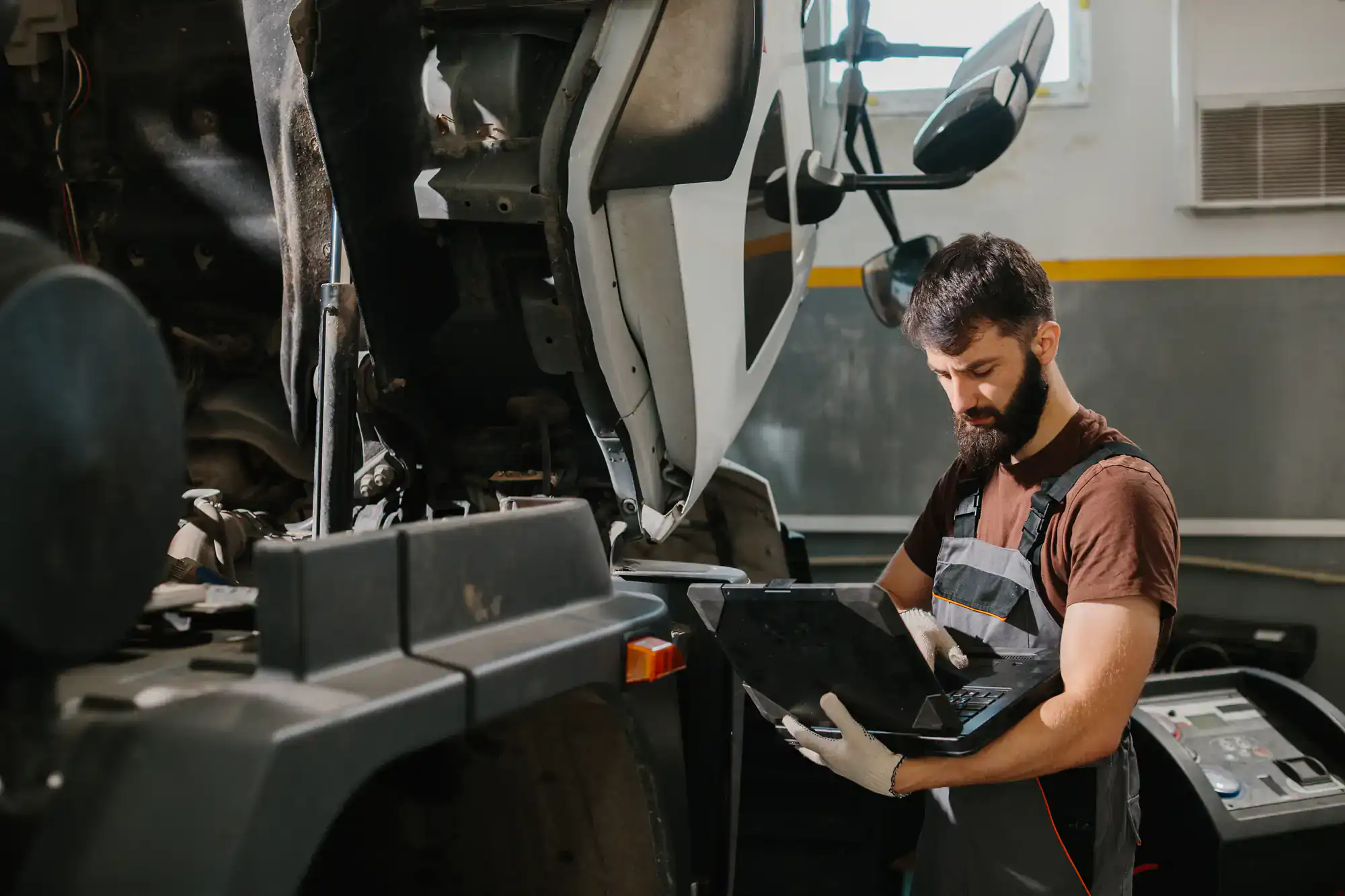
When the appointment happens, our CARB-certified OBD device connects directly to your truck’s ECU and pulls the emissions data CARB requires. The process itself is fast the equipment does the work. Once complete, the results go straight into CARB’s CTC-VIS portal. You don’t file anything, you don’t log into a system, and you don’t chase down confirmation. It gets submitted, and CARB transmits the compliant VIN data to DMV on their nightly update cycle.
One thing worth knowing: you can test up to 90 days before your compliance deadline. For operators running heavy loads through the Temescal Valley and I-15 corridor during peak construction and haul seasons, getting tested early means if something flags, you still have time to address it without missing your window. Don’t wait for the hold test before the deadline and move on.

Ready to get started?
The Clean Truck Check program formally CARB’s Heavy-Duty Vehicle Inspection and Maintenance regulation requires OBD data downloads from qualifying trucks performed by credentialed testers using CARB-certified equipment. Full enforcement began October 1, 2024. The first compliance testing deadline was January 1, 2025. If your truck qualifies and you haven’t tested, the exposure is real: DMV registration holds, fines up to $10,000 per vehicle per day, and potential removal from service.
One of the most common issues for owner-operators in rural Riverside County communities like Lake Mathews is the assumption that paying the annual $31.18 compliance fee means you’re done. It doesn’t. The fee and the emissions test are two separate requirements. Paying the fee without completing the OBD test still leaves you non-compliant and that’s exactly the kind of detail that causes a registration hold at renewal when you weren’t expecting one.
Currently, qualifying trucks must test twice per year. Starting October 1, 2027, that increases to four times per year. If you’re running one truck or managing a small fleet out of the Lake Mathews area, that change is worth planning for now. Establishing a reliable, mobile, CARB-credentialed testing relationship before the frequency quadruples puts you ahead of the problem instead of behind it.
It depends on two things: the model year and the gross vehicle weight rating. If your truck is a 2013 or newer model year and has a GVWR over 14,000 pounds, it falls under CARB’s Clean Truck Check program and is required to complete OBD emissions testing on a semi-annual basis. This applies whether you’re registered in California or operating in California from out of state.
Lake Mathews sits in Riverside County, and trucks running the Cajalco Road corridor between the I-15 and I-215 are in active territory for CARB’s roadside emissions monitoring devices. If your truck gets flagged by one of those systems, you’ll receive a Notice to Submit to Testing with a 30-day deadline to submit a passing result. The cleanest way to avoid that scenario is to test proactively before the deadline not after you’ve already received the notice.
These are two completely separate requirements, and confusing them is one of the most common reasons truck owners end up with a DMV registration hold they didn’t see coming. The annual compliance fee $31.18 per vehicle in 2025 is paid to CARB and covers your enrollment in the program. Paying it does not mean you’ve completed your emissions test. It just means you’re registered.
The emissions test itself is the OBD data download performed by a CARB-credentialed tester using certified equipment, with results submitted electronically to CARB’s CTC-VIS system. Both requirements have to be satisfied for your truck to be considered fully compliant. For owner-operators in unincorporated Riverside County communities like Lake Mathews who are managing their own compliance without a back-office team, this distinction matters a lot especially at DMV registration renewal time.
After we submit your passing test results to CARB’s CTC-VIS portal, CARB transmits compliant VIN data to DMV on their nightly update cycle. In most cases, your DMV record reflects the passing status within three to five business days. If you’re trying to clear a registration hold, that timeline is worth factoring in don’t wait until the day before your deadline to test and expect the hold to lift immediately.
If you’re in the Lake Mathews area and dealing with an active registration hold, the fastest path forward is to get the OBD test done as soon as possible, confirm the submission went through in CTC-VIS, and then allow the standard update window to run. We submit directly to the portal there’s no manual step on your end, and no risk of a submission error leaving you in limbo after the test is already done.
Yes, it is. In January 2026, the U.S. EPA issued a partial disapproval of California’s State Implementation Plan related to the Clean Truck Check program. That news circulated in trucking industry channels and created genuine confusion about whether the testing requirement was still in effect. CARB has explicitly confirmed the program remains active and fully enforceable. DMV registration holds are still being issued. Fines are still being assessed.
If you’ve been holding off on scheduling a test because you heard the program might be going away, that’s a risk worth stopping now. The compliance clock didn’t pause while the regulatory situation played out, and it’s not paused now. For Riverside County operators including those running loads out of the Lake Mathews area the safest move is to treat the program as what it is: a current, active requirement with real financial consequences for non-compliance.
A failed test means your truck’s emissions system flagged something during the OBD data download typically a diagnostic trouble code related to emissions controls. You’re not immediately fined or put out of service for a single failed test, but you are on the clock to address the issue and submit a passing result before your compliance deadline.
For owner-operators in rural areas like Lake Mathews, where heavy-duty repair shops aren’t right around the corner, this is exactly why testing early makes sense. If you test up to 90 days before your deadline and something comes back flagged, you have time to get the repair done and retest without missing your window. Waiting until the last week before your deadline and failing leaves you in a very tight spot and in an unincorporated community off Cajalco Road, getting a qualified diesel mechanic scheduled quickly isn’t always easy. Test early, give yourself the buffer.
Yes. CARB’s Clean Truck Check program applies to qualifying heavy-duty trucks operating in California not just those registered here. If your truck is model year 2013 or newer with a GVWR over 14,000 pounds and it operates in California, the testing requirement applies regardless of where it’s registered. This catches a number of owner-operators off guard, particularly those who run interstate routes and assume California’s rules only apply to California-plated vehicles.
For operators based in or around Lake Mathews who run loads across state lines through the I-15 corridor toward Nevada or Arizona, for example this is worth knowing before a roadside monitoring device flags your truck and triggers a Notice to Submit to Testing. The 30-day window to submit a passing result is the same whether your truck is California-registered or not. Getting ahead of it with a proactive mobile test at your location is a lot easier than scrambling to find a credentialed tester after you’ve already received the notice.
Useful Links
Other Services we provide in Lake Mathews