

Check Out Our Reviews!

If your truck operates anywhere near the City of Industry corridor pulling loads out of warehouses on Gale Avenue, running drayage between the ports and the San Gabriel Valley, or staging at a yard just off Valley Boulevard in La Puente you’re operating in one of the most CARB-scrutinized freight zones in the state. The I-10 and SR-60 aren’t just commuter roads. They’re two of California’s primary freight arteries, and CARB enforcement on those corridors is not theoretical. Registration holds, Notices to Submit to Testing, and fines that can reach $10,000 per vehicle per day are the real consequences of letting your Clean Truck Check lapse.
What changes when you’re current? Your truck’s VIN shows compliant in CARB’s system. DMV gets that update nightly. You’re not scrambling when your registration renewal hits. You’re not losing a load because a broker pulled your compliance status and it came back red. You’re not calling around at the last minute trying to find a credentialed tester who can actually get to your location this week.
La Puente has a high concentration of self-employed owner-operators and small fleet managers people who can’t afford to have a truck sitting idle while they sort out a compliance problem. The Clean Truck Check test itself takes far less time than dealing with a registration hold. Getting it done proactively, with a mobile tester who comes to you, is the straightforward move.
We do one thing: Clean Truck Check OBD testing for heavy-duty vehicles that are model year 2013 or newer with a GVWR over 14,000 pounds. That’s it. No passenger cars, no older opacity-test rigs, no general smog checks. Just the specific test that CARB requires for the trucks running through Los Angeles County’s busiest freight corridors including the ones that pass through La Puente every day on their way to and from the City of Industry.
CARB credentials aren’t self-declared. They’re issued, tracked, and publicly listed on CARB’s own website. You can look us up on CARB’s “Available for Hire Credentialed Testers” list at arb.ca.gov before you ever make a call. The equipment we use for every test holds CARB Executive Order certification meaning the results are valid, the submission counts, and your compliance record actually updates.
We know this territory. The yards in La Puente, the dispatch windows, the corridors. When you book with us, you’re not getting a tester who has to figure out where they’re going.

It starts with a quick booking. You tell us where your truck is located a yard in La Puente, a lot near the City of Industry, a dock off the SR-60 corridor and we schedule a time that works around your operation. No dropping the truck off. No repositioning it across the county. It stays exactly where it is.
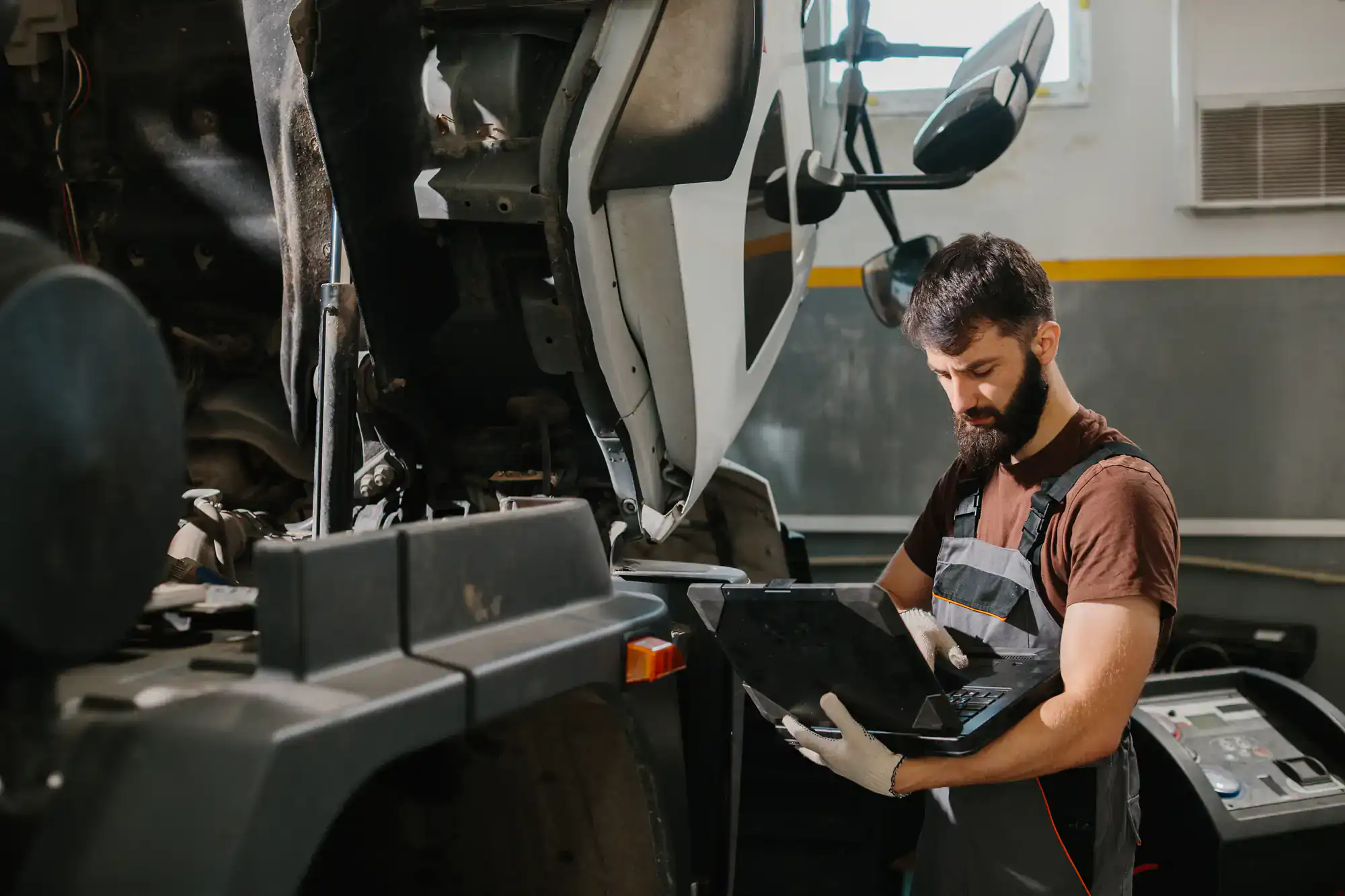
When our technician arrives, they connect CARB-certified OBD scanning equipment directly to your truck’s diagnostic port. The test reads the truck’s onboard emissions data this is the method CARB requires for 2013-and-newer heavy-duty vehicles. The scan itself doesn’t take long. What matters is that the equipment is certified, the tester is credentialed, and the process follows CARB’s exact protocol so the results are accepted without question.
Once the test is complete, results go directly into CARB’s CTC-VIS database. You don’t log into a portal. You don’t mail anything. You don’t follow up to confirm the submission went through we handle that before we leave. CARB transmits compliant VIN data to DMV nightly, so your compliance status updates fast. If you want to verify it yourself, you can log into your own CTC-VIS account and see it reflected there.

Ready to get started?
Every Clean Truck Check we perform covers the full CARB-required OBD inspection for qualifying heavy-duty vehicles model year 2013 or newer, GVWR over 14,000 pounds. If your truck doesn’t meet both of those criteria, it falls outside the scope of this program and this service. That’s not a limitation it’s the program. And knowing exactly who it applies to is part of what makes working with a specialist worthwhile.
What you get with every test: a CARB-credentialed technician at your location, CARB Executive Order-certified OBD scanning equipment, direct electronic submission to CTC-VIS, and confirmation that your results are in the system before the technician leaves. For fleet operators in La Puente managing multiple trucks with different registration renewal dates, testing can be scheduled up to 90 days before your compliance deadline which means you can plan around your dispatch calendar instead of scrambling when a deadline hits.
Starting October 1, 2027, the testing frequency increases from twice per year to four times per year. For operators running trucks through the City of Industry and along the I-10 and SR-60 corridors, that shift is coming fast. Building a consistent testing relationship now before the frequency doubles is the kind of planning that keeps your fleet moving without interruption when the new schedule kicks in.
If your truck is model year 2013 or newer and has a GVWR over 14,000 pounds, yes it’s subject to CARB’s Clean Truck Check requirement regardless of where in California it’s based. La Puente sits in Los Angeles County, which is fully within CARB’s enforcement jurisdiction. There are no local exemptions, no county-level carve-outs, and no grace period based on geography.
What does matter is your truck’s registration renewal date and whether CARB has issued a Notice to Submit to Testing for your VIN. CARB transmits compliance data to DMV nightly, so a lapsed Clean Truck Check shows up as a registration hold the moment your renewal processes. For owner-operators and fleet managers in La Puente who run freight through the City of Industry or along the I-10 and SR-60, staying current isn’t optional it’s what keeps your truck on the road and your registration clear.
The Clean Truck Check OBD test reads the emissions-related diagnostic data stored in your truck’s onboard computer. CARB requires this method for 2013-and-newer heavy-duty vehicles because modern diesel engines are equipped with sophisticated emissions control systems DPFs, SCR systems, EGR systems and the OBD port gives a direct window into whether those systems are functioning correctly and within CARB’s standards.
Our technician connects a CARB-certified OBD scanning device to your truck’s diagnostic port. The scan checks for active fault codes related to emissions systems, confirms that required monitors have run and completed, and verifies that nothing in the truck’s computer indicates an emissions control failure. If the truck passes, results are submitted to CTC-VIS immediately. If something flags during the scan, you’ll know exactly what it is which gives you a clear path to getting the truck repaired and retested rather than sitting with an unresolved compliance issue.
The OBD scan itself is not a lengthy process. For most 2013-and-newer heavy-duty trucks in good working order, the test portion takes a fraction of the time that repositioning a truck to a fixed testing facility would. Because we come to your location your yard in La Puente, your lot near the City of Industry, wherever your truck is staged there’s no drive time, no wait for a bay to open, and no pulling a driver off their route.
The bigger time factor is scheduling. If you’re managing a fleet with multiple trucks and staggered registration renewal dates, the most efficient approach is to batch the testing schedule multiple vehicles on the same visit so our technician runs through the fleet in one block. For owner-operators running a single truck on a tight dispatch window, a mobile tester who works around your schedule is a straightforward advantage over any fixed-facility alternative.
A failed test doesn’t immediately result in fines or a registration hold but it does mean your truck is not yet compliant, and you’ll need to address the underlying issue and pass a retest before your compliance deadline. The OBD test is diagnostic by nature, so a failure gives you specific information: which system flagged, what fault codes are present, and what the truck’s computer recorded. That’s actually useful data for your mechanic, not just a rejection notice.
The timeline matters here. If you’re testing proactively ahead of your deadline a failure gives you time to get the repair done and schedule a retest without triggering a hold. If you’re testing close to a deadline or responding to a Notice to Submit to Testing, the 30-day window CARB provides is tight but workable if you move quickly. We can retest once the repair is complete. The key is not waiting until the last week of your compliance window to find out there’s a problem.
Yes, and fleet testing is where mobile service makes the most practical difference. For a fleet operator running trucks out of a yard in La Puente or the adjacent City of Industry area, bringing a credentialed tester to your location means you can run through multiple vehicles in a single scheduled block without pulling drivers off routes, without repositioning trucks, and without coordinating drop-offs at a fixed facility across the county.
Fleet operators also benefit from the 90-day advance testing window CARB allows. If you have trucks with registration renewal dates spread across different months, you can schedule testing for each vehicle up to 90 days before its deadline which means you can build a testing calendar that fits your operation rather than reacting to each deadline as it arrives. Starting in October 2027, when testing frequency increases to four times per year, having that kind of organized schedule in place will matter significantly more than it does today.
A Notice to Submit to Testing means CARB has identified your truck as overdue for a Clean Truck Check and is requiring a passing test result within 30 calendar days. That window moves fast, especially if you’re running a busy dispatch schedule out of the City of Industry or managing freight along the I-10 and SR-60 corridors near La Puente. The first step is not to ignore it a missed NST deadline compounds the compliance problem and increases your exposure to fines that can reach $10,000 per vehicle per day.
Contact us as soon as you receive the notice. Because our service is mobile, there’s no waiting for a fixed facility to have availability testing comes to your truck’s location in La Puente or wherever it’s staged. If the truck passes, results go directly into CTC-VIS and your compliance status updates in CARB’s system before the 30-day window closes. If there’s a mechanical issue that causes a failure, you’ll have the diagnostic information you need to get it repaired and retested within the deadline. Moving quickly is the only approach that keeps all your options open.
Useful Links
Other Services we provide in La Puente