

Check Out Our Reviews!

When your truck is flagged non-compliant, it doesn’t just create a paperwork problem it creates a business problem. A DMV registration hold in Jurupa Valley means a truck sitting at the dock instead of moving freight. In a city where logistics is the economy, that’s not an inconvenience. That’s lost income.
What Clean Truck Check testing actually does is confirm that your 2013 or newer heavy-duty truck is running within CARB’s emissions standards, then submits that result directly into CARB’s CTC-VIS system. Once that data is in the system, CARB communicates it to DMV nightly. Your compliance record is updated. The hold risk disappears.
Jurupa Valley is one of the few communities in California with a CARB-approved Community Air Monitoring Plan specifically covering Mira Loma, Jurupa Valley, Eastvale, and Pedley. That means CARB has an active, documented presence monitoring diesel emissions in this area. Operators running 2013 and newer trucks over 14,000 lbs GVWR along I-15 and SR-60 aren’t in a gray zone. Enforcement here is real, and the cost of ignoring it up to $10,000 per truck per day is not a number worth testing.
We are a CARB-credentialed, mobile Clean Truck Check testing company serving Los Angeles and Riverside County the county Jurupa Valley sits in. This is the only service we offer. Not passenger cars. Not light-duty trucks. Not general smog checks. Just OBD-based Clean Truck Check testing for 2013 and newer heavy-duty vehicles over 14,000 lbs GVWR.
That focus matters because the Clean Truck Check program has specific equipment requirements, specific submission requirements, and a specific database CARB’s CTC-VIS that results must be entered into directly. We use only CARB-certified OBD test devices and submit results electronically to CTC-VIS immediately after testing. There’s no manual step, no third-party relay, and no gap between “test done” and “compliance recorded.”
If you want to verify our credentials before you book, you can. CARB’s list of credentialed testers is publicly available at arb.ca.gov. For Jurupa Valley and Riverside County operators who’ve watched CARB’s monitoring activity in this area grow, that kind of transparency isn’t a small thing.

It starts with a call or booking. You tell us where your truck is a fleet yard off Van Buren, a warehouse dock in the Mira Loma distribution corridor, a job site anywhere in Jurupa Valley or Riverside County and we schedule a time that works around your operation, not the other way around.
When we arrive, we connect a CARB-certified OBD test device directly to your truck’s ECU. This pulls the emissions data your truck’s onboard system has been recording. The test applies only to model year 2013 or newer diesel trucks with a GVWR over 14,000 pounds if your truck doesn’t meet both of those criteria, Clean Truck Check doesn’t apply to it. For trucks that do qualify, the whole on-site process is straightforward and doesn’t require you to pull the truck out of rotation for long.
Once the test is complete, we submit results electronically and directly to CARB’s CTC-VIS database the same day, the same visit. CARB then transmits compliant VIN data to DMV nightly, though DMV records can take 3 to 5 business days to fully update on their end. One thing worth knowing: you can submit a Clean Truck Check test up to 90 days before your compliance deadline. If you’re managing a fleet in Jurupa Valley’s warehouse district and want to get ahead of the schedule before testing shifts to quarterly frequency in October 2027, that lead time is worth using.

Ready to get started?
Clean Truck Check applies to diesel trucks that are model year 2013 or newer and have a Gross Vehicle Weight Rating over 14,000 pounds. Both conditions have to be true. If your truck is a 2012 or older, or if it falls under that weight threshold, this program doesn’t apply and neither does this test. We only test vehicles that qualify under those exact parameters.
For trucks that do qualify, the current compliance schedule requires testing twice per year through 2027. Starting October 1, 2027, that frequency increases to four times per year. The annual compliance fee is $31.18 per vehicle for 2025, indexed to CPI annually. If CARB has already flagged your truck and issued a Notice to Submit to Testing, you have 30 calendar days from the date of that notice to submit a passing result not 30 days from when you open the letter.
Jurupa Valley operators should also know that out-of-state trucks running freight through the I-15 and SR-60 corridor are subject to these same requirements. California’s Clean Truck Check program applies based on where the truck operates, not where it’s registered. If you’re hauling loads through the Mira Loma warehouse district or connecting to the Port of Long Beach supply chain through Jurupa Valley, and your truck meets the model year and weight criteria, compliance is required. We can test and submit results for out-of-state registered trucks operating in Riverside County the same way we handle any other qualifying vehicle.
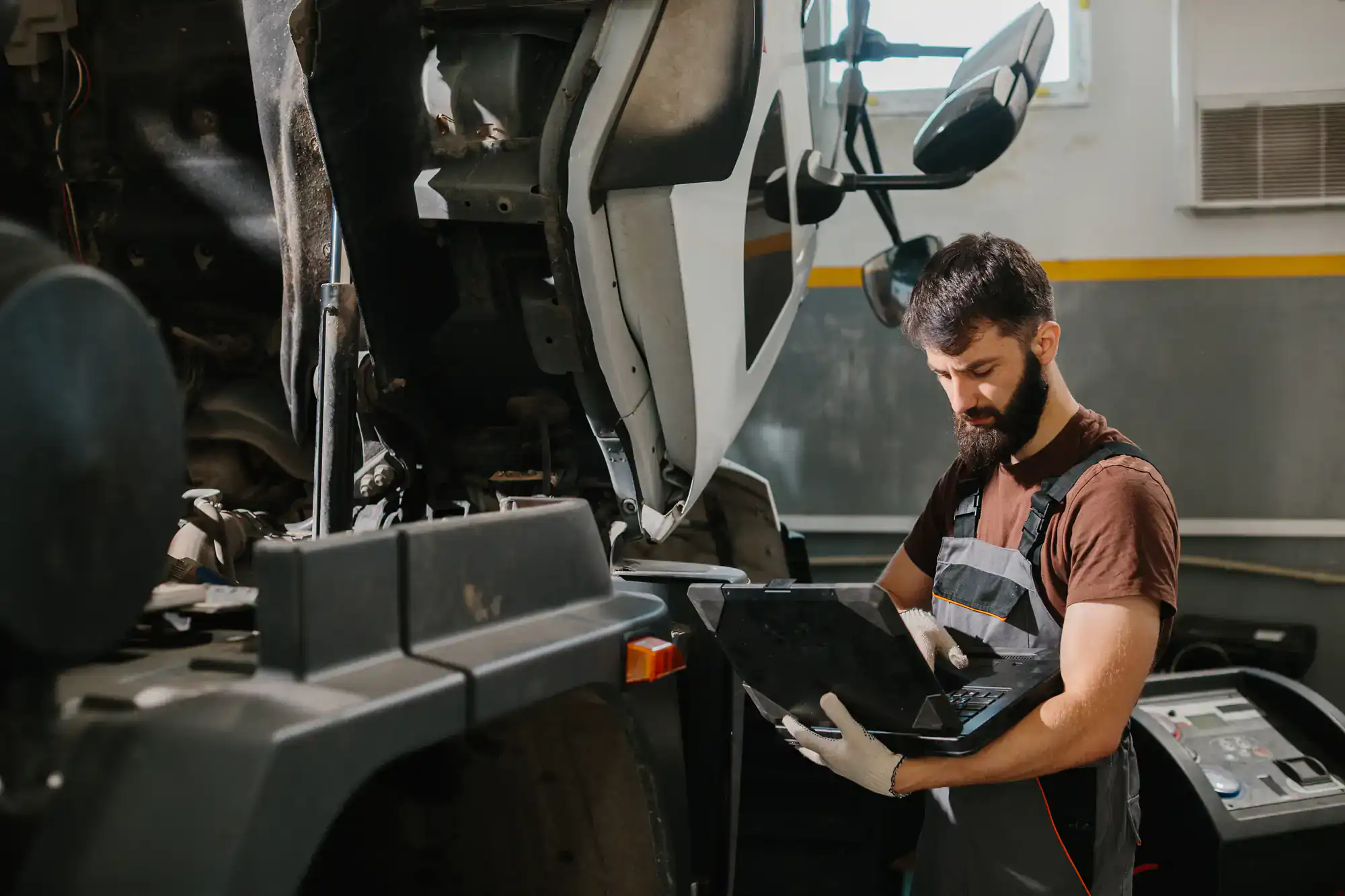
It depends on two things: the model year and the weight. If your truck is a 2013 or newer diesel and has a Gross Vehicle Weight Rating over 14,000 pounds, then yes Clean Truck Check applies to it, regardless of where in California it operates or where it’s registered. Jurupa Valley’s Mira Loma warehouse district runs a high volume of exactly this type of vehicle, and the trucks moving freight in and out of those facilities along I-15 and SR-60 are precisely the vehicles this program was built around.
If your truck is older than 2013, or if the GVWR is 14,000 pounds or under, the Clean Truck Check OBD-based program does not apply. There are separate CARB programs for older heavy-duty vehicles, but that’s a different process entirely. We only handle the OBD-based Clean Truck Check for 2013 and newer qualifying trucks so if you’re not sure whether your specific vehicle qualifies, that’s a straightforward question we can answer before you book anything.
A registration hold tied to Clean Truck Check non-compliance gets resolved through the same process as standard compliance testing you need a passing test submitted to CARB’s CTC-VIS system. Once a compliant result is in the system, CARB transmits that data to DMV nightly. However, DMV records typically take 3 to 5 business days to reflect the update on their end, so there’s a short window between “test passed” and “DMV shows clear” that you need to account for if you’re working against a deadline.
The faster you get the test done, the faster that window closes. We’re mobile and serve Jurupa Valley and Riverside County directly, so you’re not waiting on a shop to have an opening or repositioning a truck across town. If a hold is already in place and you need to move quickly, that’s exactly the kind of situation where mobile, same-location testing makes a real difference. Don’t wait on this one the hold doesn’t resolve on its own, and every day it sits there is a day your truck’s registration remains at risk.
A Notice to Submit to Testing means CARB has flagged your vehicle as a potential high emitter and is requiring you to submit a passing Clean Truck Check result within 30 calendar days of the notice date. That clock does not pause. It doesn’t reset if you miss it it results in enforcement action, which can include fines up to $10,000 per vehicle per day and an escalating compliance situation that gets harder and more expensive to resolve the longer it drags out.
The first step is to confirm your truck qualifies for OBD-based testing model year 2013 or newer, GVWR over 14,000 pounds. If it does, you need a CARB-credentialed tester with certified OBD equipment who submits directly to CTC-VIS. That’s the only result CARB accepts. We handle NST situations and can come to your location in Jurupa Valley or anywhere in Riverside County. If you’ve already received a notice, the time to act is now not after you’ve exhausted a few more days trying to sort it out.
Right now, the schedule is twice per year semi-annually through the end of 2027. That’s the current requirement for OBD-equipped heavy-duty vehicles subject to the Clean Truck Check program. Starting October 1, 2027, the frequency increases to four times per year, or quarterly. That’s not a distant concern for fleet operators in Jurupa Valley’s warehouse district it’s a planning reality that affects scheduling, budgeting, and how you manage a multi-truck operation.
One thing that helps on the planning side: you’re allowed to submit a Clean Truck Check test up to 90 days before your compliance deadline. That means you don’t have to wait until the last window before a deadline to get testing done. For fleet managers handling 10, 20, or more trucks operating out of Mira Loma distribution facilities, getting ahead of the schedule especially before the quarterly shift in 2027 is worth building into your compliance calendar now rather than scrambling when the frequency doubles.
Yes. California’s Clean Truck Check program applies based on where the truck operates, not where it’s registered. If an out-of-state carrier is running a 2013 or newer diesel truck with a GVWR over 14,000 pounds through California including through Jurupa Valley’s I-15 and SR-60 freight corridor, or in and out of the Mira Loma warehouse district that truck is subject to the same compliance requirements as any California-registered vehicle.
This catches a lot of out-of-state operators off guard, particularly carriers connecting to the Port of Long Beach supply chain through Jurupa Valley. The requirement isn’t tied to your DMV registration state it’s tied to operating in California with a qualifying vehicle. We can test and submit CTC-VIS results for out-of-state trucks operating in Riverside County the same way we handle any other qualifying vehicle. If you’re not sure whether your out-of-state fleet has California compliance exposure, that’s a question worth getting answered before CARB answers it for you.
The CARB annual compliance fee is $31.18 per vehicle for 2025 that’s the state-mandated fee, indexed to CPI each year. The testing service itself is separate from that fee, and market rates in the Inland Empire and Riverside County area generally run in the $95 to $150 range per test depending on the provider and whether mobile service is included.
For owner-operators in Jurupa Valley running one or two trucks, that number is easy to weigh against the alternative: fines up to $10,000 per vehicle per day for non-compliance, plus the cost of a DMV registration hold that sidelines your truck entirely. For fleet operators managing multiple vehicles out of the Mira Loma warehouse corridor, the per-test cost is a small line item compared to the liability exposure of running non-compliant. The compliance fee, the test cost, and the scheduling time are all manageable. A CARB enforcement action is not. We keep pricing straightforward reach out directly for current rates and mobile service availability in your area.
Useful Links
Other Services we provide in Jurupa Valley