
Check Out Our Reviews!

A DMV registration hold doesn’t just create paperwork for a Banning operator running freight on I-10, it shuts down the route entirely. The San Gorgonio Pass is the corridor. If your truck can’t legally run it, your load doesn’t move and your revenue stops. Clean Truck Check compliance is what keeps that from happening.
Trucks working the I-10 corridor through the Pass face conditions that are harder on emissions systems than most operators realize. The sustained high winds, desert dust coming off the Coachella Valley floor, and the steep thermal drop on the eastbound descent all put additional stress on DPFs and SCR systems. That means a truck running this corridor regularly is more likely to develop fault codes than one operating in a controlled urban environment which makes proactive testing smarter than waiting until a deadline forces your hand.
With the Banning Pointe warehouse project coming online and the Beaumont logistics corridor expanding just to the west, more heavy-duty trucks are going to be based in and around this area every year. Getting your compliance dialed in now before the quarterly testing requirement hits in October 2027 means you’re not scrambling when the frequency doubles.
We do one thing: Clean Truck Check OBD testing for model year 2013 and newer heavy-duty trucks with a GVWR over 14,000 pounds. That’s our entire business. No passenger cars, no older opacity-test trucks, no generalist smog shop trying to handle everything under one roof. Just the specific CARB-credentialed testing that Riverside County operators actually need.
That focus matters because the equipment, the protocols, and the submission process for heavy-duty OBD testing are different from anything else in the smog industry. We use only CARB-certified OBD devices the kind that carry CARB Executive Order approval and produce results that CARB’s CTC-VIS system will actually accept. You can verify our credentials yourself on CARB’s public tester list at arb.ca.gov.
Banning and the Pass Area have no dedicated local Clean Truck Check provider. We serve Riverside County, come to your location, and handle the CTC-VIS submission directly so you’re not navigating a government portal after a long run through the Pass.

It starts with a quick booking. You tell us where your truck is your yard, your lot, a staging area off I-10, wherever it’s parked in the Banning area and a CARB-credentialed tester comes to you. No repositioning the truck. No driving to a fixed facility. No lost hours pulling a rig off a run.
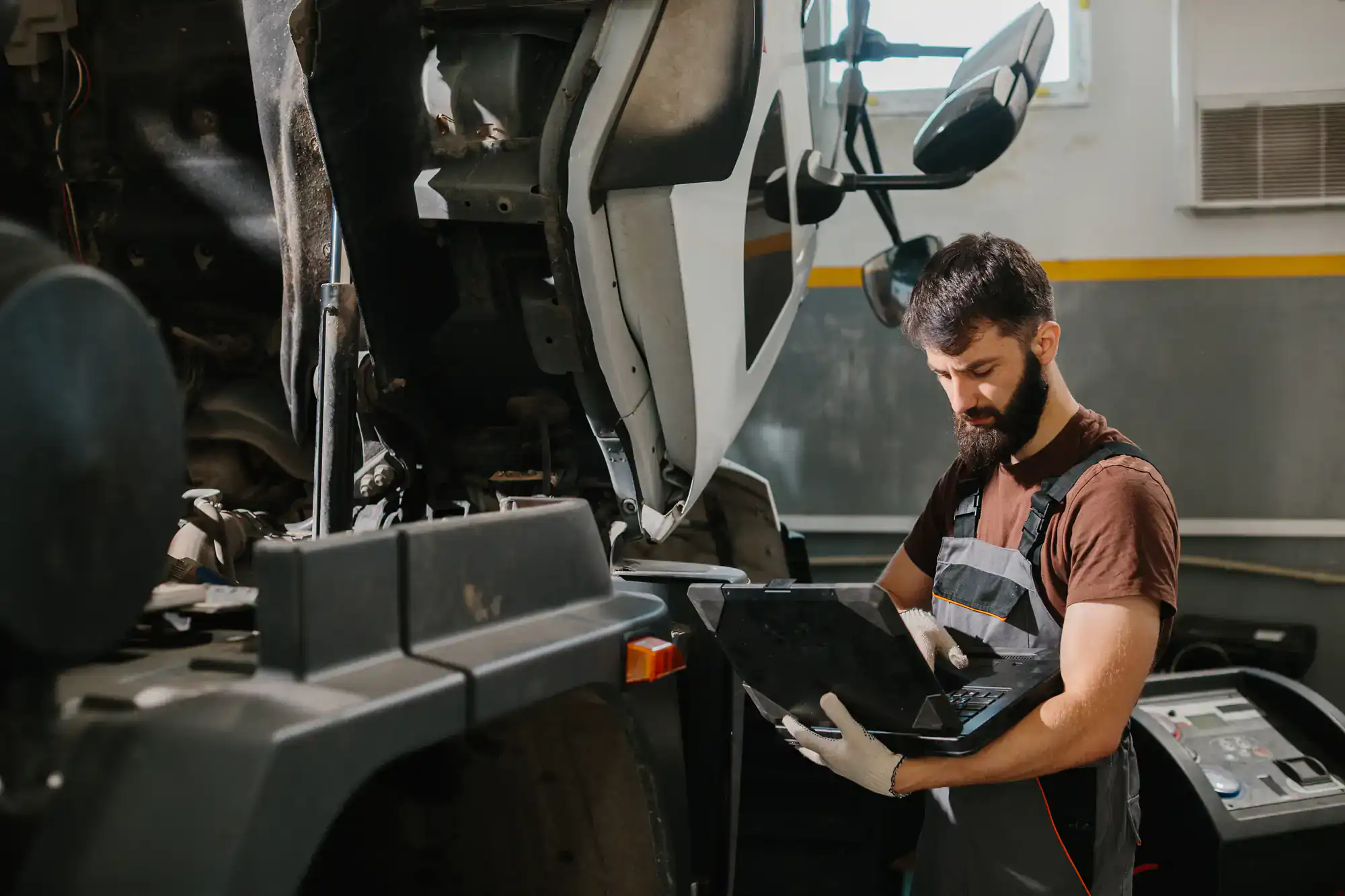
On-site, the tester connects CARB-certified OBD equipment directly to your truck’s diagnostic port and downloads the ECU data. For 2013-and-newer heavy-duty diesel trucks, this reads the J1939 and J1979 protocols that CARB’s program requires. The process itself takes minutes. If your truck’s emissions systems are functioning correctly and there are no active fault codes, you pass. If something surfaces in the data, you’ll know exactly what it is before it becomes a failed test or a missed deadline which is especially useful for trucks that run the Pass regularly, where emissions components tend to work harder.
After a passing result, we submit your test data directly to CARB’s CTC-VIS database. You don’t log into a portal. You don’t file paperwork. Your VIN shows as compliant in CARB’s system, and DMV records update within three to five business days. That’s the entire process start to finish, handled at your location.

Ready to get started?
Clean Truck Check formally CARB’s Heavy-Duty Inspection and Maintenance program applies to non-gasoline heavy-duty vehicles with a GVWR over 14,000 pounds operating on California public roads. If your truck is model year 2013 or newer and meets that weight threshold, this program applies to you. That includes owner-operators based in Banning, small fleet operators serving the Beaumont warehouse corridor, and out-of-state carriers whose routes bring them through the San Gorgonio Pass on I-10. Operating in California is what triggers the requirement not where the truck is registered.
Right now, most OBD-equipped vehicles require testing twice per year. Starting October 1, 2027, that increases to four times per year. Beyond the testing requirement, there’s also an annual compliance fee of $31.18 per vehicle paid through CARB’s CTC-VIS portal and this is separate from the emissions test. Many operators in the Pass Area have paid that fee and assumed they were done, only to hit a DMV registration hold at renewal because the test itself was never completed. Both are required. We handle the test and the CTC-VIS submission the fee registration is the one step you handle directly through CARB’s portal.
The consequences for non-compliance are real: fines of up to $10,000 per vehicle per day, DMV registration holds that block renewal automatically, and enforcement exposure on I-10 during any CHP stop in the San Gorgonio Pass Area. The cost of the test is a fraction of any one of those outcomes.
Yes and this catches a lot of carriers off guard. CARB’s Clean Truck Check program applies to any heavy-duty vehicle operating on California public roads, regardless of where the truck is registered. If your route takes you through the San Gorgonio Pass on I-10, through the Coachella Valley, or anywhere else on California’s road network, you’re subject to the program’s requirements.
That means if you’re based in Arizona or Nevada and your trucks run the LA-to-Phoenix corridor through Banning regularly, those vehicles need to be registered in CARB’s CTC-VIS system, the annual compliance fee needs to be paid, and a passing OBD emissions test from a CARB-credentialed tester needs to be on file. The CHP San Gorgonio Pass Area command actively patrols I-10 through Banning, and compliance can be verified during any roadside stop. We can test your truck wherever it’s located in Riverside County and submit results directly to CTC-VIS before your next California run.
Clean Truck Check OBD testing applies specifically to trucks that are model year 2013 or newer and have a Gross Vehicle Weight Rating over 14,000 pounds. Both conditions have to be true the model year and the weight threshold. If your truck is a 2013 or newer diesel, it falls under this program. If you’re running a 2018 or newer alternative fuel vehicle over that same weight threshold, you’re also included.
Older trucks anything pre-2013 fall under a different CARB compliance pathway involving smoke opacity testing, which is an entirely separate process that we do not perform. Lighter vehicles under 14,000 lbs GVWR are not subject to Clean Truck Check at all. If you’re not sure where your specific truck lands, the easiest check is your registration paperwork, which will list the GVWR. If it’s over 14,000 and the model year is 2013 or later, you need a Clean Truck Check and we can handle it in Banning without you moving the truck.
Right now, most OBD-equipped heavy-duty vehicles are required to pass a Clean Truck Check test twice per year semi-annually. That frequency is set to increase starting October 1, 2027, when the requirement moves to quarterly testing, meaning four passing tests per year, every year.
For operators running the I-10 corridor through the San Gorgonio Pass, that escalation matters for scheduling. The Pass conditions extreme wind, desert dust, significant elevation and temperature swings between Banning and the Coachella Valley floor put more stress on diesel emissions systems than typical urban routes. That makes it worth testing early in each compliance window rather than waiting until the deadline. If your truck develops a fault code from the demanding pass environment, you want time to address it before it becomes a failed test. We can come to your Banning location for each required testing cycle and handle the CTC-VIS submission every time, so the compliance calendar stays on track without disrupting your operation.
No, and this is one of the most common misunderstandings in the program. The annual compliance fee currently $31.18 per vehicle is paid through CARB’s CTC-VIS portal and is a separate requirement from the emissions test itself. Paying the fee registers your vehicle in the system, but it does not satisfy the testing requirement. Both are required, and a truck that has paid the fee but hasn’t passed a CARB-credentialed OBD emissions test is still considered non-compliant.
CARB transmits updated compliance data to the DMV nightly. If your vehicle is in the system as non-compliant even if the fee is paid it will show up as a registration hold when you go to renew. That hold doesn’t get resolved with a phone call. It gets resolved by completing a passing test with a CARB-credentialed tester and having the results submitted to CTC-VIS. We handle both the test and the direct submission, so your VIN status updates in CARB’s database and DMV records follow within three to five business days.
The CHP San Gorgonio Pass Area command covers more than 860 square miles of Riverside County, including the full stretch of I-10 through Banning, Beaumont, and Cabazon. Officers can verify your Clean Truck Check compliance status on the spot through CARB’s CTC-VIS system during any roadside stop. If your vehicle isn’t showing as compliant, you’re looking at potential fines that can reach $10,000 per vehicle per day under CARB’s enforcement authority and that’s separate from any action the DMV takes on your registration.
Beyond the financial exposure, a non-compliant truck stopped on I-10 near Banning is a truck that’s off the corridor. For owner-operators whose income depends on running that route, even a short enforcement delay is costly. Getting compliant before you’re on the road is the only version of this situation that doesn’t carry risk. We keep your compliance status current in CARB’s database so that any CHP interaction on the Pass is a non-event your VIN shows compliant, and you keep moving.
You don’t have to bring the truck anywhere. We’re fully mobile a CARB-credentialed tester comes to your location in Banning or anywhere in Riverside County. Your yard, your lot, a staging area near the I-10 interchange, wherever the truck is parked. The truck doesn’t move, and your operation doesn’t stop.
The OBD data download itself takes only a few minutes once the tester connects to your truck’s diagnostic port. The full on-site visit is typically short there’s no lengthy inspection process, no lift required, no physical emissions probe inserted into the exhaust. The equipment reads directly from the truck’s ECU and captures the data CARB’s system needs. After a passing result, we upload the test data to CTC-VIS directly, and your DMV records reflect the compliance update within three to five business days. For fleet operators in the Banning-Beaumont corridor managing multiple trucks, the mobile model means multiple vehicles can be tested at the same location in a single visit no scheduling chaos, no trucks going offline one at a time to visit a facility.
Useful Links
Other Services we provide in Banning